
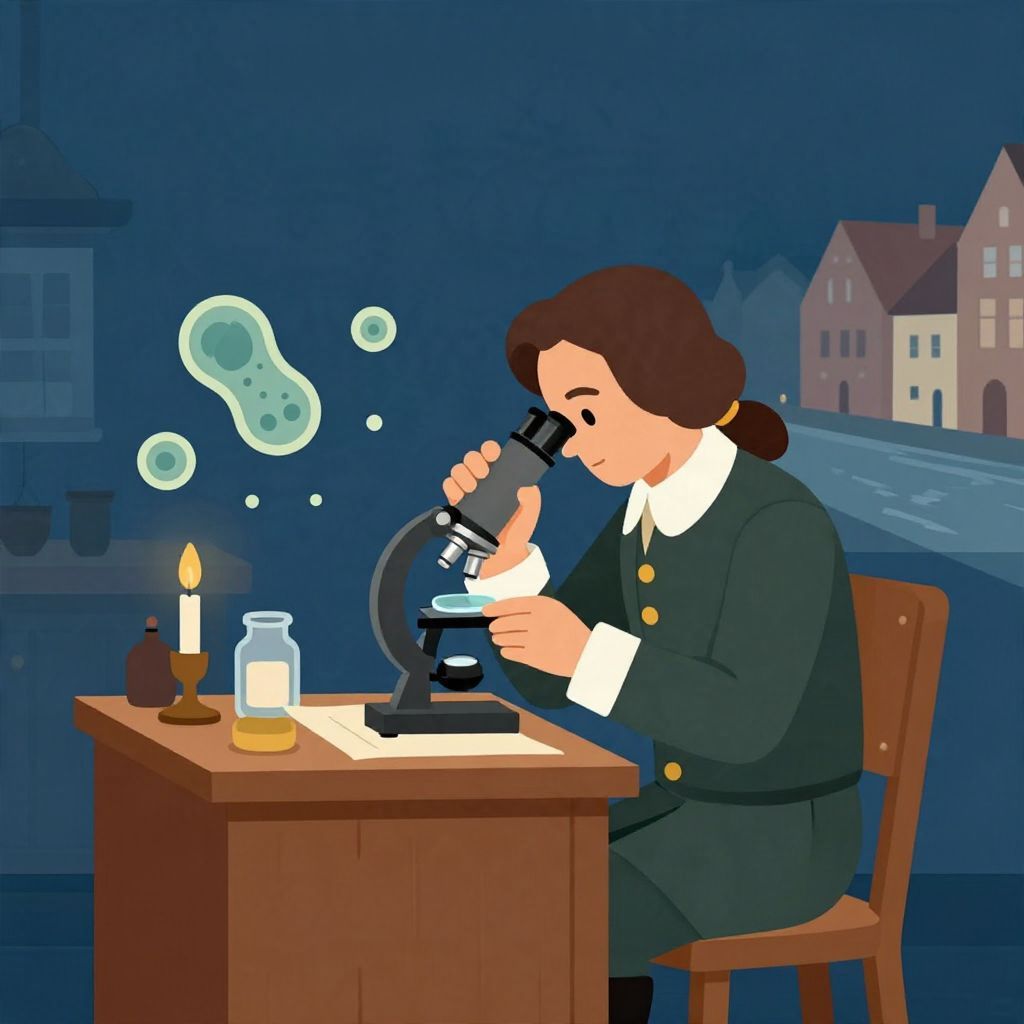
When were germs discovered? The short answer is that people began to see evidence of germs in the 17th century, but the full scientific discovery of germs as disease-causing organisms came much later, in the 19th century. The story spans microscopes, careful experiments, and a long struggle against older ideas about illness.
There is no single “discovery date” for germs. Instead, the idea emerged gradually as scientists learned to observe tiny living things and prove that some of them could cause disease.
When were germs discovered?
Germs were first observed with microscopes in the 1670s by Antonie van Leeuwenhoek, but they were not accepted as causes of disease until the 1800s. The decisive scientific breakthrough came in the mid-to-late 19th century, especially through the work of Louis Pasteur and Robert Koch, who helped establish germ theory.
The first sighting of germs: the 1600s
The earliest known observations of microorganisms came from Dutch microscope-maker Antonie van Leeuwenhoek. In the 1670s, using carefully ground lenses, he saw tiny living creatures in water, dental plaque, and other samples. He described them as “animalcules,” not as germs in the modern medical sense, because the link to disease was still unknown.
Why Leeuwenhoek mattered
Leeuwenhoek did not invent the microscope, but he improved it enough to reveal a hidden world. His observations showed that life existed on a microscopic scale. That was a major intellectual shock in a period when most people could not imagine invisible living beings.
Still, seeing microorganisms was not the same as understanding them. For more than a century after Leeuwenhoek, many scientists and physicians continued to explain disease through older theories, especially the idea of miasma, or bad air.
Why germs were not immediately accepted as the cause of disease
For much of history, illness was explained in several different ways: divine punishment, imbalanced bodily humors, contaminated air, or direct person-to-person contact. The microscopic world was real, but its role in infection was not yet proven. Without strong experimental evidence, many doctors remained skeptical that invisible organisms could make people sick.
The limits of early science
Early microscopes were useful but imperfect. Scientists could observe tiny organisms, yet they could not easily connect one specific microbe to one specific disease. They also lacked the laboratory techniques needed to isolate, grow, and test microbes in controlled ways.
That changed in the 19th century, when advances in chemistry, microscopy, and experimental medicine made it possible to trace disease to living agents.
The 19th-century breakthrough in germ theory
The modern discovery of germs as disease-causing agents is usually dated to the 1800s, especially the work of Louis Pasteur in France and Robert Koch in Germany. Their research showed that microorganisms were not just present in the world; some were responsible for fermentation, spoilage, and infectious disease.
Louis Pasteur and the challenge to spontaneous generation
In the 1850s and 1860s, Pasteur conducted experiments that undermined the old belief in spontaneous generation, the idea that living things could arise from nonliving matter. His swan-neck flask experiments showed that microorganisms came from other microorganisms in the environment, not from ordinary broth magically producing life on its own.
This mattered for medicine because it strengthened the idea that invisible living agents could enter substances, multiply, and cause change. Pasteur also studied fermentation and disease in silkworms, helping to show that microbes had practical and harmful effects.
Robert Koch and proof of specific disease agents
Robert Koch pushed germ theory further in the 1870s and 1880s. He identified the bacteria responsible for anthrax, tuberculosis, and cholera through rigorous laboratory methods. Koch’s work helped establish that particular diseases could be linked to particular microorganisms.
His methods became central to medical microbiology. Scientists could now isolate a microbe, observe it, and test whether it caused disease. This was a turning point: germs were no longer just visible curiosities under a lens, but proven agents of infection.
A simple timeline of the discovery of germs
- 1670s — Antonie van Leeuwenhoek observes microorganisms with microscopes.
- 1700s — Scientists continue to debate the nature of tiny life forms, but no clear disease theory emerges.
- 1850s–1860s — Louis Pasteur’s experiments challenge spontaneous generation and support microbial explanations.
- 1870s–1880s — Robert Koch identifies specific bacteria causing major diseases and strengthens germ theory.
- Late 1800s — Germ theory becomes widely accepted in medicine and public health.
What exactly is a “germ”?
In everyday language, a germ usually means a microorganism that can cause disease. Historically, however, the word has been used more loosely. It can refer to bacteria, viruses, fungi, protozoa, and other microscopic agents. In the 17th century, Leeuwenhoek saw living microbes, but the word “germ” in the modern disease sense developed later.
Bacteria, viruses, and the broader idea
It is important to note that not all disease-causing microbes were understood at once. Bacteria were identified first because they could be seen and studied with the microscopes of the time. Viruses would not be understood properly until much later, after the development of more advanced scientific tools.
So if someone asks when germs were discovered, the answer depends on whether they mean the first observation of microscopic life or the later proof that microbes cause disease.
How the discovery changed medicine
Once germ theory gained acceptance, medicine changed dramatically. Doctors and hospitals began to focus on cleanliness, sterilization, handwashing, vaccination, and infection control. Public health campaigns also expanded, especially in cities where crowded living conditions made disease spread more likely.
From theory to practice
The discovery of germs did not instantly eliminate disease, but it transformed how people thought about prevention. Surgery became safer when instruments and operating rooms were cleaned more carefully. Childbirth, wound care, and hospital treatment all improved as medical workers learned that invisible organisms could spread infection.
It also changed everyday life. Soap, clean water, food safety, and sanitation gained new importance. The idea that disease could be prevented by interrupting the spread of microbes became one of the foundations of modern public health.
Why the discovery took so long
The long timeline makes sense when you consider the challenge. Germs are too small to see without magnification, and seeing them is only the first step. Scientists also had to prove causation, not just presence. That required experiments, repeated observations, and tools that did not exist in earlier centuries.
In addition, older medical traditions were deeply rooted. Miasma theory, humoral medicine, and religious explanations all shaped how people understood sickness. Germ theory eventually won because it explained disease more accurately and led to practical successes.
The historical significance of germ theory
The discovery of germs was one of the most important developments in the history of science and medicine. It changed surgery, childbirth, sanitation, vaccination, laboratory science, and public health policy. It also helped establish the modern understanding that many diseases have specific natural causes that can be studied, prevented, and sometimes treated.
In that sense, the discovery of germs was not a single moment but a scientific revolution that unfolded over nearly 200 years, from Leeuwenhoek’s first glimpse of microscopic life to Pasteur and Koch’s proof that microbes could cause disease.
So, when were germs discovered? Observed in the 1670s, scientifically linked to disease in the 1800s. That distinction is the key to the history: the microscope revealed the hidden world, but germ theory explained its power. For more on how science reshaped the modern world, you may also enjoy related history articles on medicine, public health, and scientific discovery.