
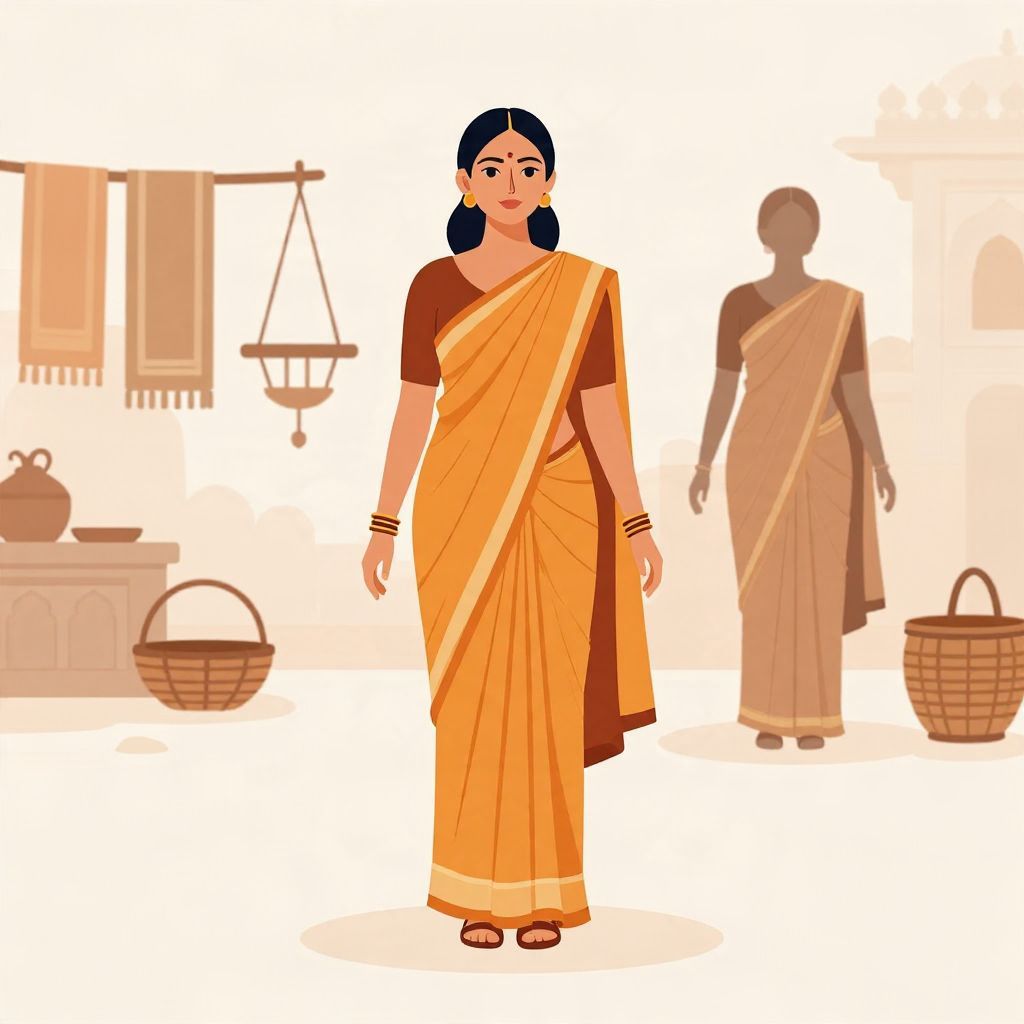
What is a sari? It is one of South Asia’s oldest and most recognizable garments: a long unstitched length of cloth, usually wrapped around the body and worn with a blouse and underskirt. Far more than “just a dress,” the sari carries centuries of regional style, social meaning, and changing fashion.
Its history reaches deep into the Indian subcontinent, where draped clothing was practical in hot climates and adaptable across communities, ranks, and occupations. Over time, the sari became both everyday wear and a powerful cultural symbol, shaped by trade, religion, courtly taste, colonial rule, and modern identity.
What Is a Sari?
A sari is a traditional garment made from a single piece of cloth, typically about 4.5 to 9 meters long, that is draped around the body in different regional styles. It is usually worn with a fitted blouse called a choli and a petticoat or underskirt. Unlike tailored clothing, the sari depends on wrapping, tucking, and pleating rather than stitching.
Where Did the Sari Come From?
The sari developed in the Indian subcontinent over a very long period, and its exact origin cannot be pinned to one inventor, date, or place. Evidence from ancient Indian sculpture, literature, and art suggests that draped garments were common in South Asia for millennia. The sari as we know it today emerged gradually from these older forms of dress rather than appearing all at once.
Ancient roots in draped clothing
In ancient India, both men and women wore unstitched cloth wrapped around the body. This made sense in a warm climate and fit a textile culture that valued weaving, dyeing, and ornament. Early depictions in sculpture and temple art show garments that resemble the ancestor of the sari, though historians are careful not to project the modern sari too directly onto the distant past.
From ancient drape to recognizable sari
By the early medieval period, women’s dress in South Asia had become more varied, with regional draping styles, blouses, and undergarments becoming more common. The sari likely took shape through this long evolution. The garment’s continuity lies in the unstitched cloth itself, while the exact drape, blouse, and styling changed across centuries.
How Is a Sari Worn?
A sari is worn by wrapping the cloth around the waist, making pleats at the front, and bringing one end—called the pallu or pallav—over the shoulder or around the upper body. The style varies by region, community, and occasion. Some drapes are practical for daily work; others are formal and elaborate, designed for weddings or festivals.
Common parts of sari dress
- Sari cloth: the long unstitched fabric.
- Choli: the fitted blouse worn underneath.
- Petticoat: an underskirt that supports the drape.
- Pallu: the decorative end of the sari, often displayed over the shoulder.
Regional draping styles
There is no single “correct” way to wear a sari. Different regions developed distinct methods. For example, the Nivi style from Andhra Pradesh became widely popular in modern India, while other styles are associated with Maharashtra, Bengal, Gujarat, Tamil Nadu, and elsewhere. These differences reflect local culture, climate, and custom.
Why Did the Sari Become So Important Historically?
The sari endured because it was practical, flexible, and culturally meaningful. A single length of cloth could be worn in many ways, adjusted for work, ceremony, age, and status. It also fit a textile economy in which weaving, dyeing, embroidery, and trade were major parts of life. Over time, the sari became a marker of identity as well as clothing.
Textiles, trade, and craftsmanship
South Asia was famous for cotton, silk, dyeing, and fine weaving. Different regions became known for distinct sari traditions: silk saris from Kanchipuram, Banaras brocades, cotton weaves from Bengal, and many others. These textiles were not only local products but also part of wider Indian Ocean trade networks that connected South Asia to West Asia, Southeast Asia, and beyond.
Class, status, and occasion
Historically, the fabric, border, weave, and embellishment of a sari could signal wealth, occupation, or ceremonial importance. A plain cotton sari might be everyday wear, while a silk sari with gold thread could be reserved for weddings, religious rites, or elite display. At the same time, the sari was never limited to the wealthy; it remained a common garment across many social groups.
How Did History Change the Sari?
The sari changed as South Asia changed. Court culture, religious practice, colonial rule, industrial textiles, nationalist politics, and modern fashion all influenced how women wore it. Rather than disappearing, the sari adapted, becoming both a living tradition and a symbol of continuity in a rapidly changing world.
Medieval and early modern developments
In the medieval period, regional kingdoms and local courts encouraged distinctive textile traditions. Silk weaving, embroidery, and dyeing flourished under patronage and trade. Religious communities also shaped dress norms, with modesty, ritual purity, and local custom influencing how cloth was worn and displayed.
Colonial era transformations
Under British colonial rule, Indian clothing was often judged through European ideas about fashion and respectability. Some elite Indian women and men adopted hybrid styles, while others defended indigenous dress as a cultural marker. Machine-made textiles also changed the market, competing with handwoven cloth and affecting weavers’ livelihoods. Yet the sari remained resilient and widely worn.
Nationalism and cultural identity
In the late 19th and early 20th centuries, the sari gained new symbolic force in nationalist movements. Indian reformers and activists sometimes used indigenous dress to express anti-colonial identity and cultural pride. At the same time, debates about women’s education, public roles, and “modern” appearance influenced sari styles, blouses, and draping conventions.
What Does the Sari Mean Culturally?
The sari is more than clothing because it can express identity, region, religion, age, marital status, and occasion. Its meaning is not fixed. For some wearers it is everyday practicality; for others it is a ceremonial garment, a family inheritance, or a statement of heritage. Its symbolism depends on context and community.
Religion and ritual
Saris are often worn for religious festivals, temple visits, weddings, and rites of passage. In many communities, specific colors or fabrics may carry ritual associations. For example, white saris can be linked with mourning or renunciation in some traditions, while red or bright colors are often associated with marriage and celebration. These meanings vary widely across South Asia.
Gender and social change
The sari has also been part of debates about women’s roles. Because it is a draped garment rather than a tailored one, some have seen it as traditional and others as adaptable. In modern cities, women may wear saris in offices, schools, political life, and public ceremonies, showing how the garment can bridge continuity and change.
What Are the Main Types of Saris?
There are many kinds of saris, distinguished by fabric, weave, region, and use. Some are famous for luxury and ceremony; others are valued for comfort and daily wear. The diversity of the sari is one reason it has remained central to South Asian dress traditions for so long.
- Cotton saris: light, breathable, and often worn daily.
- Silk saris: associated with formal wear, weddings, and prestige.
- Handloom saris: woven traditionally, often tied to regional craft communities.
- Embroidered or embellished saris: used for special occasions.
- Printed modern saris: combining tradition with industrial design and contemporary fashion.
How Has the Sari Survived Into the Modern Era?
The sari has survived because it is both traditional and adaptable. Designers have reinterpreted it for runways and formal events, while millions of women continue to wear it in everyday life. In India, Bangladesh, Sri Lanka, Nepal, and diaspora communities around the world, the sari remains a visible link to South Asian heritage.
Fashion, adaptation, and continuity
Modern wearers may pair saris with new blouse designs, synthetic fabrics, or pre-stitched versions that simplify dressing. These changes do not erase the sari’s history; they show how a historical garment can evolve without losing its core form. The sari’s survival is a reminder that tradition is often dynamic, not static.
Key Facts About the Sari
- The sari is an unstitched draped garment, not a sewn dress.
- It is most strongly associated with the Indian subcontinent.
- Its origins are ancient, but its exact beginning cannot be dated precisely.
- Regional draping styles differ widely across South Asia.
- It has been worn by women across social classes for centuries.
- Its meaning can be practical, ceremonial, religious, or political.
So, what is a sari? Historically, it is a long, unstitched draped garment that grew out of ancient South Asian clothing traditions and became one of the region’s most enduring cultural forms. Its history reflects textile skill, regional diversity, and changing social life. For readers interested in traditional dress across cultures, you might also explore what a dashiki is or what a kilt is.