
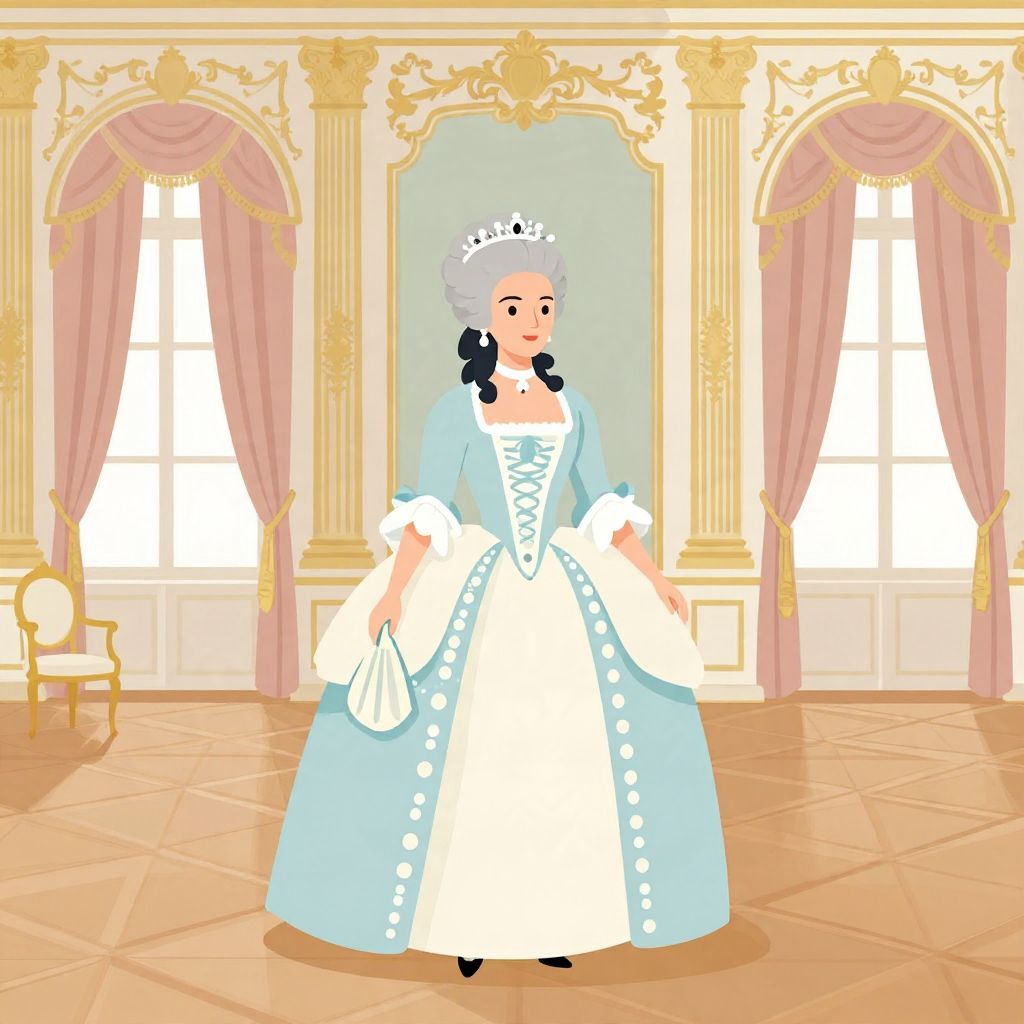
Who was Marie Antoinette, and why does her name still evoke such strong reactions? She was the last queen of France before the French Revolution, a Habsburg archduchess who became queen consort to Louis XVI, and one of the most famous figures in European history.
Her life unfolded at the center of monarchy, court culture, war, and revolutionary upheaval. Admired by some, vilified by others, Marie Antoinette became a symbol of royal excess in the revolutionary imagination, even though her real life was more complex than the myths that later formed around her.
Who Is Marie Antoinette?
Marie Antoinette was the queen of France from 1774 until the monarchy’s collapse in 1792. Born in Vienna in 1755 as an Austrian archduchess, she married the future Louis XVI at age 14 and became a public face of the French court. Her reputation was shaped by politics, propaganda, and the crisis of the French Revolution.
Early Life in Vienna
Marie Antoinette was born on 2 November 1755 in Vienna, the fifteenth child of Empress Maria Theresa and Emperor Francis I. She belonged to the powerful Habsburg dynasty, which had long shaped the politics of Central Europe. Her upbringing was aristocratic, though not especially rigorous by later standards of statecraft.
As a young princess, she received a courtly education in music, etiquette, religion, and languages, but she was not trained to rule France. Her marriage was part of a diplomatic alliance between Austria and France, two traditional rivals. In that sense, her life was political from the beginning, even before she set foot in France.
A Dynastic Marriage
At age 14, she was married by proxy in 1770 to Louis-Auguste, the French dauphin, who became Louis XVI in 1774. The marriage was intended to strengthen Franco-Austrian relations after years of war and rivalry. For France, the union was strategic; for Marie Antoinette, it meant entering one of Europe’s most watched and ceremonial courts.
Marie Antoinette as Queen of France
Marie Antoinette became queen in 1774 when Louis XVI ascended the throne. At first, she was popular, fashionable, and closely observed by the French public. Over time, however, her image changed sharply. Court gossip, political hostility, and economic hardship all contributed to a growing sense that she was out of touch with ordinary French life.
Her position was powerful in appearance but limited in formal authority. As queen consort, she did not govern in her own name, yet she influenced court appointments, patronage, and the social atmosphere around the monarchy. Because she was foreign-born and conspicuously visible, she became an easy target for criticism.
Public Image and Court Life
At Versailles, Marie Antoinette helped shape fashion and taste. She favored elegant clothing, refined entertainments, and a more private social circle than the older ceremonial style of the French court. Her preference for intimacy and leisure was not unusual among aristocrats, but in the public climate of the late 18th century it looked increasingly extravagant.
She was especially associated with the Petit Trianon, a smaller retreat at Versailles where she could escape court formality. Later critics portrayed this as proof of selfishness, though it was also a common aristocratic practice. What made her controversial was not merely luxury, but the broader political meaning attached to luxury in a time of fiscal crisis.
Why Did Marie Antoinette Become So Controversial?
Marie Antoinette became controversial because she symbolized several anxieties at once: foreign influence, royal extravagance, weak monarchy, and social inequality. Many accusations against her were exaggerated or false, but they spread because they fit revolutionary politics. In the public mind, she came to represent a court disconnected from the suffering of the people.
The “Let Them Eat Cake” Myth
One of the most famous sayings attributed to Marie Antoinette is “Let them eat cake,” supposedly spoken in response to news that peasants had no bread. Historians do not accept this as a reliable statement by her. The phrase circulated in different forms before and around the revolutionary era and was later attached to her as propaganda.
This myth matters because it captures how she was remembered: not as a complex person, but as a symbol of indifference. The story persisted because it was useful to critics who wanted to portray the monarchy as morally bankrupt.
Political Propaganda and Scandal
Printed pamphlets, cartoons, and rumors attacked Marie Antoinette relentlessly. Some focused on her spending, others on alleged sexual misconduct, and many were openly misogynistic. These attacks were not simply personal gossip; they were part of a political struggle over the legitimacy of the monarchy.
Her Austrian birth also made her vulnerable. In revolutionary France, suspicion of foreign powers was intense, and Austria was often treated as an enemy. Because she was linked by family and diplomacy to the Habsburg world, opponents could portray her as disloyal even when the evidence was thin or nonexistent.
Marie Antoinette and the French Revolution
The French Revolution, beginning in 1789, transformed Marie Antoinette from a criticized queen into a central political target. As the monarchy weakened, revolutionary leaders and crowds increasingly viewed her as a dangerous obstacle to reform. Her role became more symbolic than practical, but symbols mattered enormously in revolutionary France.
The financial crisis of the French state, food shortages, and resentment of privilege all intensified public anger. Although the monarchy’s problems had deep structural causes, Marie Antoinette often bore the blame because she was visible, foreign, and associated with court privilege.
The Flight to Varennes
In June 1791, the royal family attempted to flee Paris in the Flight to Varennes. The escape failed, and the family was brought back under guard. This event was a turning point. It shattered trust in the monarchy and made many French citizens believe the king and queen were working against the Revolution rather than adapting to it.
Marie Antoinette’s political position after Varennes became much more dangerous. She continued to correspond with supporters and foreign powers, seeking help for the royal family. Those actions were understandable from the perspective of a threatened queen, but they also confirmed revolutionary suspicions that she could not be trusted.
Imprisonment and Trial
After the monarchy was abolished in 1792, Marie Antoinette was imprisoned with her family. Louis XVI was executed in January 1793. Marie Antoinette was then tried by the Revolutionary Tribunal and accused of treason, among other charges. The trial was political as well as legal, and the outcome was effectively predetermined.
She was executed by guillotine in Paris on 16 October 1793, at the age of 37. Her death marked the end of a queen who had become one of the Revolution’s most famous victims and one of its most enduring symbols.
What Was Marie Antoinette Really Like?
Historical evidence suggests that Marie Antoinette was neither the monstrous villain of revolutionary propaganda nor a completely innocent victim. She was a privileged aristocrat shaped by court culture and dynastic politics, but also a woman trapped in a collapsing political order. Her personality appears to have combined confidence, charm, stubbornness, and a strong sense of family loyalty.
She could be impulsive and politically naive, especially in the early years of her queenship. Yet she also showed resilience under pressure, particularly during the final years of the monarchy and her imprisonment. The historical record shows a human being far more complicated than the caricatures that later surrounded her.
Motherhood and Family Life
Marie Antoinette had four children who survived infancy: Marie-Thérèse, Louis-Joseph, Louis-Charles, and Sophie. Her role as a mother became more prominent as her public reputation deteriorated. In private, she appears to have been deeply attached to her children, and family bonds became one of the most important parts of her life.
For many later admirers, this maternal image softened her reputation. For critics during the Revolution, however, family feeling did little to offset the political danger she represented.
Legacy of Marie Antoinette
Marie Antoinette’s legacy is inseparable from the French Revolution and from the history of political image-making. She became a lasting symbol of monarchy’s excess, but also of the way women in power can be blamed for broader social and political failures. Her story reveals how reputation can be shaped by rumor, gender, class, and crisis.
In the centuries after her death, writers, artists, filmmakers, and historians have repeatedly reinterpreted her. Some portray her as frivolous and detached; others as a tragic figure destroyed by forces larger than herself. Modern history tends to place her somewhere in between: a real queen whose actions mattered, but whose legend was magnified far beyond the evidence.
Why She Still Matters
Marie Antoinette remains important because she helps explain the collapse of the French monarchy and the power of political symbolism. She also illustrates how public opinion can turn a royal person into a national scapegoat. Her life is a reminder that history is often shaped as much by image and rumor as by formal power.
Her name still stands for luxury and downfall, but the historical Marie Antoinette was more than a slogan. She was a Habsburg princess, a French queen, a mother, a political symbol, and a victim of revolutionary violence. To understand her is to understand the tensions that tore old-regime France apart. For a closer look at her final days, see why Marie Antoinette was executed and how Marie Antoinette died.