
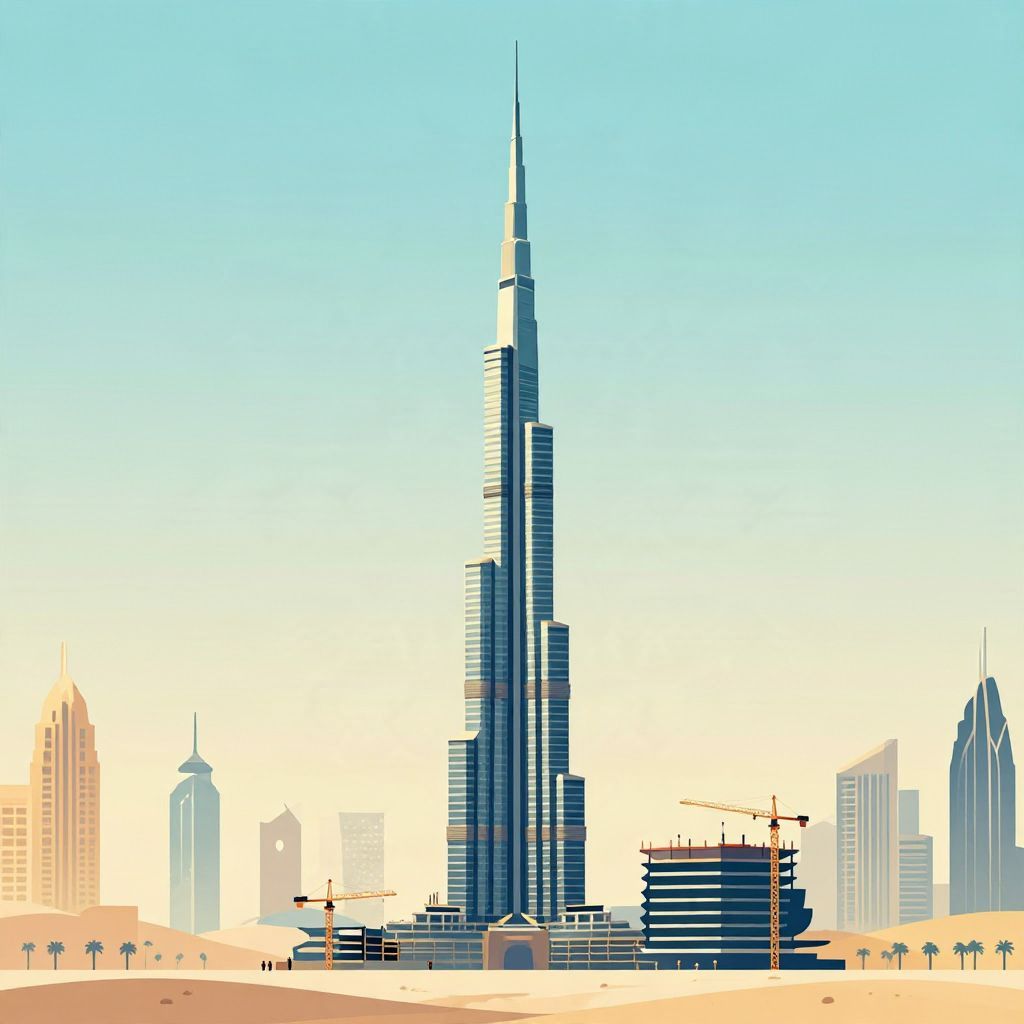
When was the Burj Khalifa built? The short answer is that construction began in 2004, the skyscraper rose through the mid-2000s, and it was officially completed and opened in 2010. Its story is not just about a record-breaking tower, but about Dubai’s rapid transformation, global ambition, and the engineering effort needed to build the world’s tallest building.
Understanding the Burj Khalifa’s timeline means looking at both the construction dates and the larger historical moment that produced it. The tower was planned during Dubai’s early 21st-century boom, designed to symbolize economic diversification and modernity, and built with an international team of architects, engineers, contractors, and laborers.
When Was the Burj Khalifa Built?
The Burj Khalifa was built between 2004 and 2010. Groundwork and excavation began in 2004, the structure started rising in 2005, and the building was completed in late 2009 before its official opening on 4 January 2010. It was conceived as a centerpiece of downtown Dubai and became the tallest building in the world upon completion.
The Construction Timeline
The Burj Khalifa’s construction unfolded in clear stages. Each phase reflected the scale of the project and the complexity of building a supertall tower in a desert environment.
Planning and Design
The project emerged in the early 2000s, when Dubai was investing heavily in large-scale development. The tower was designed by the architectural firm Skidmore, Owings & Merrill, with architect Adrian Smith leading the design. The project was originally known as Burj Dubai before being renamed Burj Khalifa in honor of Abu Dhabi’s ruler, Sheikh Khalifa bin Zayed Al Nahyan, after financial support from Abu Dhabi during the global financial crisis.
Groundbreaking in 2004
Construction officially began in 2004. The first major work involved preparing the site and laying foundations capable of supporting an unprecedented height. Because the tower would rise far above any existing building in the region, engineers had to solve problems involving load distribution, wind resistance, and deep structural support in sandy ground.
Rising Structure, 2005 to 2009
The tower’s vertical construction accelerated in 2005. As the building climbed, its distinctive stepped form helped reduce wind forces. The structure used reinforced concrete for much of the main tower, with a steel spire completing the silhouette. By 2007 and 2008, the Burj Khalifa was already dominating Dubai’s skyline and attracting international attention as it broke height records during construction.
Completion and Opening in 2010
The building was structurally completed in late 2009. It opened to the public on 4 January 2010, with a high-profile inauguration ceremony. At that point, the tower stood at 828 meters tall, making it the tallest building ever completed. The opening marked the end of one construction era and the beginning of the Burj Khalifa’s life as a global landmark.
Why Was the Burj Khalifa Built?
The Burj Khalifa was built as part of Dubai’s broader effort to redefine its economy and international image. In the late 20th and early 21st centuries, Dubai sought to move beyond dependence on oil and toward tourism, finance, real estate, and global investment. A landmark tower in the heart of a new downtown district fit that strategy perfectly.
The building also served a symbolic purpose. Tall buildings have long been used to express power, technological confidence, and civic ambition. In Dubai’s case, the Burj Khalifa announced that the city intended to compete with major global centers, not merely regionally but on a world stage.
Part of a Larger Urban Project
The tower was not built in isolation. It was the centerpiece of Downtown Dubai, a major development that included the Dubai Mall, hotels, fountains, roads, and public spaces. The project was designed to create a new urban district rather than a single isolated skyscraper. This made the Burj Khalifa both a building and a catalyst for city-making.
Who Built the Burj Khalifa?
The Burj Khalifa was the product of international collaboration. The developer was Emaar Properties, one of Dubai’s major real estate firms. The architectural design came from Skidmore, Owings & Merrill, and the tower was built by a large construction team involving contractors, engineers, and workers from multiple countries.
Engineering and Labor
Building a tower of this size required specialized expertise in structural engineering, concrete pumping, elevator systems, and wind analysis. The project also depended on a large migrant labor force, which is typical of major construction in the Gulf region. While the Burj Khalifa is often celebrated for its design and height, its construction history also reflects the realities of global labor and development in the modern Middle East.
How the Burj Khalifa Changed the History of Skyscrapers
The Burj Khalifa did more than set a height record. It changed expectations about what tall buildings could be. Before 2010, the title of world’s tallest building had shifted among a few famous skyscrapers, including the Empire State Building and the Petronas Towers. The Burj Khalifa pushed the category into a new scale altogether.
Its design influenced later discussions about supertall buildings, especially the balance between symbolism and engineering practicality. The tower showed that extreme height was possible, but only with enormous financial investment, advanced technology, and a carefully planned structural system. It also demonstrated how skyscrapers could function as national or city branding tools in the 21st century.
Key Records and Features
- Height: 828 meters
- Construction start: 2004
- Structural completion: 2009
- Official opening: 4 January 2010
- Original name: Burj Dubai
- Renamed: Burj Khalifa in 2010
Why the Date Matters
Knowing when the Burj Khalifa was built helps place it in the history of the early 21st century. The tower was not a leftover from an earlier era of monumental architecture; it was a product of globalization, rapid urban growth, and the competition among cities to define themselves through iconic design. Its construction dates capture a moment when Dubai was reshaping its identity at extraordinary speed.
The building’s timeline also reflects the impact of the global financial crisis. The renaming of the tower in 2010, after support from Abu Dhabi, shows that even a project meant to symbolize independence and ambition was shaped by regional political and financial realities. In that sense, the Burj Khalifa is a historical document as much as an architectural one.
Burj Khalifa in Historical Context
The Burj Khalifa belongs to a long tradition of monumental architecture, from ancient pyramids to medieval cathedrals and modern skyscrapers. Like those earlier structures, it was meant to impress, organize space, and communicate power. But unlike many historic monuments, it was built within a highly globalized economy, using international design talent, cross-border capital, and a multinational labor force.
Its completion in 2010 also marked the end of one phase in Dubai’s development. The city had already become known for rapid modernization, but the Burj Khalifa gave that transformation a single, unmistakable image. For many people around the world, the tower became the visual shorthand for Dubai itself.
So, When Was the Burj Khalifa Built?
The Burj Khalifa was built from 2004 to 2010, with construction beginning in 2004, the tower rising through the middle of the decade, and official opening taking place on 4 January 2010. If you are looking for the simplest historical answer, that is it. If you want the fuller story, the building also tells us how Dubai used architecture to announce its place in the modern world.
If you are interested in other famous construction timelines, you may also enjoy reading about when the Sears Tower was built or when the Pyramids of Giza were built.