
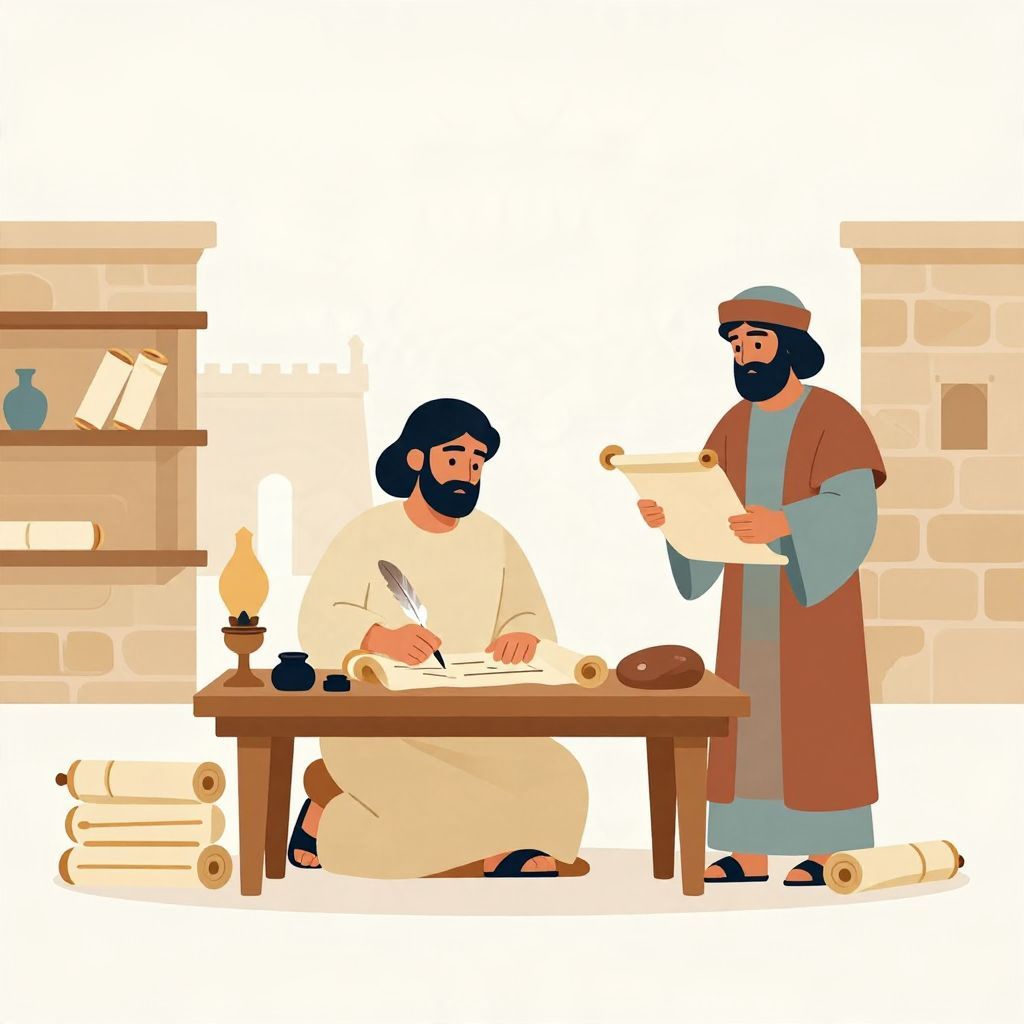
How was the Bible written? The short answer is that it was not written all at once by one person. It took shape over many centuries as different communities preserved laws, stories, poems, prophecies, letters, and teachings, then copied, edited, and collected them into sacred books.
Its history matters because the Bible is both a religious text and a historical artifact of the ancient Near East and early Christianity. Understanding how it was written helps explain why it contains multiple voices, genres, and versions.
How was the Bible written?
The Bible was written gradually, in Hebrew, Aramaic, and Greek, by many authors and editors over roughly a thousand years. Its books began as oral traditions and written texts, were copied by hand, and were later gathered into the Hebrew Bible and the Christian Old and New Testaments.
From oral tradition to written text
Before many biblical books existed in written form, stories, laws, prayers, and songs were passed on orally. In the ancient world, oral transmission was common and reliable enough for long traditions to survive, but it also allowed variation. Over time, scribes and religious leaders began writing these traditions down, especially as kingdoms, temples, and exile created a need to preserve identity.
Why writing became important
Writing gave permanence to material that communities considered sacred or authoritative. It also served practical needs: laws could be preserved, genealogies recorded, royal histories remembered, and worship standardized. In ancient Israel and Judah, scribes likely worked in royal and temple settings, though the exact process is not always visible in the surviving evidence.
The Hebrew Bible: a long process of collection and editing
The books now called the Hebrew Bible, or Tanakh, did not appear in a single moment. They were composed and edited across the first millennium BCE, with many scholars placing major stages between about the 10th and 2nd centuries BCE. Some traditions may be older, but the surviving text reflects long development rather than one original draft.
Law, history, and prophecy
Several biblical books preserve different kinds of material:
- Law such as parts of Exodus, Leviticus, and Deuteronomy.
- Historical narratives such as Joshua, Samuel, and Kings.
- Poetry and wisdom such as Psalms, Proverbs, and Job.
- Prophetic writings such as Isaiah, Jeremiah, and Amos.
These books did not all come from the same time or author. Some contain older traditions embedded in later compositions. Others were expanded by editors who shaped earlier material to address new circumstances, including political crisis, exile, and return.
Exile and editing
One of the most important historical turning points was the Babylonian exile in the 6th century BCE, when many Judeans were deported after Jerusalem fell in 586 BCE. That crisis likely encouraged reflection, preservation, and reworking of traditions. Later, under Persian rule, Jewish communities continued to copy and interpret these texts. The exile did not create the Bible by itself, but it strongly influenced how traditions were organized and understood.
Who wrote the Bible?
There is no single answer, because “the Bible” is a library, not one book. Traditional religious belief often attributes books to prophets, kings, apostles, or inspired figures. Historical scholarship, however, usually sees most biblical books as the work of multiple authors, editors, and scribes, some known and many anonymous.
Traditional attributions versus historical evidence
For example, tradition associates the Torah with Moses, the Psalms with David, and parts of the New Testament with Paul or the apostles. Historians treat these attributions carefully. They may reflect ancient belief, literary convention, or a real connection to a founding figure, but they do not always prove direct authorship in the modern sense.
The role of scribes
Scribes were essential. In the ancient world, writing was a skilled craft, and texts were copied by hand. Scribes could preserve a text faithfully, but they could also update spellings, clarify wording, combine sources, or harmonize traditions. This means many biblical books show layers of composition rather than a single untouched original.
How the Old Testament or Hebrew Bible took shape
The Hebrew Bible developed from Israelite and Judean traditions over centuries. Its final form likely emerged gradually between the Persian and Hellenistic periods, though scholars debate exact dates for specific books. Some books reached near-final form earlier; others continued to be edited later.
Major stages in the formation of the text
- Early traditions were spoken, sung, and remembered in communities.
- Written collections began to preserve laws, royal records, and prophetic sayings.
- Editorial work combined older material into larger books and narratives.
- Copying and standardization helped certain versions become authoritative.
By the late Second Temple period, Jewish communities recognized a set of sacred writings, though the exact boundaries of that collection were not identical everywhere. The process of canonization was gradual and not fully uniform.
How the New Testament was written
The New Testament was written in the first century CE, mainly in Greek, within the expanding world of early Christianity. Its books were composed over a few decades, roughly from the 50s to the early 2nd century CE, though scholars debate the dates of individual works. Unlike the Hebrew Bible, the New Testament reflects a much shorter composition period.
Letters came first
The earliest Christian writings are generally considered to be Paul’s letters, written to communities in the eastern Roman Empire in the 50s CE. These letters addressed real disputes, worship practices, ethics, and beliefs about Jesus. They were not written as a single theological system, but they became foundational because they are among the earliest surviving Christian texts.
The Gospels and Acts
The four Gospels—Matthew, Mark, Luke, and John—present the life, death, and resurrection of Jesus from different perspectives. Most scholars date Mark around 70 CE, Matthew and Luke around 80–90 CE, and John somewhat later, though exact dates remain debated. These texts drew on oral traditions, earlier written sources, and the needs of specific communities.
Acts, usually linked with Luke, continues the story of the early church. It shows how Christians understood the movement from Jerusalem to the wider Roman world. Like the Gospels, it is both theological and historical in purpose, though not a neutral modern biography.
Other New Testament writings
Other books include Hebrews, the Catholic Epistles, and Revelation. Some were written to encourage persecuted believers, correct false teaching, or interpret events in light of faith. Revelation, for instance, uses symbolic language typical of apocalyptic literature, a genre that can be difficult for modern readers because it is highly figurative and rooted in crisis.
Languages, translation, and copying
The Bible was written in several languages because it emerged across different communities and periods. Most of the Hebrew Bible was written in Hebrew, with some sections in Aramaic. The New Testament was written in Greek, the common written language of much of the eastern Roman Empire.
Why language matters
Language shaped meaning, audience, and later interpretation. As Jewish and Christian communities spread, translation became essential. The Greek Septuagint, a translation of Hebrew scriptures into Greek, was especially important for early Christians. Later Latin, Syriac, Coptic, Ethiopic, and many other translations carried the Bible into new regions.
Copying by hand
For centuries, every biblical text existed in handwritten copies. That meant small differences entered the manuscript tradition over time: spelling changes, missing lines, added clarifications, or alternate wordings. Most differences are minor, but they remind us that the Bible’s text has a history. Modern biblical scholars compare manuscripts to reconstruct earlier forms as carefully as possible.
Canon: how certain books became “the Bible”
The Bible did not become a closed collection immediately. Communities gradually decided which books were authoritative for teaching, worship, and identity. This process is called canonization. Different Jewish and Christian traditions eventually recognized different canons, which is why Protestant, Catholic, Orthodox, and Ethiopian Bibles do not all contain exactly the same books.
Judaism and Christianity followed different paths
After the destruction of the Second Temple in 70 CE, Jewish and Christian communities developed along increasingly distinct lines. Rabbinic Judaism centered on the Torah and other sacred writings in new ways, while Christianity expanded its own collection of authoritative texts, including the New Testament. By late antiquity, these traditions had related but not identical biblical canons.
What historical evidence do we actually have?
We do not have the original handwritten copies of most biblical books. What we do have are later manuscripts, ancient translations, quotations in other writings, and archaeological evidence that helps place the texts in their historical settings. Famous manuscript discoveries, such as the Dead Sea Scrolls, show that biblical texts circulated in more than one form before standardization.
What scholars can and cannot know
Scholars can often identify broad patterns: when a text likely took shape, what earlier traditions it used, and how it was edited. They cannot always identify every author or reconstruct every stage with certainty. That uncertainty is not a weakness of history; it is part of responsible historical method when dealing with ancient texts.
Why it matters how the Bible was written
Knowing how the Bible was written changes how we read it. It shows that the Bible is a collection shaped by history, not a single flat document. Its variety of voices reflects centuries of worship, conflict, hope, exile, empire, and renewal. That complexity is one reason the Bible has remained so influential.
For readers today, the Bible’s formation explains why it contains repeated stories, differing emphases, and distinct genres. It also helps separate historical inquiry from faith claims: historians can study how the text came together, while believers may also see divine guidance in that process. If you want to go further, you may also be interested in what the original language of the Bible was and where the Bible came from.