
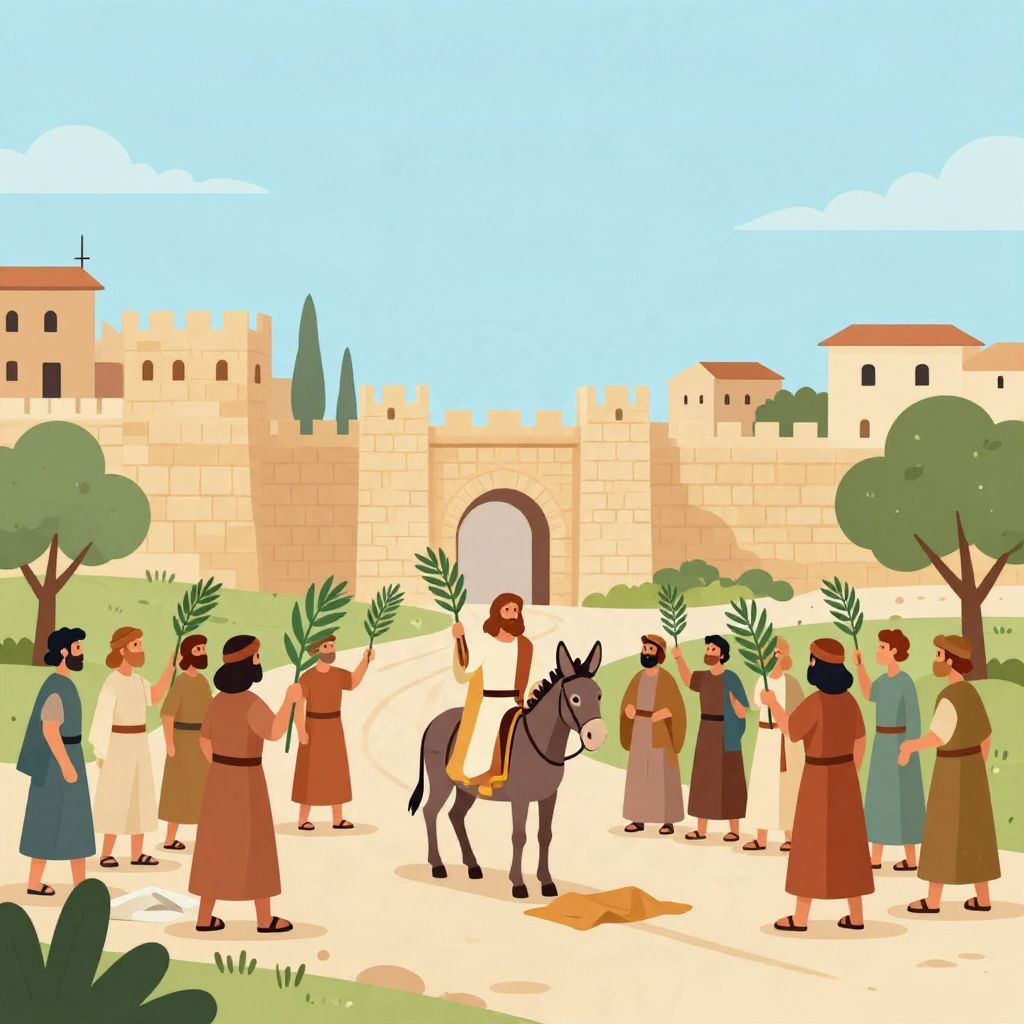
Palm Sunday is the Christian day that remembers Jesus’ entry into Jerusalem shortly before his crucifixion. It falls on the Sunday before Easter and opens Holy Week, the final stretch of the Easter story in the New Testament.
What happened on Palm Sunday was both a public arrival and a symbolic act. According to the Gospels, Jesus entered Jerusalem amid crowds who greeted him with palm branches, cloaks, and acclamations. The event is usually dated to around Passover, in the final week of Jesus’ life, and it set the stage for the tensions that led to his arrest and death.
What happened on Palm Sunday?
On Palm Sunday, Jesus entered Jerusalem from the Mount of Olives while supporters welcomed him as a messianic figure. The Gospels describe people spreading cloaks on the road and waving palm branches. The scene signaled hope, but also heightened conflict with religious and political authorities in a city crowded for Passover.
The Palm Sunday timeline in the Gospels
The exact sequence varies slightly across the four Gospels, but the core story is consistent. Jesus approached Jerusalem near the time of Passover, rode into the city on a donkey or colt, and was greeted by crowds who shouted praises. The event is remembered as a deliberate, symbolic fulfillment of Jewish expectations about a peaceful king.
1. Jesus approaches Jerusalem
In the Gospel accounts, Jesus comes from the direction of Bethany and Bethphage on the eastern side of Jerusalem, near the Mount of Olives. This location mattered. The Mount of Olives had strong prophetic associations in Jewish tradition, which gave the entrance added meaning for listeners familiar with scripture.
2. The donkey or colt
Jesus is described as entering on a donkey, or in Matthew’s version, on a donkey and a colt. This detail is usually understood as symbolic rather than practical. In Jewish scripture, especially Zechariah 9:9, a king arrives humbly on a donkey, not as a warlord on a horse. The image suggested peace rather than military conquest.
3. The crowd’s welcome
The crowd spread cloaks on the road and, in the accounts of Matthew, Mark, and John, waved palm branches. They shouted phrases such as “Hosanna,” a Hebrew expression that originally meant “save, please,” but could function as a cry of praise. The crowd’s words linked Jesus with hopes for deliverance and the coming kingdom of God.
4. Entry into the city
After the procession, Jesus entered Jerusalem and, according to some accounts, looked around the Temple area before leaving or continuing his ministry there. This matters because the Temple was the religious and political center of Jewish life. Any public act there during Passover, when the city was crowded, would have been noticed by authorities.
Why Palm Sunday mattered in first-century Jerusalem
Palm Sunday was not just a devotional scene; it unfolded in a tense historical setting. Jerusalem during Passover was full of pilgrims. Passover celebrated liberation from slavery in Egypt, so the festival naturally carried political overtones. Roman authorities and local elites would have been alert to any movement that looked like a popular challenge to order.
Jerusalem under Roman rule
In the first century, Judea was under Roman control, and the city was governed through a mix of imperial power and local leadership. Rome feared unrest during major festivals. A public procession could be read in more than one way: as a religious celebration, a prophetic sign, or a possible messianic demonstration. That ambiguity is one reason Palm Sunday is historically important.
Messianic expectations
Many Jews in the period hoped for God’s intervention in history, though not everyone imagined the same kind of messiah. Some expected a royal deliverer, others a priestly or prophetic figure, and still others focused on divine renewal rather than a political ruler. Jesus’ entry into Jerusalem fit these hopes in a striking but also unsettling way.
What the palm branches symbolized
Palm branches were more than decoration. In Jewish and wider Mediterranean culture, palms could symbolize victory, celebration, and national identity. In the Gospel of John, the crowd uses palms explicitly. In the other accounts, cloaks and acclamations play a similar role. The branches helped turn the procession into a public sign of honor.
Were palms used everywhere?
Not necessarily. The exact historical details of the crowd’s gestures may differ by Gospel writer and by later Christian memory. The central point is that the entrance was treated as a triumphal welcome. The palm became the lasting symbol because it captured the mood of celebration and the sense of royal expectation.
How the Gospel writers present the event
The four Gospels agree on the basic story but emphasize different details. That is important for historical reading. These texts are theological narratives, not modern news reports, so each writer shapes the scene to make a point about Jesus’ identity and mission.
Mark and Matthew
Mark and Matthew present the entry as a fulfillment of scripture and a sign of Jesus’ authority. Matthew especially highlights fulfillment language, while Mark’s version is concise and dramatic. Both place the event near the beginning of the final week leading to the crucifixion.
Luke
Luke emphasizes the crowd’s praise and the Pharisees’ concern. In his account, some religious leaders tell Jesus to rebuke his followers, and he replies that if the people were silent, the stones would cry out. Whether taken literally or symbolically, the line underscores the inevitability of the moment in Luke’s theology.
John
John gives the clearest palm-branch scene and ties the event more explicitly to Jesus’ public reputation after the raising of Lazarus. This helps explain why the crowd is so large in John’s account. It also shows how the Gospel writers connect Palm Sunday to the growing tension that followed Jesus’ signs and teachings.
What happened after Palm Sunday?
Palm Sunday did not end the story. It began the most intense week of Jesus’ ministry in Jerusalem. The entry was followed by confrontations in the Temple, disputes with religious authorities, the Last Supper, arrest, trial, crucifixion, and, according to Christian belief, resurrection on Easter Sunday.
Temple conflict
After entering the city, Jesus’ actions in the Temple became central. The Gospels describe him challenging commercial activity there, an act that symbolized judgment on corruption and abuse. Historians debate the exact form and scale of this episode, but the tradition clearly presents it as a major escalation.
Growing tension with authorities
The public welcome on Palm Sunday may have alarmed both the Temple leadership and Roman officials. A popular teacher receiving messianic honors during Passover could be seen as politically dangerous. Even if Jesus did not lead a rebellion, the optics of the procession would have mattered in a city where order was closely watched.
The road to the crucifixion
Within Christian chronology, Palm Sunday leads directly into the Passion narrative. The same week that begins with praise ends with execution. That contrast is one reason the day remains central in Christian worship: it captures the movement from acclaim to rejection, from hope to suffering.
Historical interpretation: what can we know?
Historians generally agree that Jesus entered Jerusalem near Passover and that the event was remembered as a public, symbolic procession. The details of the crowd, the exact words spoken, and the precise number of participants cannot be verified with certainty. Still, the core historical setting is strong: a Galilean preacher came into Jerusalem at a volatile time and was greeted in a way that suggested royal or messianic expectation.
What is likely historical
- Jesus was active in Jerusalem during Passover.
- He entered the city in a public and symbolic manner.
- The event was associated with messianic hopes.
- The entrance contributed to the tensions that led to his arrest.
What is harder to prove
- Whether the crowd was large or small.
- Whether palm branches were used exactly as described in every Gospel.
- Whether specific acclamations were shouted verbatim.
- How much of the scene was remembered history and how much was shaped by scriptural interpretation.
Why Palm Sunday is still remembered
Palm Sunday survives because it holds together several themes at once: kingship, humility, hope, and danger. It presents Jesus not as a military conqueror but as a peaceful figure entering a city that would soon reject him. For Christians, it marks the beginning of Holy Week and the emotional turn from celebration to suffering.
Historically, the day is important because it shows how religious symbolism and political anxiety could overlap in Roman Judea. The procession was not just a religious gesture; it was a public statement made in a charged environment. That is why Palm Sunday remains one of the most vivid and consequential moments in the Gospel narrative. For related reading, you may also want to explore Holy Week history and the history of Passover.