
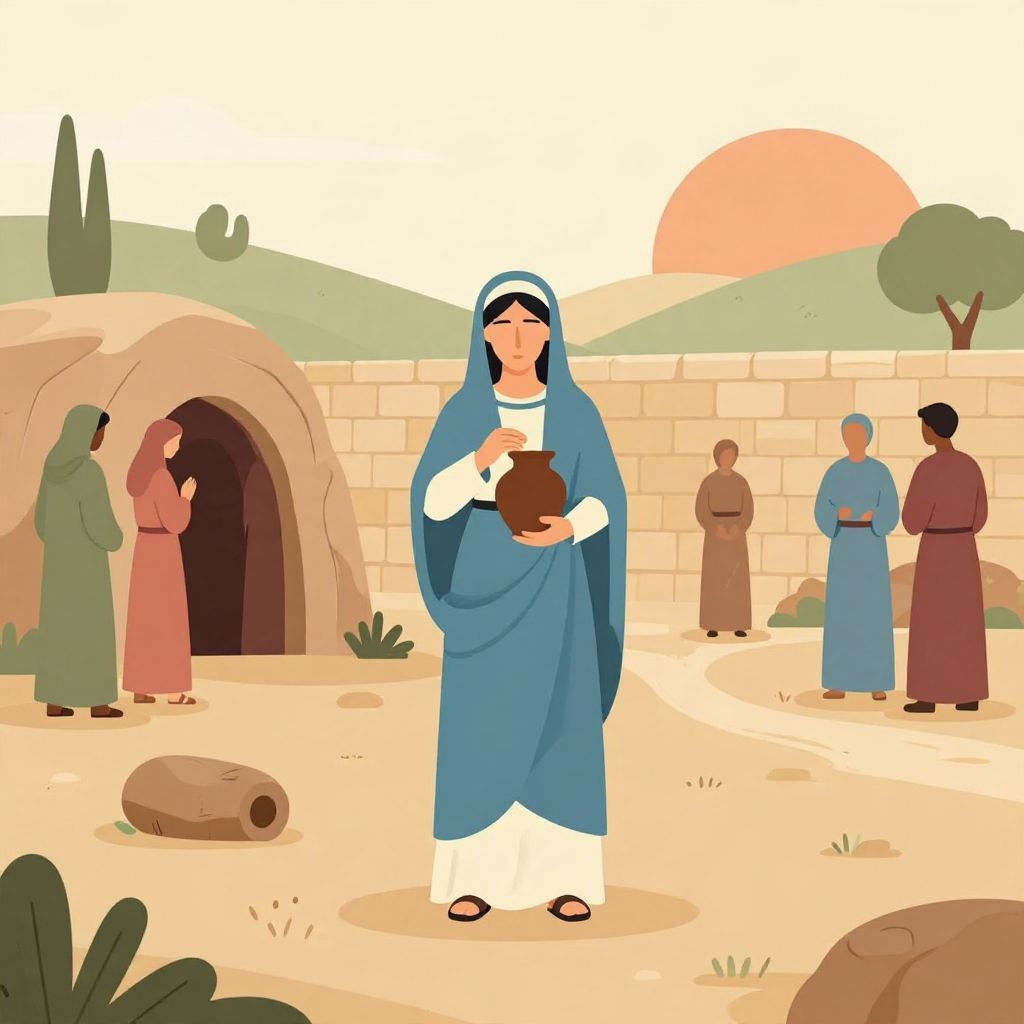
What happened to Mary Magdalene is one of the most enduring questions in Christian history. She appears in the New Testament as a follower of Jesus, a witness to his crucifixion and burial, and the first person to see the risen Christ in the Gospel of John.
After that, her story becomes a mix of scripture, later tradition, and legend. Historians can say a fair amount about her role in the earliest Christian movement, but much less about her later life, death, or burial with certainty.
What happened to Mary Magdalene?
Mary Magdalene was a prominent follower of Jesus who remained with him through his death and, according to the Gospels, was the first witness of the resurrection. After the New Testament period, her life becomes uncertain; later Christian traditions say she preached, lived in repentance, and died in southern France or Ephesus, but these accounts are not historically secure.
Mary Magdalene in the Gospels
Mary Magdalene is one of the most important women in the New Testament. Her name suggests she came from Magdala, a town on the western shore of the Sea of Galilee. The Gospels identify her as someone from whom Jesus had cast out seven demons, a phrase that likely refers to healing or deliverance rather than a detailed medical diagnosis.
Unlike many male disciples who fled after Jesus’ arrest, Mary Magdalene is shown staying near the cross, helping observe the burial, and returning to the tomb after the Sabbath. In the Gospel accounts, this makes her a central witness to the final events of Jesus’ life.
Her role during Jesus’ ministry
The Gospels do not describe Mary Magdalene as one of the Twelve Apostles, but they do place her among the women who supported Jesus’ movement. In Luke 8, she is listed with other women who provided for Jesus and the disciples out of their resources. That detail suggests she was not a marginal figure but part of the wider circle of early followers.
Her importance lies partly in her presence at key moments. She is not just mentioned once and forgotten; she appears at the crucifixion, burial, and resurrection narrative, which is why later Christian tradition gave her such a prominent place in memory and devotion.
The resurrection appearances and the earliest aftermath
The most famous event connected with Mary Magdalene is her encounter with the risen Jesus. In John 20, she goes to the tomb early in the morning, finds it empty, and later recognizes Jesus after initially mistaking him for the gardener. Jesus then sends her to tell the disciples what she has seen. Because of this, many Christians have called her the “apostle to the apostles.”
That phrase is a later honorific, not a New Testament title, but it captures her role in the story: she is the first messenger of the resurrection. In the other Gospels, women collectively discover the empty tomb, and Mary Magdalene is consistently among them, though the details differ slightly from one account to another.
Why the Gospel accounts differ
The differences between the resurrection narratives do not mean the tradition is meaningless. They show that early Christians preserved the event in more than one literary form. Some accounts emphasize Mary Magdalene alone; others include other women such as Mary the mother of James and Salome. Historians usually treat these as related traditions shaped by different communities, not as a single harmonized report.
What remains consistent is her status as a witness. In a society where women’s testimony was often undervalued, the prominence of Mary Magdalene in the resurrection story is striking and likely reflects an early, remembered tradition rather than a later embellishment.
Did Mary Magdalene become a repentant sinner?
One of the most widespread beliefs about Mary Magdalene is that she was a former prostitute or a “sinful woman” who repented. That image became powerful in Western Christianity, but it is not explicitly stated in the New Testament. The association grew from later interpretation, especially the merging of several different women in biblical tradition.
In 591 CE, Pope Gregory I delivered a sermon that helped popularize the idea that Mary Magdalene was the same person as the unnamed sinful woman in Luke 7 and also as Mary of Bethany. This identification became influential in medieval Western Christianity, even though Eastern Christian traditions generally did not make the same connection.
What historians think today
Most modern scholars distinguish Mary Magdalene from the unnamed woman in Luke and from Mary of Bethany. The New Testament itself presents them as separate figures. The “penitent prostitute” image is therefore best understood as a later tradition, not a secure historical fact.
This matters because it changed how Mary Magdalene was remembered. Instead of being remembered primarily as a disciple and resurrection witness, she was often recast as a symbol of repentance. That interpretation shaped art, preaching, and popular culture for centuries.
What happened to Mary Magdalene after the New Testament?
After the resurrection narratives, the historical trail becomes thin. The New Testament does not clearly describe what happened to Mary Magdalene in her later life, where she traveled, or how she died. That silence has left room for many traditions, especially in later Christian communities.
Some traditions say she remained with the early disciples in Jerusalem. Others say she traveled as a missionary. Because the sources are late and often legendary, historians cannot confirm these stories with confidence.
Later traditions about her mission
In medieval Western legend, Mary Magdalene was said to have traveled to Provence in southern France with other Christians after the resurrection. There she allegedly preached, converted people, and lived as a hermit. This story became especially popular in medieval France, where several churches and shrines claimed connection to her.
Another tradition, more common in Eastern Christianity, places her later life in Ephesus, where she may have lived near the apostle John. This tradition is also difficult to verify historically, but it shows how widely her memory spread across the Christian world.
Her death and burial
There is no universally accepted historical account of Mary Magdalene’s death. Some traditions say she died in Ephesus; others say she died in France. Relics associated with her have been venerated in several places, but relic traditions often developed long after the person in question and do not provide firm historical proof.
In short, her death is not known with certainty. What can be said is that her cult and memory grew steadily in Christian devotion, especially from late antiquity through the Middle Ages.
Why Mary Magdalene became so important
Mary Magdalene’s significance comes from both history and theology. Historically, she appears to have been a real follower of Jesus who played a major role in the movement’s earliest days. Theologically, her witness to the resurrection made her a powerful symbol of faith, recognition, and testimony.
Her prominence also reflects an important pattern in the Gospels: women are often shown as faithful when many male disciples have scattered. That does not mean the texts are modern statements about gender equality, but it does mean the early Christian memory preserved women in central roles more than some later traditions did.
From disciple to symbol
Over time, Mary Magdalene came to symbolize several different things at once: repentance, devotion, witness, and misunderstood holiness. Medieval art often portrayed her with long hair, an ointment jar, or in the wilderness as a penitent ascetic. These images were not historical portraits, but devotional ones.
In modern scholarship and many contemporary Christian traditions, there has been a renewed effort to distinguish the historical Mary Magdalene from the later legend attached to her name. This has restored attention to her original role as a disciple and witness rather than merely a repentant sinner.
A simple timeline of Mary Magdalene’s story
The following outline shows what can be said with the most confidence and where tradition takes over:
- Before Jesus’ death: Mary Magdalene follows Jesus and is associated with his ministry in Galilee.
- c. 30 CE: She is present at the crucifixion and burial of Jesus according to the Gospels.
- Early Easter morning: She visits the tomb and, in the Gospel of John, encounters the risen Jesus.
- After the resurrection: The New Testament gives no clear account of her later life.
- Late antiquity and medieval period: Legends develop about her as a penitent sinner, missionary, and hermit.
- Modern era: Scholars increasingly separate the historical Mary Magdalene from later legend.
What happened to Mary Magdalene in the historical record?
The honest answer is that Mary Magdalene was remembered early and powerfully, but documented only briefly. The New Testament preserves her as a key witness to Jesus’ death and resurrection. After that, later Christian imagination filled in the gaps with stories of repentance, travel, preaching, and holy death.
So, what happened to Mary Magdalene? Historically, she became one of the most important women in early Christianity. Later tradition transformed her into a much larger figure than the surviving evidence can fully support. Her real legacy lies in that first role: faithful disciple, witness to the crucifixion, and first herald of the resurrection. If you want to place her story in the wider biblical context, you may also find it useful to read about what happened to Judas after he betrayed Jesus.