
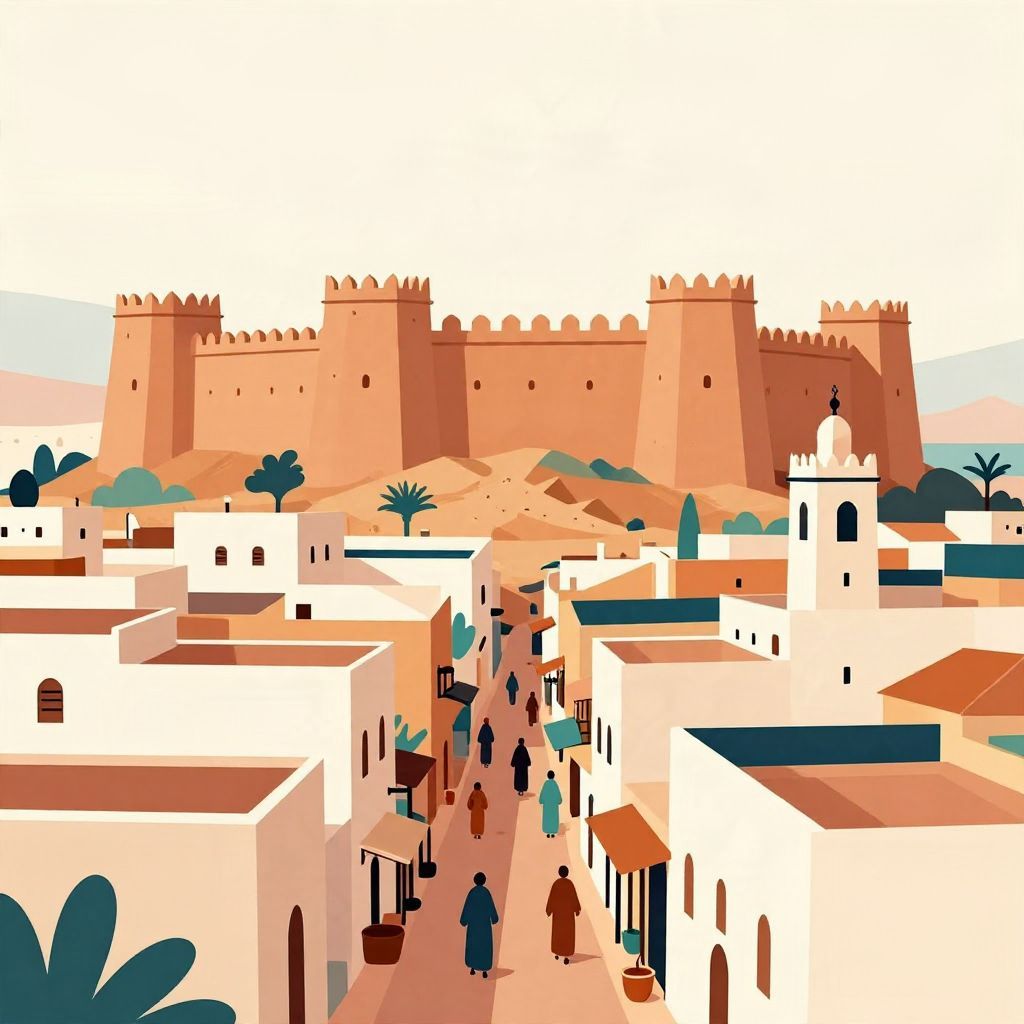
What is a casbah? In history, the word usually refers to the fortified core of a North African city, especially in the Maghreb, where rulers, soldiers, merchants, and families lived within defensive walls and narrow streets. Over time, “casbah” also came to mean an old quarter or citadel-like district shaped by local traditions, trade, and security needs.
The term is strongly associated with Islamic urban history, but its meaning can vary by place and period. In some cities, the casbah was the seat of power; in others, it was a dense residential neighborhood that preserved older architecture and social life.
What Is A Casbah?
A casbah is a fortified urban district, often the oldest or most defensible part of a North African city. Historically, it could function as a citadel, administrative center, military stronghold, or walled neighborhood. The word is most closely linked to the Maghreb—especially Algeria, Morocco, Tunisia, and Libya—though its usage can extend more broadly in popular speech.
Origins of the Word and the Idea
The word “casbah” is commonly traced to Arabic qaṣbah, meaning a citadel, stronghold, or fortified place. In historical usage, it described a protected center of authority rather than a single architectural style. Because Arabic spread across North Africa after the 7th century, the term became part of the region’s urban vocabulary and was adopted into local and European languages in different forms.
From fortress to neighborhood
In many cities, the casbah began as a place of defense and rule. As settlements grew, the protected core often remained the most prestigious or strategically important district. Over time, the word could refer not only to the fortress itself but also to the surrounding old quarter, especially where the original defensive layout shaped later urban life.
How a Casbah Worked in Historical Cities
Casbahs developed in response to insecurity, political authority, and the practical needs of urban life. Their walls, gates, and compact streets helped protect inhabitants from attack and made it easier for rulers to control access. At the same time, they supported commerce, religion, and daily neighborhood life in a dense environment adapted to climate and local custom.
Typical features of a casbah
- Fortified walls or defensive boundaries
- Narrow streets and winding passages that limited movement by outsiders
- Gates that controlled entry and could be closed in times of danger
- Religious buildings, such as mosques or shrines
- Markets or workshops serving local trade
- Residential houses built for privacy and climate control
- Administrative or military structures in some cities
Why the layout mattered
The compact form of a casbah was not accidental. Dense construction reduced exposure to heat and helped conserve space inside walls. Narrow lanes created shade and encouraged pedestrian movement. In many places, homes were arranged inward around courtyards, reflecting both social customs and the need for privacy. The result was an urban form that blended defense, community, and adaptation to environment.
Casbahs in North African History
Casbahs became especially important in the medieval and early modern history of North Africa, where dynasties, local rulers, and imperial powers competed for control of strategic cities and ports. A casbah often marked the center of political authority, especially in coastal or commercial towns where defense mattered greatly. It could house garrisons, governors, and the institutions of rule.
Algiers as a famous example
The Casbah of Algiers is among the best-known examples today. Its old quarter developed under successive rulers and became a major urban center in the Ottoman period. The area’s steep lanes, dense housing, and historic buildings reflect centuries of layered history. In modern times, it has become a symbol of Algerian heritage and urban memory, though it has also faced pressure from decay, overcrowding, and modernization.
Other regional examples
Similar fortified quarters existed in many North African cities, though local names and functions varied. In Morocco, historic medinas sometimes included citadel-like districts or royal compounds. In Tunisia and Libya, fortified cores likewise played roles in governance and defense. The casbah was therefore not a single fixed model but part of a wider urban tradition shaped by local politics and geography.
Casbah, Medina, and Kasbah: Are They the Same?
These terms are related but not identical. A medina usually means the old city or historic urban center, especially in Arabic-speaking regions. A kasbah or casbah often refers more specifically to a fortified part of that city, or to a citadel. In everyday use, however, the words can overlap, especially in translation or tourism.
Why the confusion happens
European languages borrowed and adapted these terms in different ways. As a result, “casbah” sometimes became a broad label for any picturesque old quarter, even when historians would distinguish between a citadel, a medina, and a residential neighborhood. The exact meaning depends on local history, architecture, and language usage.
The Social Life of the Casbah
A casbah was not only a defensive structure; it was also a lived-in community. Families, artisans, traders, religious leaders, and officials all occupied different parts of the urban fabric. Life inside could be tightly knit, with strong neighborhood ties and shared public spaces, but also marked by social hierarchy, crowded conditions, and limited access for outsiders.
Daily life and local economy
Small workshops, food sellers, and craft production often supported the neighborhood economy. Goods moved through markets and side streets, while homes and courtyards provided private domestic space. In many casbahs, the balance between public and private life was carefully maintained by architecture, custom, and social norms.
Authority and control
Because casbahs were often associated with rulers or military power, they could also symbolize control over the city. Gates, patrols, and elevated positions made them easier to defend and govern. In periods of unrest, they could become centers of resistance, siege, or political change. Their importance was therefore both practical and symbolic.
How Casbahs Changed Over Time
Casbahs did not remain static. As cities expanded and new forms of government emerged, some lost their military role and became primarily residential or commercial districts. Others were partially demolished, rebuilt, or absorbed into larger urban areas. Colonial rule, modern planning, and population growth often altered their original functions and street patterns.
Colonial and modern transformations
In the 19th and 20th centuries, European colonial powers often reshaped North African cities by building new administrative quarters outside the old walls. This sometimes marginalized the casbah, which could be portrayed as overcrowded or outdated. Yet these districts remained important centers of identity, memory, and local life, even when their political role declined.
Preservation and heritage
Today, many casbahs are valued as historic urban landscapes. Preservation efforts aim to protect traditional houses, mosques, gates, and street patterns, though conservation can be difficult when residents need modern services and infrastructure. The challenge is to protect cultural heritage without turning living neighborhoods into empty monuments.
Why the Casbah Matters Historically
The casbah matters because it reveals how cities in North Africa were shaped by defense, authority, religion, trade, and climate. It shows that urban history is not only about palaces and battles, but also about streets, homes, and the organization of everyday life. Casbahs preserve evidence of how communities adapted to political uncertainty and built durable forms of urban identity.
Key historical significance
- They reflect the interaction of fortification and urban planning.
- They show how rulers organized power and administration in city centers.
- They preserve patterns of social life and neighborhood structure.
- They are important sources for studying Islamic and North African architecture.
- They remain symbols of cultural continuity and historical memory.
Common Misconceptions About Casbahs
One common misconception is that a casbah is simply any old or exotic-looking neighborhood. In historical terms, it usually has a more specific meaning tied to fortification and authority. Another misconception is that all casbahs look the same. In reality, their appearance and function varied widely from city to city, depending on local rulers, topography, and building traditions.
Not just a tourist image
Popular culture often uses “casbah” to evoke winding alleys, market scenes, or romanticized urban mystery. While those images may reflect real features of historic districts, they can obscure the casbah’s political and social importance. It was not merely a picturesque backdrop; it was often the core of governance and community life.
Conclusion
A casbah is best understood as a fortified historic urban core, especially in North Africa, where defense, administration, and everyday life came together inside a compact city district. Its history reflects centuries of change, from medieval rule and Ottoman governance to colonial disruption and modern heritage preservation. For related reading, see what cultural preservation in architecture means and what political reform is.