
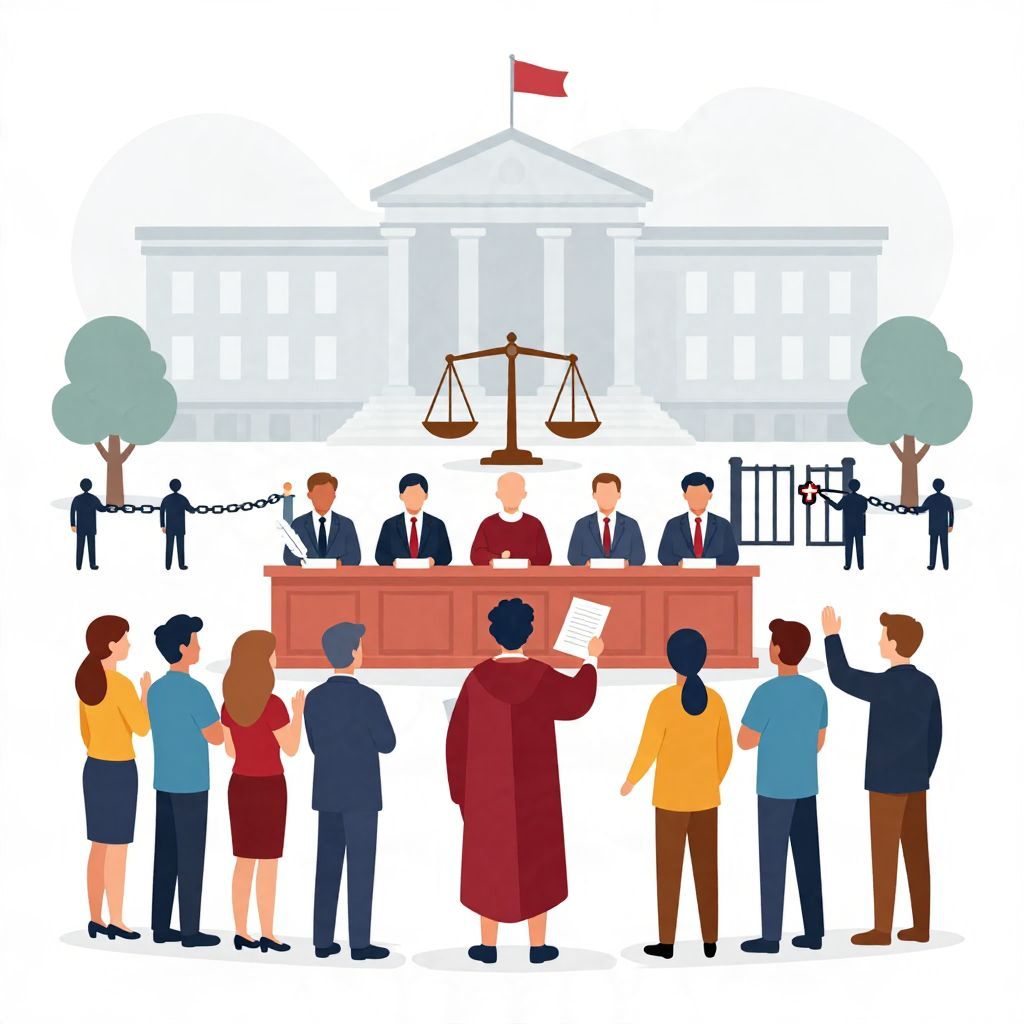
What is political reform? In history, it means deliberate changes to laws, institutions, or political practices meant to improve how a government works, broaden participation, or reduce abuse of power. Political reform can be gradual or dramatic, and it often emerges when people believe existing systems no longer represent society fairly.
Across centuries, reform has taken many forms: extending the vote, changing parliaments, ending corruption, limiting monarchs, protecting civil rights, or redesigning constitutions. Sometimes reform preserved a state by adapting it; at other times it became a stepping-stone to revolution.
What Is Political Reform?
Political reform is the process of changing political institutions, rules, or practices to make government more representative, accountable, efficient, or just. It usually works within an existing system rather than overthrowing it, though reforms can open the door to deeper political transformation.
Where Did Political Reform Come From?
Political reform is not tied to one single origin. As long as states have existed, rulers and subjects have argued over how power should be distributed. In the ancient world, reform often meant adjusting laws or offices to reduce unrest. In the modern era, it became closely linked to democracy, citizenship, and constitutional government.
Early examples in the ancient world
One of the best-known early reformers was Solon in sixth-century BCE Athens. His reforms aimed to ease social tensions by restructuring debt obligations and political participation. Later Athenian reforms, especially those associated with Cleisthenes around 508/507 BCE, helped lay foundations for broader citizen involvement. These were not “democracy” in the modern sense, but they showed an early pattern: political change as a response to instability and inequality.
Medieval and early modern reform
In medieval Europe, reform often focused on limiting arbitrary rule, clarifying legal rights, or negotiating between monarchs and elites. The Magna Carta of 1215 is often cited as a landmark because it constrained royal power, though it was not a democratic document. In the early modern period, reform movements expanded as printing, commerce, and religious conflict spread new ideas about authority and governance.
Why Do Political Reforms Happen?
Political reforms usually arise when existing arrangements no longer match social realities. Population growth, war, industrialization, economic inequality, corruption, colonial rule, or exclusion from voting can all create pressure for change. Reform is often a compromise: leaders concede some changes to avoid revolution, while reformers push to make institutions more legitimate and responsive.
Common causes of reform
- Unequal political rights — when only a small group can vote or hold office.
- Corruption or patronage — when offices and favors are distributed unfairly.
- Social unrest — protests, strikes, and petitions can force change.
- Economic transformation — industrialization and urbanization create new political demands.
- National crisis — war or defeat can expose weaknesses in government.
How Political Reform Changed Modern History
From the late eighteenth century onward, political reform became one of the central themes of modern history. Revolutions in America and France raised questions about sovereignty, rights, and representation. Even where revolution did not occur, reform movements pressed governments to expand suffrage, professionalize administration, and recognize citizens as political actors.
The age of revolutions
The American Revolution helped popularize the idea that legitimate government required consent and representation. The French Revolution pushed these ideas further, though its course was violent and unstable. Across Europe and the Atlantic world, reformers debated whether political change should come through constitutional adjustment or revolutionary rupture. The distinction mattered: reform implied continuity, while revolution implied a break with the old order.
Reform in the nineteenth century
The nineteenth century was a major era of political reform. In Britain, the Reform Acts of 1832, 1867, and 1884 gradually broadened the electorate and adjusted representation to reflect changing populations. Similar struggles unfolded elsewhere as workers, middle classes, and reform-minded elites pressed for more inclusive systems. Many states also reformed civil service, local government, and parliamentary procedures to reduce patronage and improve efficiency.
Outside Europe, reform took different forms. In Japan, the Meiji Restoration beginning in 1868 transformed political authority and state institutions in the name of national strength. In the Ottoman Empire, the Tanzimat reforms of the nineteenth century sought to modernize administration and legal structures. These were not simply democratic reforms; they were efforts to preserve states under pressure from internal unrest and foreign competition.
What Are the Main Types of Political Reform?
Political reform can target many parts of a system. Some reforms expand participation, while others improve administration or limit abuse. Historians usually group them by the problem they are meant to solve rather than by ideology alone.
1. Electoral reform
Electoral reform changes how votes are cast, counted, and translated into seats. It may involve extending suffrage, redrawing districts, introducing secret ballots, or changing voting systems. The goal is often to make elections fairer and more representative.
2. Constitutional reform
Constitutional reform alters the basic rules of government. This can include redefining the powers of executives, legislatures, courts, or federal units. Such reforms are often highly contested because they reshape the balance of power.
3. Administrative reform
Administrative reform improves how government functions day to day. Examples include merit-based civil service systems, anti-corruption measures, and clearer bureaucratic procedures. These reforms may seem less dramatic than elections or constitutions, but they can strongly affect how power is exercised.
4. Social and civil rights reform
Some political reforms aim to extend rights to groups previously excluded by law or custom. Abolitionism, women’s suffrage, civil rights movements, and decolonization all involved political reform, because they changed who counted as a full political participant.
Political Reform Versus Revolution
Reform and revolution are related but not identical. Reform changes a system from within, usually step by step. Revolution seeks a more abrupt overthrow of the existing order. In practice, the boundary can blur: reforms may fail and radicalize opposition, while revolutions often preserve some institutions after the upheaval.
Why reform can be preferred
Reform is often less destructive than revolution. It can preserve stability, protect property, and reduce violence while still addressing grievances. For rulers, reform may be a survival strategy. For reformers, it can be a practical path when the state is too strong to overthrow or when broad social support for revolution is lacking.
Why reform can be resisted
Political reform often threatens those who benefit from the existing order. Elites may fear losing power, wealth, or status. Even modest reforms can provoke backlash if they are seen as opening the door to deeper change. This is why reform movements frequently face delays, dilution, or partial implementation.
Important Historical Examples of Political Reform
Political reform has appeared in many places and periods, but several examples stand out because they changed the structure of government or citizenship in lasting ways.
- Athens under Solon and Cleisthenes — early experiments in redistributing political power among citizens.
- Magna Carta (1215) — a limitation on royal authority that later became symbolically important for constitutionalism.
- British parliamentary reform — gradual expansion of representation in the nineteenth century.
- Abolition and emancipation movements — reforms that transformed legal status and political rights.
- Women’s suffrage campaigns — long struggles that expanded democratic participation in many countries during the late nineteenth and early twentieth centuries.
- Decolonization — political reforms and independence movements that dismantled imperial rule across Asia, Africa, and the Caribbean.
How Historians Understand Political Reform
Historians usually see political reform as a response to conflict, not a simple story of progress. Reform can widen rights, but it can also be limited, uneven, or designed to preserve elite control. A reform that looks minor in the short term may have major long-term effects, especially when it changes who can participate in politics.
Reform is often incremental
Many of the most important reforms happened in stages rather than all at once. Voting rights, for example, were often expanded gradually through repeated campaigns, each building on the last. This incremental pattern helps explain why political reform can seem slow even when it eventually transforms a system.
Reform can be symbolic as well as practical
Some reforms change laws; others change expectations. A new constitution, a reformed parliament, or a broadened franchise can signal that political legitimacy now rests on different principles. Even when implementation is imperfect, the symbolism of reform can reshape public debate for generations.
What Political Reform Means Today
In modern usage, political reform still means changing political systems to make them fairer, more effective, or more accountable. Today it may involve anti-corruption measures, electoral redesign, campaign finance rules, decentralization, judicial reform, or efforts to protect minority rights. The basic historical pattern remains the same: people call for reform when they believe power is too concentrated, too unresponsive, or too easily abused.
Political reform is therefore both a historical process and a continuing idea. It has helped create modern citizenship, constitutional government, and broader participation, but it has also been contested at every stage. To understand political reform is to understand how societies try to change power without destroying the state that holds it.
For related background, see what political ideology means in history and how trust-busting became a reform movement.