
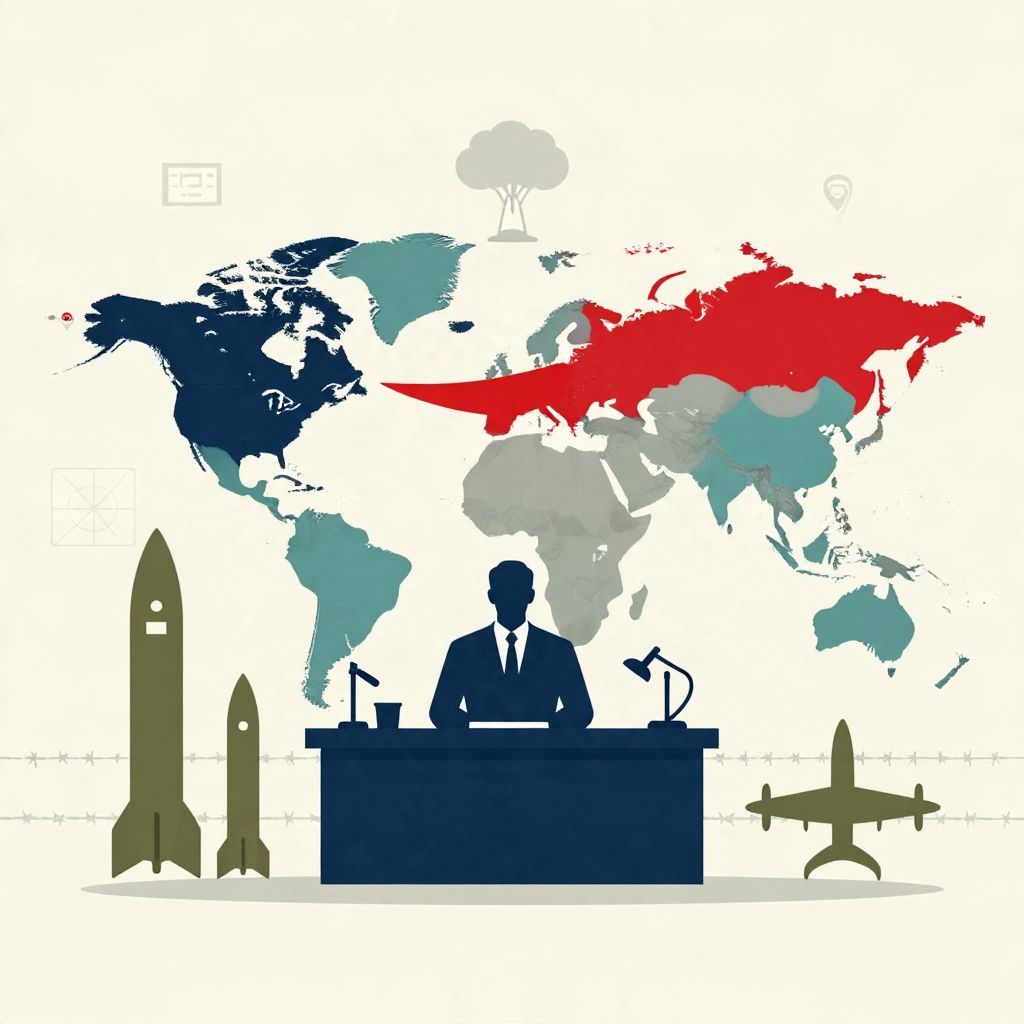
During the Cold War, what was the main concern of the United States? At its core, the answer was the spread of Soviet communism and the fear that it could expand into Europe, Asia, the Middle East, and eventually threaten American security and global influence.
That concern shaped U.S. foreign policy from the late 1940s through 1991. It influenced military alliances, wars, covert operations, nuclear strategy, and domestic politics, making the Cold War a long struggle over power, ideology, and the future of the postwar world.
During the Cold War, what was the main concern of the United States?
The main concern of the United States during the Cold War was containing the expansion of Soviet communism. American leaders feared that if the Soviet Union gained more territory, allies, or influence, it could weaken democratic governments, endanger trade and security, and shift the global balance of power against the United States.
Why Soviet expansion worried U.S. leaders
After World War II, the United States and the Soviet Union emerged as rival superpowers with very different political systems. Washington saw Moscow not just as a competitor, but as a state that supported one-party rule, controlled economies, and backed communist movements abroad. U.S. officials worried that Soviet influence could spread through military pressure, political subversion, or local revolutions.
This fear was sharpened by the collapse of wartime alliances. The Red Army occupied much of Eastern Europe, and communist governments soon took power across the region. To American policymakers, these developments looked like evidence of an expanding Soviet sphere rather than isolated national choices.
The idea of containment
The central U.S. strategy became containment, the effort to stop communism from spreading further rather than trying to roll it back everywhere at once. This approach is closely associated with diplomat George F. Kennan in 1947. In practice, containment meant aid, alliances, military readiness, and sometimes covert action.
Containment did not mean the United States ignored every communist government. Instead, it meant American leaders believed the most dangerous outcome would be a chain reaction in which one country after another fell under Soviet-aligned influence.
Major Cold War events shaped by that concern
Several major events show how the fear of communist expansion guided U.S. policy. These were not random crises; they were part of a larger effort to prevent the Soviet Union from gaining strategic advantage.
- 1947: The Truman Doctrine promised U.S. support for Greece and Turkey, signaling American commitment to resisting communist pressure.
- 1948–1949: The Berlin Blockade led the United States and its allies to organize the Berlin Airlift, reinforcing West Berlin without direct war.
- 1949: The Soviet Union tested its first atomic bomb, deepening U.S. fears of a military and technological balance shift.
- 1950–1953: The Korean War became a major test of containment, as the United States fought to stop communist expansion in Asia.
- 1955 onward: NATO and later other alliances reflected the U.S. desire to build collective defense against Soviet power.
- 1962: The Cuban Missile Crisis showed how nuclear confrontation could arise when Soviet influence appeared close to the U.S. mainland.
- 1960s–1970s: U.S. involvement in Vietnam reflected the “domino theory,” the belief that one communist victory could trigger others nearby.
Europe as the first battleground
Europe was the earliest and most visible arena of concern. The United States helped rebuild Western Europe through the Marshall Plan, partly to stabilize economies and reduce the appeal of communist parties. American leaders believed poverty and political instability could make countries vulnerable to Soviet pressure.
Berlin became a symbol of the wider struggle. The city was divided between East and West, and the 1948–1949 blockade convinced many Americans that the Soviet Union was willing to use pressure tactics to force political concessions. The airlift was therefore more than a supply operation; it was a demonstration that the United States would resist expansion without immediately starting a war.
Asia and the fear of a domino effect
In Asia, the concern was that communist victories could spread across strategically important regions. The Chinese Communist victory in 1949 alarmed U.S. officials, who interpreted it as a major setback for American influence. The Korean War then reinforced the belief that communist states and movements might test U.S. resolve through armed conflict.
By the 1960s, the Vietnam War became the most controversial expression of this fear. Many American policymakers believed that losing South Vietnam could encourage communist advances elsewhere in Southeast Asia. Historians continue to debate how accurate the domino theory was, but it clearly shaped U.S. decision-making at the time.
Nuclear weapons and the fear of global war
The Cold War was not only about ideology and territory. It was also about the terrifying possibility of nuclear war. Once both superpowers had atomic weapons, the main concern was no longer just who would win a conventional conflict, but how to avoid a catastrophe that could destroy cities and kill millions.
This reality made the Soviet threat feel even more urgent. If communism spread under Soviet protection, American leaders feared the United States might face a stronger enemy with more bases, more allies, and greater nuclear reach. The arms race, therefore, was tied directly to the larger concern about containing Soviet power.
Mutual deterrence
By the 1950s and 1960s, both sides had enough weapons to threaten each other with devastating retaliation. This created the logic of mutual assured destruction, often abbreviated as MAD. The term became common later, but the basic idea was simple: a direct nuclear war would be suicidal for both sides.
Because of that danger, U.S. leaders often pursued indirect methods—alliances, espionage, economic aid, propaganda, and proxy wars—rather than direct combat with the Soviet Union. The fear of escalation shaped nearly every major Cold War crisis.
How the concern affected American politics at home
The Cold War was not only fought overseas. The fear of communism also influenced domestic politics in the United States. Many Americans worried that Soviet agents, communist sympathizers, or ideological “infiltration” could undermine the country from within. This helped fuel loyalty programs, investigations, and anti-communist campaigns.
In the late 1940s and 1950s, anticommunism became a powerful force in public life. Some concerns were based on real espionage cases, but others were exaggerated or used unfairly against political opponents, labor organizers, artists, and civil servants. The result was a climate of suspicion that affected civil liberties and public debate.
Why fear at home mattered
American policymakers believed that a divided or politically unstable society would be weaker in the global struggle. That is one reason anti-communism became linked to patriotism. Critics argued that this sometimes encouraged overreach and fearmongering, but it undeniably reflected the broader Cold War mindset: the Soviet challenge was seen as military, ideological, and domestic all at once.
Was the concern only about communism?
Communism was the central concern, but not the only one. U.S. leaders also worried about access to markets, the security of allies, the credibility of American commitments, and the possibility that the Soviet Union could dominate key regions rich in resources or strategic routes. In other words, ideology and geopolitics were closely connected.
Some historians emphasize that American policy was defensive, aimed at protecting free institutions and preventing coercion. Others stress that the United States also acted to preserve its own global power and economic interests. Both views help explain why the Cold War became such a long and costly struggle.
Lasting effects of the Cold War concern
The main U.S. concern during the Cold War left a lasting mark on the modern world. NATO remains a major alliance. American military bases and security commitments spread across Europe and Asia. Intelligence agencies expanded greatly. And the U.S. government developed a habit of viewing many regional conflicts through the lens of superpower rivalry.
The Cold War also shaped public memory. For many Americans, the era became associated with vigilance, sacrifice, and the defense of freedom. For others, it also meant fear, propaganda, and interventions that had mixed or damaging results abroad. Both legacies are part of the historical record.
Conclusion
So, during the Cold War, the main concern of the United States was stopping the spread of Soviet communism and preventing the Soviet Union from gaining strategic advantage in Europe, Asia, and beyond. That fear drove containment, alliances, proxy wars, nuclear planning, and domestic anti-communism. For related context, see what American imperialism means and why communism was so widely opposed.