
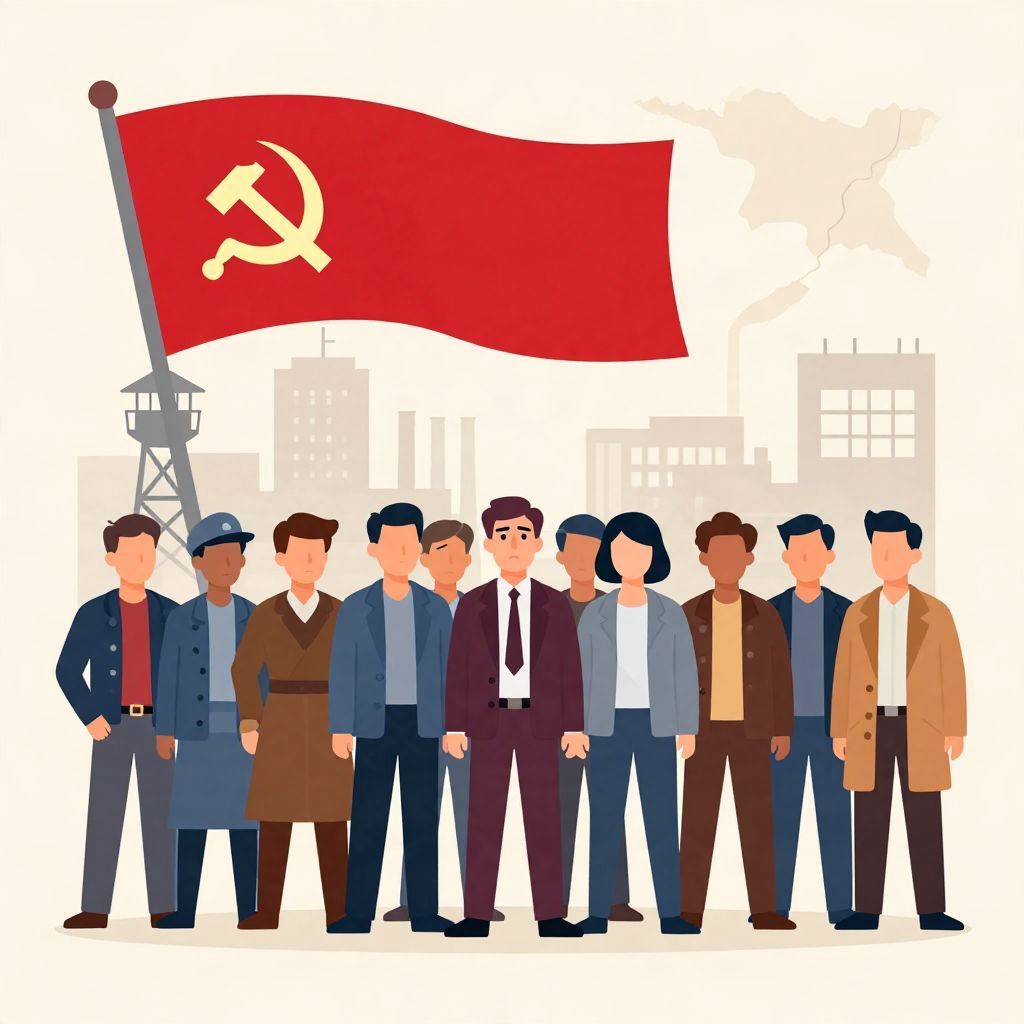
Why is communism hated? The short historical answer is that many people associate it with authoritarian rule, political repression, economic shortages, and mass violence in states that claimed to build communism. Those experiences shaped public memory far more than the theory itself.
At the same time, communism has also been defended as an ideal of equality and workers’ power. To understand why it became so controversial, it helps to separate the original ideas from the governments that ruled in its name.
Why is communism hated?
Communism is often hated because the 20th century produced several communist states that became one-party dictatorships, restricted freedoms, and in some cases caused famine, terror, prison camps, and millions of deaths. Critics judge communism by these historical outcomes, while supporters argue that many abuses came from authoritarian leaders rather than the theory alone.
What communism was supposed to be
In its classic form, communism was a revolutionary political and economic theory associated most strongly with Karl Marx and Friedrich Engels in the 19th century. They argued that capitalism created class conflict between owners and workers, and that history would move toward a classless society without private ownership of the means of production.
The ideal versus the state
In theory, communism promised equality, shared wealth, and the eventual disappearance of exploitation. In practice, however, the states that called themselves communist usually passed through a “socialist” stage led by a revolutionary party. That transition gave enormous power to the party, security services, and state planners. This gap between ideal and reality is central to why communism became so disliked.
The Russian Revolution and the birth of communist rule
The most important turning point came in 1917, when the Bolsheviks, led by Vladimir Lenin, seized power in Russia during the upheaval of World War I. Russia was exhausted by war, hunger, and political collapse. The Bolsheviks promised “peace, land, and bread,” but once in power they faced civil war and used harsh measures to survive.
Violence during revolution and civil war
From 1918 to 1921, Russia was torn by civil war between the Bolshevik Red Army and anti-Bolshevik forces. Both sides committed violence, but the Bolsheviks also built a system of political policing and repression that became a model for later communist regimes. The message many observers took from this period was that communist revolution led not to freedom, but to coercion.
Why communist governments became feared
Communist governments often claimed that they were building a better society, but they tended to concentrate power in the party and suppress rivals. That structure made it difficult to criticize leaders, correct policy failures, or change course peacefully. Over time, this produced a pattern that shaped global opinion.
1. One-party rule and loss of political freedom
In many communist states, opposition parties were banned or neutralized. Elections, where they existed, were tightly controlled. Newspapers, radio, unions, and schools were brought under party influence. For many people, communism came to mean the loss of basic political rights: free speech, free association, and the ability to replace leaders without violence.
2. Secret police and surveillance
Communist regimes commonly relied on secret police to monitor society and eliminate dissent. In the Soviet Union, agencies such as the NKVD became symbols of fear. Similar institutions appeared in Eastern Europe, China, North Korea, Cambodia, and elsewhere. Even when not every citizen was directly targeted, the atmosphere of surveillance made many people view communism as inherently oppressive.
3. Purges, prisons, and labor camps
Under Joseph Stalin, the Soviet Union carried out the Great Terror in the 1930s, during which real and imagined enemies were arrested, exiled, or executed. Millions passed through the Gulag labor camp system over time. Other communist states also used prison camps and forced labor. These experiences left a lasting moral stain on the ideology’s reputation.
Economic failures and everyday hardship
Another major reason communism is hated is that centrally planned economies often struggled to provide abundance, choice, and efficiency. Communist leaders promised to end poverty and inequality, but many citizens instead experienced shortages, low-quality goods, and rigid bureaucracy.
Shortages and planning problems
Central planning gave the state control over production, prices, and distribution. In theory, this could direct resources fairly. In practice, planners often lacked accurate information, incentives were weak, and local officials falsified reports to meet targets. The result in many places was chronic scarcity of food, housing, and consumer goods.
Famine and forced collectivization
The worst example came in the Soviet Union during forced collectivization in the early 1930s. Peasants were pushed into collective farms, resistance was crushed, and agricultural disruption contributed to catastrophic famine, especially in Ukraine and other regions. Historians debate the exact balance of policy failure, coercion, and intent in different cases, but the human suffering was undeniable. For many people, this became proof that communist economic experiments could be deadly.
Mass violence in the name of ideology
Communism’s reputation was also shaped by regimes that used revolutionary language to justify extreme violence. This was not unique to communism—many ideologies have been used to excuse brutality—but communist states often claimed moral certainty, which made their crimes especially shocking to critics.
Stalinism in the Soviet Union
Stalin transformed the Soviet state into a highly centralized dictatorship. Industrialization and military power increased, but at enormous human cost. Forced labor, deportations, show trials, and political executions became part of the system. The Soviet victory over Nazi Germany in World War II later made the USSR a superpower, but it did not erase memory of terror at home.
Maoist China
In China, Mao Zedong led the Communist Party to victory in 1949. His rule brought land reform and state-building, but also disastrous campaigns. The Great Leap Forward (1958–1962) aimed to accelerate industrial and agricultural transformation, yet it contributed to one of the worst famines in modern history. The Cultural Revolution (1966–1976) then unleashed political chaos, persecution, and destruction of cultural life. These events deeply influenced global hostility toward communism.
Cambodia under the Khmer Rouge
Between 1975 and 1979, the Khmer Rouge under Pol Pot attempted to remake Cambodian society through radical agrarian revolution. Cities were emptied, intellectuals were targeted, and mass death followed through execution, starvation, and exhaustion. This became one of the clearest examples of communist-inspired rule turning into genocide and total social collapse.
The Cold War made communism a global enemy
Communism was not hated only because of events inside communist countries. During the Cold War, it became the main ideological rival of the United States and its allies. Anti-communism was promoted through diplomacy, propaganda, military alliances, and domestic politics, especially after World War II.
Fear of expansion
After 1945, the Soviet Union established influence over Eastern Europe, and communist parties gained strength in parts of Asia, Africa, and Latin America. To many in the West, communism appeared not just as a domestic system but as a global expansionist threat. The Korean War, the Vietnam War, and the Soviet invasion of Afghanistan reinforced that fear.
Propaganda and public memory
Western governments highlighted communist repression to rally support against the Soviet bloc. At the same time, communist states portrayed capitalism as exploitative and imperialist. The result was a long propaganda battle in which each side emphasized the other’s crimes. Because the Soviet Union collapsed in 1991, while many communist-era abuses remained vivid in memory, anti-communist narratives often became dominant in public culture.
Why some people still defend communism
It is important to note that not everyone who supports communism ignores its history. Some defenders argue that the worst atrocities came from specific leaders, not from the idea of equality itself. Others point out that many communist movements emerged in societies marked by poverty, colonialism, war, or extreme inequality.
Appeal to justice and equality
Communism has appealed to people who wanted land reform, worker protection, literacy, healthcare, and an end to inherited privilege. In places where capitalism seemed to mean exploitation, communism could look like liberation. That helps explain why communist parties and revolutions gained support in the first place.
The problem of implementation
Still, a recurring historical problem was that revolutionary parties claimed to represent the people while eliminating pluralism. Once a party monopolized power, it often became difficult to challenge mistakes or abuses. This is why many historians distinguish between communist ideals and communist regimes, even if the two were often linked in practice.
Why the hatred persists today
Communism remains controversial because its historical record is tied to some of the 20th century’s most traumatic events. For people whose families suffered under Stalinism, Maoism, the Khmer Rouge, or other communist governments, the ideology is remembered not as a theory of fairness but as a system of fear. That memory is powerful and often passed down across generations.
Different countries, different memories
Public attitudes toward communism vary by region. In Eastern Europe, the collapse of communist rule was often welcomed as liberation. In China, the official party remains communist, but the state has moved far from classic Marxist economics. In parts of Latin America and elsewhere, some leftist movements still use communist language while rejecting earlier authoritarian models. So the hatred of communism is not universal, but it is historically understandable.
The historical answer in one sentence
Communism is hated because the regimes that claimed to build it frequently produced dictatorship, repression, shortages, and mass death, especially in the Soviet Union, Maoist China, and Cambodia, even though the original theory promised equality and liberation.
Seen historically, the hostility toward communism is not just a matter of ideology; it comes from lived experience, political memory, and the gap between revolutionary promises and authoritarian outcomes. If you want to explore related Cold War history, you may also be interested in why Hitler invaded the Soviet Union and why Marie Antoinette was killed.