
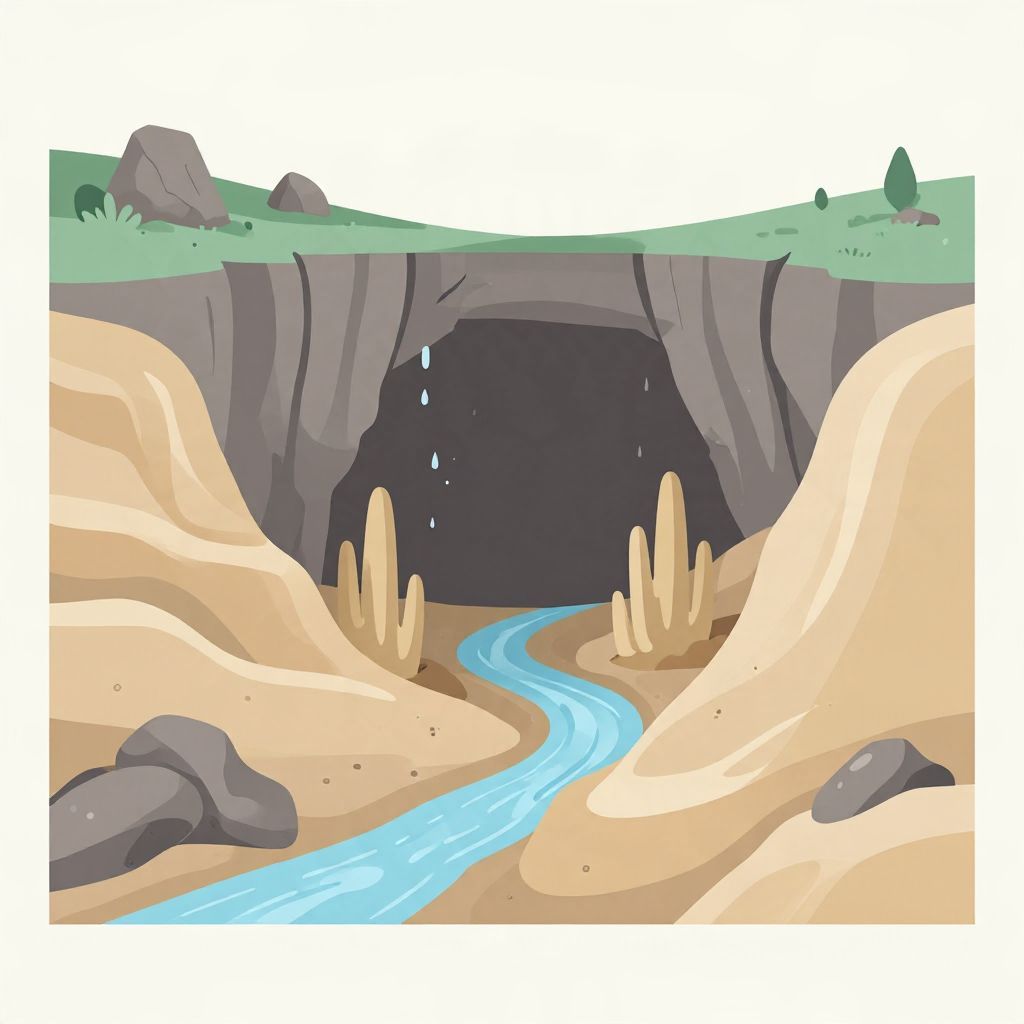
How did Lerakuty Cave form? The short answer is that it was created by natural geological processes over a very long time, most likely through the slow dissolution of soluble rock by water, followed by erosion and collapse in places. Like many caves, its present shape is the result of climate, groundwater movement, rock type, and time rather than a single dramatic event.
Because the name Lerakuty Cave does not appear in widely standardized historical or geological reference works, the safest explanation is a general one based on how caves of this kind typically form. The exact local details may depend on the cave’s rock layers, water sources, and regional geology, but the underlying story is a familiar one in earth history.
How Lerakuty Cave Formed
Lerakuty Cave most likely formed when slightly acidic water seeped into cracks in soluble rock, gradually widening them into passages and chambers. Over thousands to millions of years, flowing groundwater could dissolve limestone or similar rock, while occasional roof collapses and surface erosion enlarged the cave and gave it its current shape.
The basic process: water, rock, and time
Most caves do not begin as empty spaces. They begin as tiny fractures in rock. Rainwater absorbs carbon dioxide from the air and soil, becoming weakly acidic. When this water enters limestone, dolomite, or other soluble rocks, it slowly dissolves the mineral material. The cracks widen, water flows more easily, and the process accelerates.
In a cave like Lerakuty, this chemical weathering is usually the main engine of formation. The underground passages may have started as narrow joints or bedding planes. As water kept moving through them, the openings expanded into tunnels, chambers, and connecting corridors. This is why many caves have winding routes rather than straight, uniform halls.
Why limestone caves are so common
If Lerakuty Cave is a limestone cave, that would fit a very common pattern in karst landscapes. Karst is terrain shaped by the dissolution of soluble rock. It often includes sinkholes, underground streams, springs, and caves. Limestone is especially prone to this kind of erosion because it reacts with weak carbonic acid in groundwater.
In karst regions, caves often form below the water table first, where groundwater flows under pressure. Later, as land rises, rivers cut deeper, or climate changes, the water table drops and the cave becomes air-filled. That transition can leave behind dry chambers, dripstone formations, and collapsed sections. Lerakuty Cave may preserve some or all of these stages.
What geological conditions would have shaped Lerakuty Cave?
The cave’s formation would have depended on a combination of rock type, fractures, groundwater flow, and regional uplift or erosion. If the surrounding rock was thick, fractured limestone, water could move through it efficiently. If the landscape later changed, the cave may have been exposed, enlarged, or partially collapsed.
Rock structure matters
Caves form faster where rock already has weaknesses. Natural joints, faults, and bedding planes give water pathways to follow. Instead of dissolving rock evenly, water enlarges these existing lines of weakness. Over time, a network of cracks can become a connected cave system.
This means the shape of Lerakuty Cave would not be random. Its passages likely reflect the structure of the host rock. A narrow fissure can become a vertical shaft. A horizontal bedding plane can become a long corridor. A fault zone can create a broader, more irregular chamber.
Groundwater did most of the work
Underground water is central to cave formation. At first, water may have moved through the rock slowly and invisibly. Later, as passages widened, the flow increased. In some caves, underground streams continue to shape the cave today, carrying sediment and dissolving new channels.
If Lerakuty Cave is now dry, that does not mean water was unimportant. It simply means the active water flow may have shifted elsewhere. Many caves are “fossil” caves in the geological sense: they are no longer actively enlarging in the same way, but they preserve evidence of older water routes.
Collapse can change a cave’s appearance
Even after dissolution creates a cave, gravity keeps working. Roof sections can weaken and fall, especially where the cave roof becomes too thin or where surface water changes the rock’s stability. Collapse can widen entrances, create sinkholes above the cave, and produce piles of breakdown rock inside.
If Lerakuty Cave has large openings or irregular chambers, some of that shape may come from collapse rather than dissolution alone. In many caves, the final appearance is a combination of chemical carving and mechanical breakdown.
How long did it take?
Cave formation is usually measured in very long spans of time. It is rarely possible to assign a precise date to a cave’s origin unless the geology has been carefully studied. For a cave like Lerakuty, the process likely unfolded over thousands to millions of years, depending on the age of the surrounding rock and the pace of erosion.
A slow process with multiple stages
- Cracks formed in the rock through tectonic stress, cooling, or sedimentary layering.
- Water entered those cracks and began dissolving the rock.
- Passages widened as groundwater circulated repeatedly.
- Chambers expanded where flow was strongest or where rock was weaker.
- Collapse and erosion reshaped the cave after parts of the roof weakened.
- Modern conditions stabilized or altered the cave, leaving the form seen today.
This long timeline is important because caves are not usually products of a single era. They may begin deep underground in one geological period and become visible at the surface much later. The cave we see today is the latest chapter in a much older story.
Could Lerakuty Cave have formed in another way?
Yes. While dissolution in soluble rock is the most likely explanation for a cave of this type, not every cave forms the same way. Some caves are lava tubes created by flowing volcanic rock. Others are sea caves cut by waves into coastal cliffs. A few are formed by glaciers, wind, or a combination of processes.
Why karst formation is still the best fit
Without specific evidence that Lerakuty Cave is volcanic or coastal, the most reasonable interpretation is karst formation. That is the most common origin for inland caves worldwide. It also matches the way most long, branching cave systems develop: through groundwater dissolving rock over immense periods.
Popular accounts sometimes describe caves as if they were “dug out” by a river or “opened” by a collapse. Those descriptions can be useful shorthand, but they can also hide the real process. In geological terms, caves are usually sculpted gradually, not excavated all at once.
What evidence would confirm the cave’s origin?
To determine exactly how Lerakuty Cave formed, geologists would look for clues in the rock and sediment. These clues can reveal whether the cave was made by groundwater dissolution, surface collapse, stream erosion, or another process. The cave’s minerals, fossils, and passage shapes all matter.
Key signs geologists study
- Rock type — limestone, dolomite, gypsum, or volcanic rock point to different formation processes.
- Passage shape — rounded tubes often suggest water flow; sharp, irregular forms may indicate collapse.
- Sediment layers — mud, sand, and gravel can show how water moved through the cave.
- Speleothems — stalactites and stalagmites indicate periods when the cave was air-filled and dripping water deposited minerals.
- Faults and joints — structural weaknesses explain why passages formed where they did.
These observations help separate established evidence from guesswork. If a cave has not been fully surveyed or published in geological literature, it is better to speak in terms of likely formation rather than absolute certainty.
What Lerakuty Cave tells us about earth history
Even when a cave’s exact local history is not fully documented, its formation reveals a great deal about the landscape around it. A cave implies the presence of water, soluble rock, and a long period of geological change. It also shows that the surface we see today is only one layer of a much deeper history.
For this reason, Lerakuty Cave should be understood not as a static hole in the ground, but as a record of environmental change. Its passages may preserve evidence of ancient groundwater routes, shifts in climate, and the gradual reshaping of the land above it. In that sense, the cave is both a landform and an archive.
Why the formation of Lerakuty Cave matters
The story of Lerakuty Cave is a reminder that geology often works on scales far beyond human experience. What looks permanent to us can be the result of extremely slow change. Water, rock, and time can create landscapes that seem sudden only because the full process is too long for a single lifetime to witness.
So, how did Lerakuty Cave form? Most likely through the long-term dissolution of soluble rock by groundwater, followed by erosion and collapse that shaped its present form. If you want to explore related geological histories, you may also be interested in how Mount Everest was formed and how Havajazon formed.