
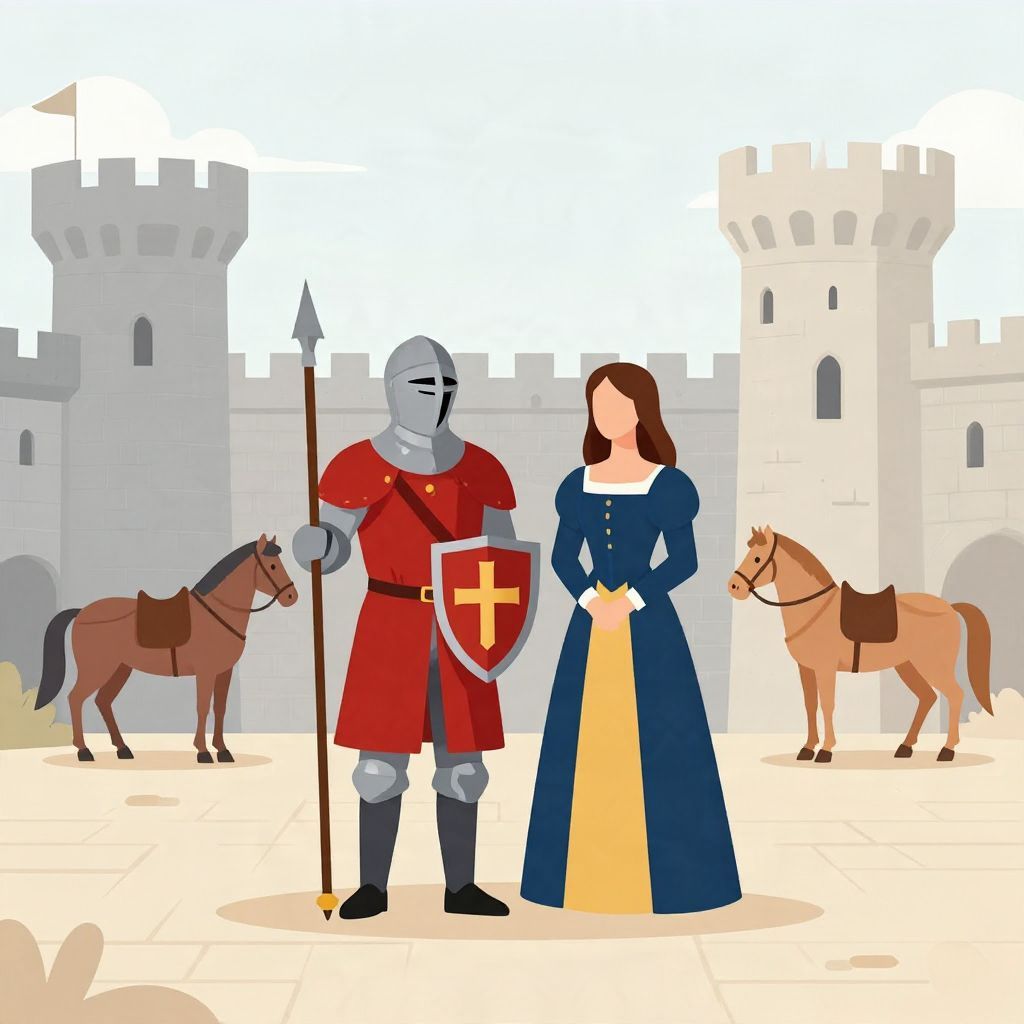
What does chivalry mean? The word is often used today to describe polite, respectful behavior, especially toward women, but historically it meant much more. Chivalry was a medieval code tied to knights, warfare, religion, and aristocratic ideals in Europe.
Its meaning changed over time. What began as a practical warrior ethic in the Middle Ages later became a literary ideal of honor, courtesy, and noble conduct, and eventually a modern shorthand for manners.
What Does Chivalry Mean?
Historically, chivalry was the code and culture associated with medieval knights in Europe, combining military skill, loyalty, courage, religious devotion, and proper social behavior. The word comes from the French chevalerie, linked to cheval, meaning “horse,” because knights were mounted warriors. In modern use, it usually means courteous or gallant behavior.
The Medieval Origins of Chivalry
Chivalry developed in Western Europe during the High Middle Ages, roughly from the 11th to the 13th centuries, when mounted warriors became a powerful military elite. It was not a single written law followed everywhere. Instead, it was a set of ideals shaped by feudal society, the Church, and aristocratic culture.
Knighthood depended on horses, armor, land, and service. In a world of local lords, castles, and frequent warfare, mounted fighters were valuable military assets. Over time, society tried to regulate their violence by tying it to duty, discipline, and honor.
From Warrior to Knight
Early medieval mounted fighters were not always “knights” in the later romantic sense. The knightly class gradually emerged as military technology, landholding, and social rank became more closely connected. By the 12th century, knighthood had become a recognized status in many parts of Europe, especially in France, England, and the German lands.
As this class gained prestige, writers and churchmen began to define how such warriors should behave. The result was chivalry: an ideal that tried to shape force into a moral and social order.
What Did Chivalry Include in the Middle Ages?
Medieval chivalry usually included loyalty to one’s lord, bravery in battle, protection of the weak, generosity, piety, and courtesy. These ideals were often celebrated in literature, but they were not always practiced. Many knights behaved brutally in war, and the code was as aspirational as it was real.
Core Chivalric Values
- Military courage — facing danger and fighting skillfully.
- Loyalty — serving a lord, king, or cause faithfully.
- Honor — maintaining reputation and social standing.
- Courtesy — polite conduct in courts and social settings.
- Religious devotion — supporting Christian ideals and institutions.
- Protection — defending women, the poor, clergy, and the vulnerable, at least in theory.
These values were not evenly applied. The “protection of the weak,” for example, was often selective and idealized. Medieval warfare could be destructive, and knights were not always gentle or restrained. Still, the code mattered because it offered a standard by which noble conduct could be judged.
How the Church Shaped Chivalry
The medieval Church played a major role in shaping chivalry. Church leaders were deeply concerned about violence in feudal Europe, where armed nobles often fought one another. Rather than trying to eliminate warfare entirely, the Church helped redirect knightly violence toward approved purposes such as defending Christian lands or participating in crusades.
This is one reason chivalry became linked with religion. Knights were expected to see themselves not just as fighters, but as Christian warriors with moral responsibilities. Ceremonies such as the blessing of arms or the dubbing of knights reinforced this sacred dimension.
Crusades and Religious Warfare
The Crusades, beginning in 1095 after Pope Urban II’s call for armed pilgrimage to the Holy Land, gave chivalry a powerful religious frame. Knights were encouraged to fight for faith, not merely for personal gain. In practice, crusading could be violent and politically complex, but it helped connect knighthood with holy purpose in European imagination.
At the same time, the Church also promoted peace movements such as the Peace and Truce of God, which sought to limit violence against noncombatants and sacred spaces. Chivalry emerged partly from this tension between aristocratic warfare and religious restraint.
Chivalry in Literature and Romance
Much of what people imagine as chivalry comes from medieval literature rather than battlefield reality. Courtly romances, epic poems, and later stories helped create the image of the noble knight who was brave, loyal, and devoted to a lady. These works shaped the cultural meaning of chivalry across Europe.
Stories of King Arthur, the Knights of the Round Table, and other legendary figures did not simply reflect history; they helped invent an idealized version of it. Writers used knights to explore honor, temptation, faith, and social order.
Courtliness and “Courtly Love”
By the 12th and 13th centuries, chivalry was increasingly linked to court etiquette and the behavior of nobles in refined settings. This included speech, dress, gift-giving, and manners. The idea of “courtly love” also became associated with chivalric culture, though it was more a literary convention than a universal social rule.
In these stories, a knight might serve a noble lady with devotion, restraint, and admiration. This was not always about real relationships; it was often a stylized literary language that connected love, status, and self-control.
Was Chivalry Real or Just an Ideal?
Chivalry was both real and idealized. Medieval nobles did adopt codes of conduct, and ceremonies of knighthood were meaningful. But the historical record shows that knights often ignored the very standards they were supposed to uphold. Chivalry was therefore less a perfect description of behavior than a social ideal used to guide and judge elite men.
That gap between ideal and reality is important. A knight might be praised for generosity in one context and condemned for cruelty in another. Chivalry did not eliminate violence; it tried to make violence socially acceptable within a hierarchical Christian society.
Why the Ideal Mattered
The code mattered because it gave the nobility a moral language. It helped justify privilege by linking rank to responsibility. A nobleman was not simply powerful; he was supposed to be honorable, disciplined, and protective. In that sense, chivalry was also a political and social tool.
How the Meaning of Chivalry Changed Over Time
By the late Middle Ages and early modern period, the military role of knights declined as gunpowder, professional armies, and changing warfare reduced the importance of armored cavalry. Chivalry did not disappear, but it shifted from a warrior code into a broader ideal of noble behavior, especially in courts and literature.
During the Renaissance and later centuries, writers often treated chivalry nostalgically, as a lost age of honor. By the 18th and 19th centuries, the word could describe gentlemanly conduct, romantic gallantry, or old-fashioned courtesy. In modern English, it often refers to polite gestures, especially toward women, though that usage is only one small part of its history.
Modern Uses of the Word
Today, someone may say a person is “chivalrous” if he opens a door, offers help, or behaves in a courteous way. This modern sense is much narrower than the medieval one. It keeps the ideas of respect and gallantry, but drops the military, feudal, and religious dimensions that once defined the term.
Because of this change, modern discussions of chivalry can be confusing. Some people use it positively as a sign of kindness; others see it as outdated or tied to gender roles. Historically, both reactions make sense, because the word has carried different meanings in different eras.
Common Myths About Chivalry
Popular culture often simplifies chivalry into a few romantic images. The real history is more complicated.
- Myth: Chivalry always meant treating women politely.
Reality: Medieval chivalry was mainly about knightly conduct, not modern dating etiquette. - Myth: All knights followed a strict code.
Reality: The code was unevenly observed and often idealized. - Myth: Chivalry was purely about honor.
Reality: It also involved religion, class, warfare, and political loyalty. - Myth: Chivalry was the same everywhere in Europe.
Reality: It varied by region, time period, and social context.
Why Chivalry Still Matters in History
Chivalry matters because it shows how medieval societies tried to control violence and define elite identity. It also reveals how ideals can shape reality even when they are not fully obeyed. The code of chivalry helped transform rough mounted warriors into a noble class with social expectations, religious duties, and literary glamour.
Just as importantly, chivalry reminds us that words can change. What began as a medieval system of knightly conduct became a symbol of courtesy, romance, and manners. Understanding that shift helps explain both the Middle Ages and the modern use of the term.
In short, chivalry meant the ideal behavior of knights in medieval Europe: brave, loyal, courteous, and devout. Over time, it evolved into a broader idea of gentlemanly conduct. If you want to see how chivalry fit into the world of nobles, land, and service, you may also like reading about what a feudal system was and what a highwayman was.