
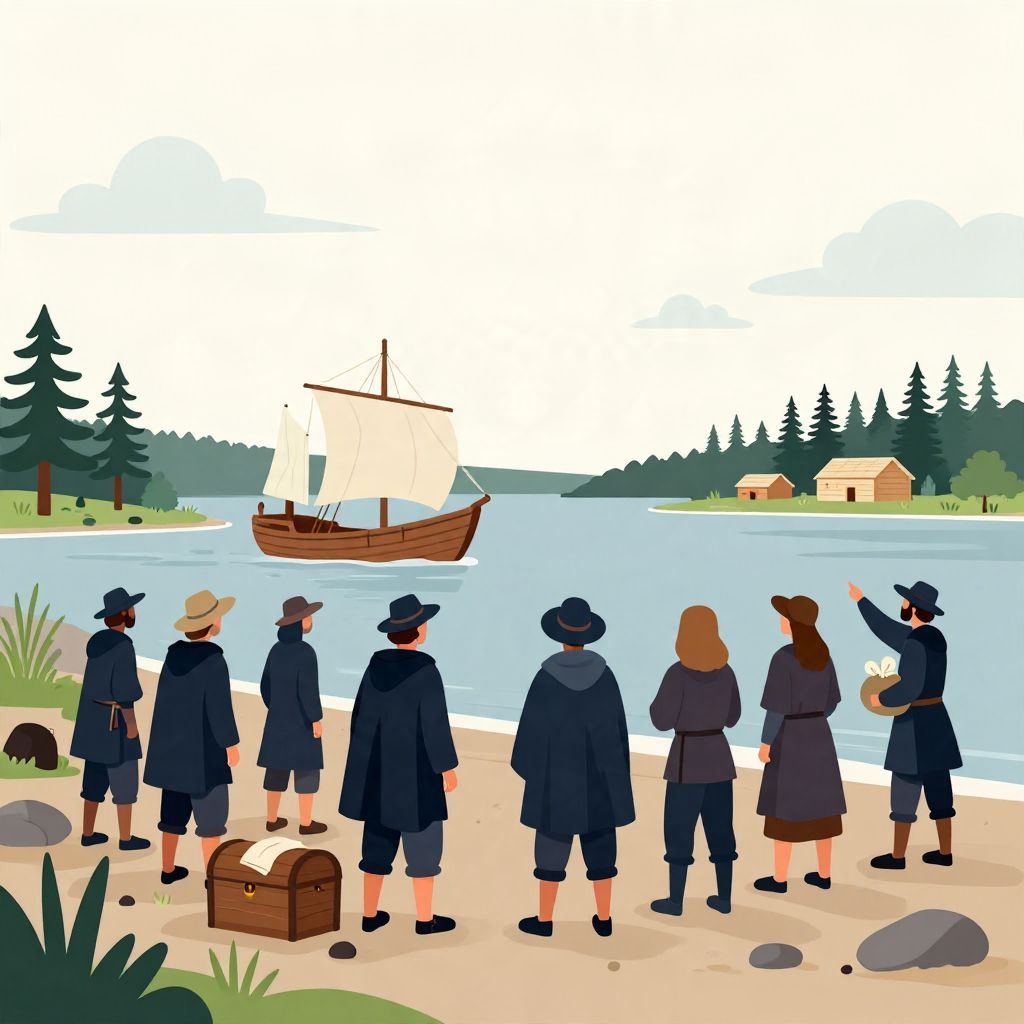
Why did Pilgrims come to America? The short answer is that they were seeking religious freedom, but the full story is more complicated. The Pilgrims were English Separatists who wanted to worship according to their own beliefs, outside the control of the Church of England. Economic pressures, political tension, and the hope of building a stable community also shaped their decision.
Their journey was part of a larger wave of English migration in the early 1600s. They did not come simply to “start Thanksgiving” or because America was empty and waiting for them; they came because Europe was religiously divided, the English government was hostile to dissenters, and the New World offered a chance—though a dangerous one—to begin again.
Why Did Pilgrims Come To America?
The Pilgrims came to America primarily to escape religious persecution and preserve their Separatist faith. After years of pressure in England and exile in the Netherlands, they hoped to create a community where they could worship freely. They also wanted economic survival, political stability, and a future for their children in a place they could govern themselves.
Religious conflict was the main reason
The Pilgrims were not ordinary English Protestants. They were Separatists, meaning they believed the Church of England was too closely tied to Catholic traditions and should be separated from entirely. In the late 1500s and early 1600s, that belief was dangerous. English law expected religious conformity, and dissenters could face fines, imprisonment, or worse.
This is the central reason historians give for their migration. The Pilgrims wanted the freedom to practice their religion in a way they believed was faithful to Scripture. They were not seeking religious liberty for everyone in a modern sense; rather, they wanted space for their own congregation to live according to its convictions.
They had already tried living in the Netherlands
Before coming to North America, many of the Pilgrims fled England and settled in Leiden in the Dutch Republic around 1608. The Netherlands was more tolerant than England, and the group could worship more openly there. But life in exile brought new problems. Work was difficult, money was scarce, and some feared their children would lose their English identity and adopt Dutch customs.
So the move to America was not their first choice. It was the result of years of searching for a place where they could remain both faithful and secure. America seemed remote, difficult, and uncertain, but it also seemed like a place where they might build a community on their own terms.
They wanted more control over their community
Religion was central, but governance mattered too. The Pilgrims wanted to organize their own society without interference from English authorities. That desire helps explain the Mayflower Compact, signed in 1620 before they went ashore at Plymouth. It was not a democratic constitution in the modern sense, but it did show the settlers agreeing to govern themselves for the common good.
In practice, self-government was a survival tool. Because they landed outside the territory of the Virginia Company’s planned settlement, they needed a framework to maintain order. Their compact reflected both religious ideals and practical necessity.
The Historical Context Behind the Migration
The Pilgrims’ decision makes more sense when placed in the broader history of early 17th-century England. This was a period of religious tension after the English Reformation. The Church of England had broken with Rome, but many English Protestants wanted further reform. Separatists went the furthest, refusing to remain in the national church at all.
England was hostile to religious dissent
Under Elizabeth I and James I, religious nonconformity was not treated lightly. Authorities feared that religious division could lead to political instability. Since church and state were closely linked, challenging the church could look like challenging the king. For the Pilgrims, that meant their beliefs were not just unpopular; they were politically risky.
James I especially opposed Separatists. He believed in a unified church under royal authority. That made it difficult for groups like the Pilgrims to imagine a future in England, even if they wanted one.
The New World offered opportunity and danger
North America was not a blank slate, and it was certainly not easy to settle. The Pilgrims knew they would face harsh weather, disease, hunger, and uncertainty. Still, the Atlantic world was opening up, and English colonization was expanding. For people with few good options at home, the colonies offered a chance to start over.
The Pilgrims also hoped to profit enough to survive. Like many early colonists, they were influenced by both spiritual and material concerns. Their migration was not purely idealistic. They needed food, trade, land, and support from investors to make the venture possible.
They were part of a larger migration movement
The Pilgrims were one group among many English settlers moving to North America in the early 1600s. Some came for land, some for business, some for adventure, and some for religion. The Pilgrims were distinctive because their religious motivations were unusually strong and well documented, but they were not alone in seeing America as a place of possibility.
That broader context matters. The Pilgrims’ voyage was not the beginning of European migration to North America, nor was it the last. It was one chapter in a larger story of colonization, conflict, and settlement.
Who Were the Pilgrims?
The term “Pilgrims” usually refers to the English Separatists who settled at Plymouth in 1620. They are often confused with all early New England colonists, but that is not accurate. The group that sailed on the Mayflower was relatively small, and not all of them were religious Separatists. Some were hired workers or “strangers” who joined the voyage for practical reasons.
The Mayflower voyage
In 1620, about 102 passengers sailed from England on the Mayflower. Their destination was supposed to be near the Hudson River, then within the bounds of the Virginia Company’s territory. Storms and navigational difficulties pushed them farther north, and they landed at Cape Cod before eventually settling at Plymouth.
This accident mattered. Because they landed outside their intended jurisdiction, they had to negotiate their own political arrangement. That helped shape the colony’s early identity.
Not everyone on the ship shared the same motives
It is important not to oversimplify the group. The Separatist leaders had religious goals, but the voyage also included servants, laborers, and others who were not part of the original congregation. Some were recruited to help make the colony viable. So while “the Pilgrims” are often described as one unified body, the reality was more mixed.
Even so, the religiously motivated Separatists were the core group whose beliefs shaped the settlement’s purpose and memory.
What Happened After They Arrived?
Arriving in America did not solve the Pilgrims’ problems. The first winter at Plymouth was devastating. Disease, exposure, and food shortages killed many of the settlers. Their survival depended in part on Indigenous knowledge, local ecology, and later cooperation with Native peoples such as the Wampanoag.
Survival came before success
The popular story often jumps quickly from the voyage to celebration, but the colony’s early years were fragile. The Pilgrims were trying to establish a settlement in an unfamiliar environment with limited resources. Their original reasons for coming—religion, stability, and control over their community—were tested immediately by hardship.
Over time, Plymouth endured, though it remained small compared with later English colonies. Its historical importance lies less in size than in symbolism: it became a lasting example of migration driven by religious conviction.
Their legacy was later reshaped
Much of the modern image of the Pilgrims developed long after 1620. The Thanksgiving story, for example, became a powerful national myth in the United States, but it should not be mistaken for the full reason they came. The famous feast of 1621 was a local harvest event, not the purpose of the migration itself.
Later generations turned the Pilgrims into symbols of faith, perseverance, and American origins. Those themes contain some truth, but they also simplify a much more difficult history.
So, Why Did Pilgrims Come To America?
The Pilgrims came to America mainly because they wanted to practice their religion without interference from the English church and state. They also hoped to build a self-governing community, find economic security, and protect their way of life. Their migration was shaped by persecution, exile, opportunity, and the harsh realities of early colonization.
In other words, they came not for one single reason, but because several pressures came together at once. Their story is best understood as a search for religious autonomy in a dangerous and uncertain Atlantic world. If you want to explore related topics, see one reason colonists came to America and where Thanksgiving originated.