
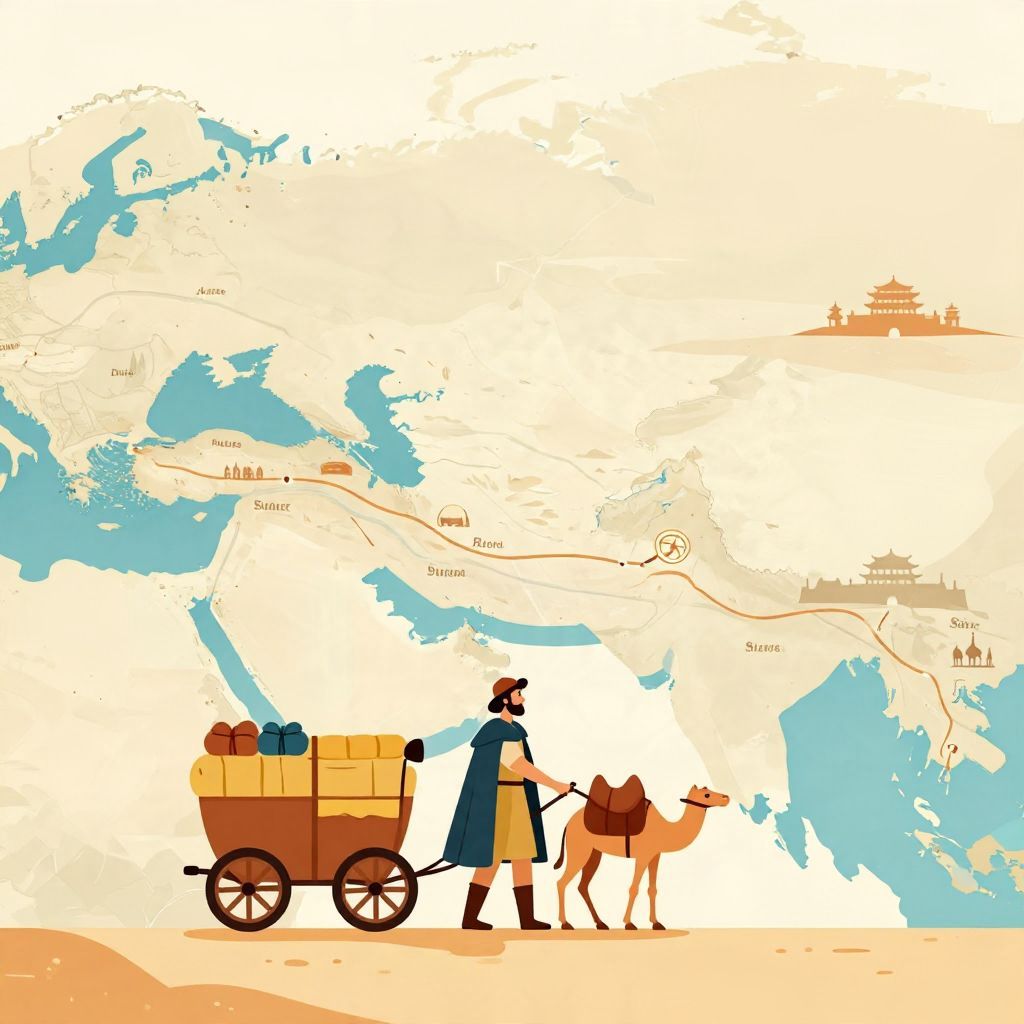
Where did Marco Polo travel? The short answer is that he journeyed from Venice across Central Asia to the Mongol Empire, especially to the court of Kublai Khan in China, and later returned to Europe by a sea route through Southeast Asia and the Indian Ocean. His travels took place in the late 13th century, during a period when Mongol rule linked much of Eurasia.
Because Marco Polo’s account became one of the most famous travel narratives in history, people often ask not only where he went, but also how far he really traveled and what parts of his story are certain. The answer combines well-supported history, later retellings, and some disputed details.
Where Did Marco Polo Travel?
Marco Polo traveled from Venice through the eastern Mediterranean, the Middle East, Persia, Central Asia, and into the Mongol Empire, reaching China under Kublai Khan. On his return, he likely traveled by sea through Southeast Asia, India, and the Persian Gulf before coming back to Venice in 1295. His journey connected Europe and Asia across one of the largest travel networks of the medieval world.
The Main Route of Marco Polo’s Journey
Marco Polo’s route is usually reconstructed from The Travels of Marco Polo, the account dictated after his return. The broad outline is accepted by historians, even though some specific places and episodes remain debated. He did not travel in a straight line, and the journey took years, with long stays in several regions.
From Venice to the Eastern Mediterranean
Marco Polo was born in Venice around 1254, into a merchant family. In 1271, he left with his father Niccolò and uncle Maffeo. Their first stage took them eastward through the Mediterranean world, likely through ports and trade centers that connected Italy to the wider Islamic and Asian worlds.
From there, they moved overland through parts of the Levant and the Middle East. The exact sequence of cities is not fully certain, but the journey would have followed established commercial corridors used by merchants, diplomats, and pilgrims.
Across Persia and Central Asia
After leaving the eastern Mediterranean, the Polos traveled through Persia, then across Central Asia. This was one of the hardest parts of the journey, involving deserts, mountain passes, and long distances between settlements. These regions were under Mongol influence or control, which made long-distance movement more possible than it had been in earlier centuries.
The route likely passed through areas associated with modern-day Iran, Afghanistan, and Central Asian lands before reaching the Mongol domains farther east. Marco Polo’s descriptions of these regions reflect a world of caravan trade, local rulers, and cultural diversity, though some details may have been shaped by oral retelling.
Into the Mongol Empire and China
The most famous part of Marco Polo’s journey was his arrival in the Mongol Empire and his reported service at the court of Kublai Khan. By the time he reached the east, Kublai ruled the Yuan dynasty in China and presided over a vast empire that stretched across much of Asia. Polo’s account places him in northern China and at or near the imperial court for years.
Historians generally accept that the Polos reached the Mongol world and spent significant time there. Whether Marco Polo held the exact official roles described in later tradition is less certain, but his familiarity with the region suggests prolonged contact with Mongol administration and travel networks.
What Places Are Associated with Marco Polo’s Travels?
Marco Polo is linked with a wide range of places across Eurasia. Some are firmly grounded in historical geography, while others are inferred from his narrative. The best-known locations associated with his travels include Venice, the eastern Mediterranean, Persia, Central Asia, the Mongol court, and parts of China.
- Venice — his birthplace and point of departure and return.
- The Levant and eastern Mediterranean — the first stage of the overland journey.
- Persia — a major transit zone on the way east.
- Central Asia — caravan routes, deserts, and steppe corridors.
- China under the Yuan dynasty — the destination most closely associated with his fame.
- Sea routes through Southeast Asia and the Indian Ocean — likely part of his return.
Did Marco Polo Travel to Every Place He Described?
Not necessarily. This is one of the major historical debates surrounding Marco Polo. Scholars generally agree that he traveled far into Asia, but some places in his book may have been reported secondhand, especially regions he may not have visited personally. Medieval travel writing often mixed firsthand observation with information gathered from merchants, officials, and local informants.
That does not make the book unreliable in a simple sense. Instead, it means The Travels of Marco Polo should be read as a medieval travel narrative shaped by memory, translation, and storytelling, not as a modern itinerary with exact coordinates.
The Return Journey: How Did Marco Polo Get Back to Venice?
Marco Polo did not simply retrace his steps. His return was likely by sea, and this is one reason his route is especially important to historians of medieval trade. The return journey probably took him through the South China Sea, Southeast Asia, and the Indian Ocean, before reaching the Persian Gulf and then Europe.
Sea Travel Through Asia
According to the traditional account, Marco Polo and his companions helped escort a Mongol princess by sea. The route may have included ports in Southeast Asia and possibly areas near Sumatra or other island regions. From there, they continued westward across the Indian Ocean.
This sea route mattered because it shows how interconnected Eurasia had become under Mongol power and maritime trade. It also suggests that Marco Polo’s travels were not limited to the overland Silk Road alone, even though that route remains central to his fame.
Back Through the Middle East and Home to Venice
After reaching the Persian region, the Polos likely continued overland or by coastal routes toward the eastern Mediterranean and then back to Venice. They returned in 1295, after being away for about 24 years. By then, Marco Polo was no longer a young merchant but a seasoned traveler with experience across multiple cultural zones.
Why Marco Polo’s Route Mattered in History
Marco Polo’s travels mattered because they revealed the scale of medieval Eurasian connections. His journey took place during the Pax Mongolica, a period when Mongol rule helped stabilize trade routes across much of Asia. Merchants, envoys, religious travelers, and administrators moved more easily than they often had in earlier centuries.
His account also helped shape European ideas about Asia. Even when readers doubted parts of his story, the book expanded knowledge of distant lands, goods, customs, and political systems. It became one of the most influential travel texts of the Middle Ages.
The Silk Road and Long-Distance Exchange
Marco Polo is often associated with the Silk Road, though that term is modern and refers to a network of routes rather than one single road. His travels crossed this broader system of exchange, which linked China, Central Asia, the Middle East, and Europe through trade in silk, spices, precious metals, textiles, and ideas.
For that reason, asking where Marco Polo traveled also means asking how the medieval world was connected. His journey is one of the clearest examples of how merchants and travelers could move across enormous distances in the thirteenth century.
What Can We Say with Confidence?
Historians are most confident about the broad outline of Marco Polo’s travels, not every stop along the way. The evidence strongly supports that he left Venice in 1271, traveled east through the Middle East and Central Asia, reached the Mongol world in Asia, and returned to Venice in 1295. The exact path, especially on the return, is less certain.
Established Points
- Marco Polo was a Venetian merchant traveler born around 1254.
- He left Venice in 1271 with his father and uncle.
- He traveled across Asia and reached the Mongol Empire.
- He returned to Venice in 1295.
- His journey took place during the height of Mongol Eurasian connections.
Uncertain or Debated Points
- Some specific cities and regions in his narrative may come from secondhand reports.
- The exact route of his return voyage is not fully certain.
- Scholars debate the extent of his direct service to Kublai Khan.
Marco Polo’s Lasting Historical Legacy
Marco Polo’s travels became famous not only because of the distance covered, but because they were recorded and retold in a way that fascinated later audiences. His story helped Europeans imagine Asia as a place of powerful empires, rich trade, and complex societies. At the same time, modern historians read his account carefully, separating likely observation from embellishment.
The deeper historical significance of his journey lies in what it reveals about medieval mobility. Marco Polo traveled through a world where empires, caravan routes, and maritime networks made extraordinary distance possible. His path from Venice to Asia and back remains one of the most remarkable journeys of the Middle Ages. For more context, you may also find it useful to read about why the Silk Road was important and the largest empire in history.