
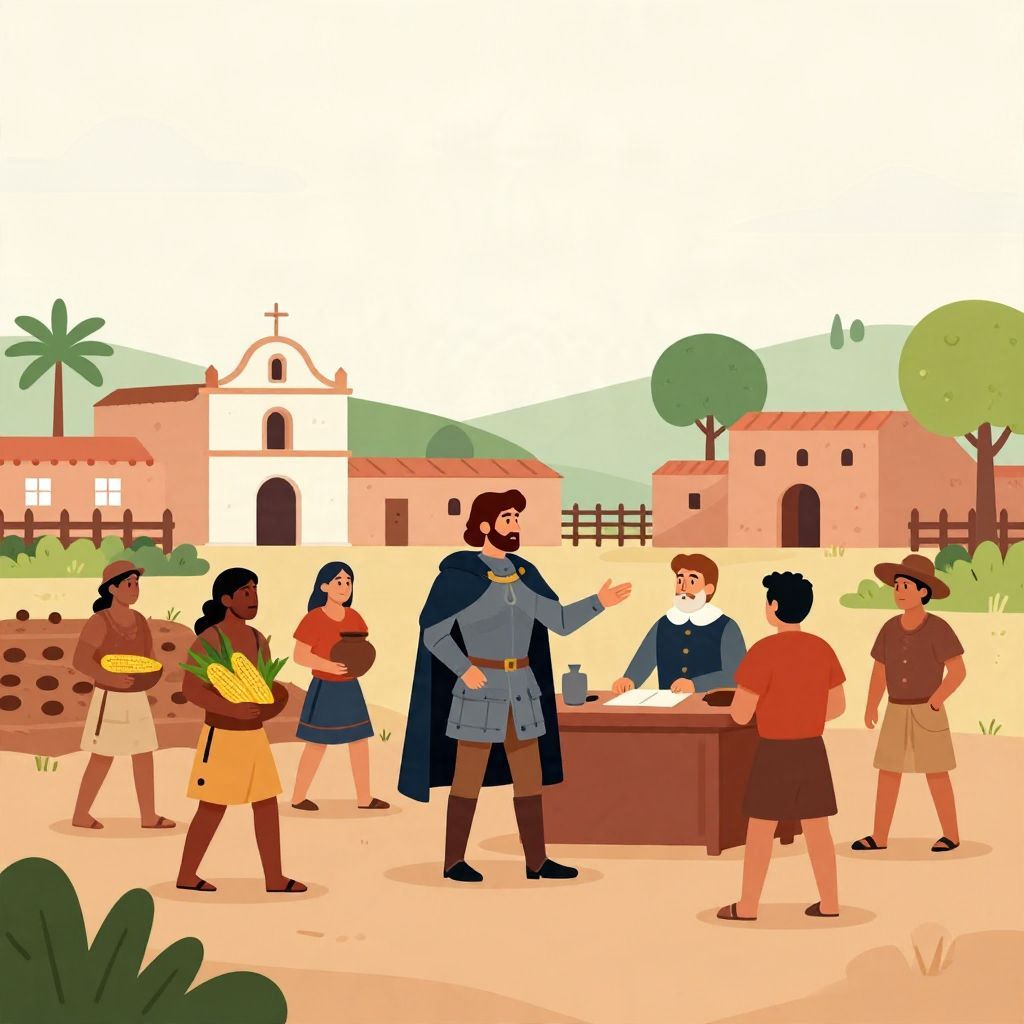
What is encomienda? In the Spanish Empire, it was a colonial labor and tribute system that granted a Spanish settler the right to receive labor, goods, or tribute from Indigenous communities in the Americas. In theory, the arrangement also carried obligations: the encomendero was supposed to protect the people and promote Christian instruction.
In practice, encomienda often became a harsh system of exploitation. It shaped early Spanish colonization in the Caribbean, Mexico, Peru, and beyond, and it left a long legacy in the history of labor, empire, and Indigenous dispossession.
What Is Encomienda?
Encomienda was a Spanish colonial institution that assigned a Spanish individual the right to collect tribute and labor from a specific Indigenous community, usually in return for supposed protection and religious instruction. It was not outright ownership of land or people, but it often functioned like forced labor and became one of the most abusive features of Spanish rule in the Americas.
How Did the Encomienda System Begin?
The encomienda emerged in the early 1500s during Spain’s conquest of the Caribbean and mainland America. Spanish conquerors needed a way to reward soldiers and settlers while extracting wealth from newly conquered territories. The Crown adapted older Iberian practices of tribute and protection, then applied them to colonial conditions in the Americas.
The system developed after the arrival of Christopher Columbus in 1492 and expanded rapidly as Spain established settlements in Hispaniola, Cuba, Mexico, and Peru. Because the Spanish monarchy claimed sovereignty over these lands, it tried to organize colonization through grants that linked labor, tribute, and evangelization.
Origins in Iberia
The word encomienda comes from the Spanish verb encomendar, meaning “to entrust.” In medieval Spain, the term could refer to a grant or charge given to a person or institution. The colonial version borrowed that language of trust and responsibility, but in the Americas it became tied to conquest, tribute, and coercion.
Why the Spanish Crown Used It
Spain faced a practical problem: how to govern vast new territories with limited numbers of Europeans. The encomienda offered a quick way to reward conquistadors, secure local labor, and support settlement. It also fit the Crown’s claim that Spanish rule would bring Christianity and “civilization” to Indigenous peoples, even though the reality was often violent and extractive.
How Did Encomienda Work?
An encomienda granted a Spanish encomendero the right to receive tribute from an Indigenous community. Tribute could take the form of gold, food, textiles, or labor. In exchange, the encomendero was expected to provide military protection and ensure Christian teaching, usually through priests or missionaries. The Indigenous people were not supposed to be enslaved under law, but the distinction was frequently ignored.
The system was typically organized around communities rather than individual households. Spanish authorities assigned villages or groups to an encomendero, who then profited from the tribute. Local Indigenous leaders often had to mediate between colonial demands and community survival, which made the system both administrative and coercive.
Encomenderos and Indigenous Communities
Encomenderos were usually conquistadors, soldiers, or settlers rewarded for service to the Crown. Many became powerful local elites. Indigenous communities, meanwhile, were forced to meet tribute quotas and labor demands while coping with warfare, disease, population collapse, and disruption of traditional political systems.
Not the Same as Land Ownership
One common misconception is that encomienda meant ownership of land. Legally, it did not. The encomendero held rights to tribute and labor, not title to the land itself. In real life, however, the system often encouraged settlers to dominate land, local politics, and labor networks, blurring the legal distinction.
Why Was Encomienda So Important in Spanish America?
Encomienda mattered because it helped Spain establish control over conquered territories quickly and cheaply. It provided labor for mining, agriculture, construction, and transport, and it tied Indigenous communities into the colonial economy. The system also helped create a colonial elite that became influential in local society and politics.
Its importance was especially visible in areas where Spanish colonization depended on extracting wealth from Indigenous labor. In the Caribbean, population collapse made the system unstable. In Mexico and Peru, where larger Indigenous populations and existing tribute systems already existed, encomienda became a major tool of colonial rule.
Connection to Existing Indigenous Tribute Systems
In some regions, the Spanish adapted preexisting tribute arrangements rather than inventing tribute from nothing. For example, in central Mexico the Aztec Empire had already required tribute from subject communities. The Spanish redirected and intensified these obligations for colonial benefit, which made the transition to Spanish rule especially burdensome.
Was Encomienda the Same as Slavery?
Encomienda was not legally identical to chattel slavery, but in practice the difference could be narrow. Indigenous people under encomienda were not supposed to be bought and sold as property, yet they were often compelled to work under harsh conditions with little freedom to refuse. Abuse, overwork, and violence were common.
Because the system relied on coercion, many historians describe it as a form of forced labor or semi-feudal exploitation rather than a benign labor arrangement. The legal language of protection and conversion often masked severe human suffering.
Why the Distinction Mattered to Spaniards
Spanish law and royal policy tried to distinguish encomienda from slavery because the Crown wanted to claim moral authority and control over colonization. By saying Indigenous people were vassals of the king rather than enslaved property, Spanish officials could argue that the empire was just and Christian. In reality, many local officials and settlers treated Indigenous labor as if it were theirs to command.
What Were the Main Abuses and Consequences?
The most serious consequence of encomienda was exploitation. Indigenous communities faced heavy tribute demands, forced labor, displacement, and social disruption. Combined with epidemic disease introduced from Europe, the system contributed to catastrophic population decline in many regions of the Americas.
Encomienda also undermined Indigenous political autonomy. Traditional authorities were often subordinated to colonial demands, and communities had to navigate a new hierarchy that placed Spanish settlers above local leaders. This destabilization affected family life, agriculture, religious practice, and regional economies.
Religious Justification and Cultural Pressure
Spanish colonizers often defended encomienda as part of a Christian mission. Indigenous people were expected to accept instruction in Catholic doctrine, and conversion was presented as a moral justification for colonial rule. Yet evangelization was frequently entangled with coercion, and many Indigenous communities resisted, adapted, or blended Christian and native beliefs in complex ways.
How Did the Spanish Crown Try to Reform It?
As criticism grew, the Spanish Crown attempted to regulate encomienda. Some churchmen and officials argued that the system violated Christian principles. The most famous critic was Bartolomé de las Casas, who denounced the abuse of Indigenous peoples and pushed for reform.
In response, the Crown issued the New Laws of 1542, which aimed to limit hereditary encomiendas and reduce abuses. These reforms did not end exploitation overnight, but they signaled royal concern about the power of encomenderos and the moral legitimacy of colonial rule.
Resistance from Settlers
Many encomenderos resisted reform because the system was central to their wealth and status. In some colonies, enforcement of the New Laws was weak or uneven. This tension between royal authority and colonial elites became a recurring feature of Spanish imperial history.
When Did Encomienda Decline?
Encomienda gradually declined over the 16th and 17th centuries, though its end was uneven and regionally varied. Several factors contributed to its weakening: Indigenous population loss, Crown reforms, the rise of wage labor and other labor systems, and the Spanish monarchy’s desire to limit the independence of colonial elites.
In many places, encomienda was replaced or supplemented by other labor arrangements, including repartimiento, mita, hacienda labor, and wage labor. These systems could also be exploitative, but they reflected changing colonial needs and imperial policy.
From Encomienda to Other Labor Systems
- Repartimiento: a rotational labor draft used in some regions.
- Mita: adapted especially in Andean areas, drawing on pre-Hispanic labor obligations but intensified under Spanish rule.
- Hacienda labor: later agricultural estates that tied workers to land and debt.
What Is the Historical Significance of Encomienda?
Encomienda is significant because it reveals how the Spanish Empire turned conquest into a colonial system of extraction. It helped finance settlement, reward conquerors, and organize early rule, but it also exposed the contradiction between Spain’s Christian claims and the violence of colonial labor exploitation.
Historians study encomienda as part of broader debates about empire, labor, and Indigenous survival. It is often compared to feudalism because of its hierarchy and obligations, but it was not medieval Europe transplanted intact. It was a distinctly colonial institution shaped by conquest, race, religion, and imperial power.
Why It Still Matters
The legacy of encomienda can be seen in later colonial labor systems, in the concentration of wealth among colonial elites, and in long-term patterns of inequality in Latin America. It also remains important for understanding how empires justified domination while claiming to protect and civilize the people they ruled.
Key Facts About Encomienda
- Period: Early Spanish colonial era, mainly the 16th century.
- Region: Spanish America, especially the Caribbean, Mexico, and Peru.
- Purpose: To extract tribute and labor while rewarding Spanish settlers.
- Legal claim: Protection and Christian instruction for Indigenous communities.
- Reality: Frequent coercion, abuse, and forced labor.
- Decline: Gradual, uneven, and replaced by other colonial labor systems.
So, what is encomienda? It was a foundational Spanish colonial labor and tribute system that helped build the early empire in the Americas while inflicting severe harm on Indigenous peoples. To understand it fully, it helps to compare it with feudal systems and with the wider economic logic of mercantilism, both of which shaped European imperial rule.