
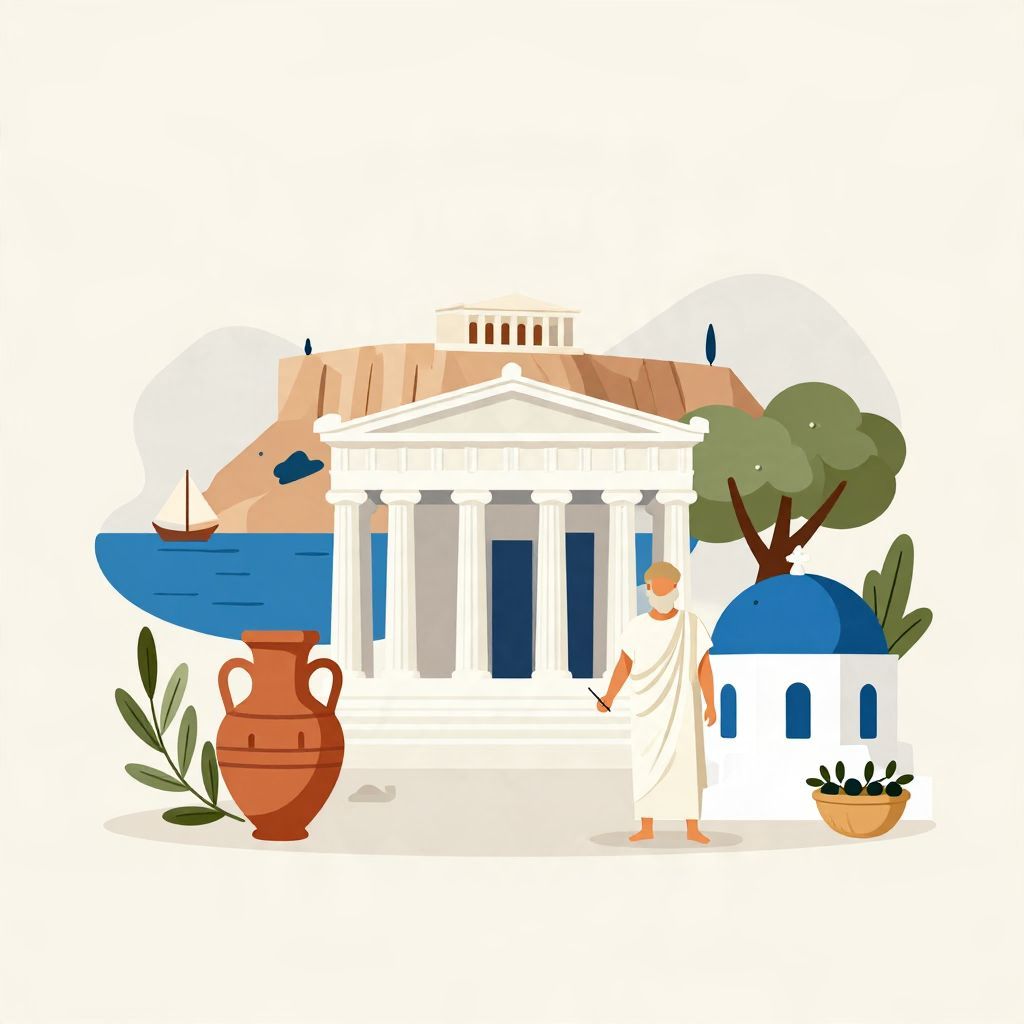
What is Greece known for? The short answer is that Greece is famous for its ancient civilization, its role in the birth of democracy and philosophy, its mythology, its art and architecture, and its lasting influence on Western culture. It is also known today for its islands, cuisine, Orthodox Christian heritage, and a long history shaped by trade, empire, conquest, and resistance.
To understand why Greece is so well known, it helps to look at both ancient and modern history. “Greece” has meant different things over time: a landscape of city-states in antiquity, a province of empires, and a modern nation that emerged in the 19th century after centuries of foreign rule.
What Is Greece Known For?
Greece is best known for ancient achievements in democracy, philosophy, drama, history, mathematics, and architecture, especially in Athens during the 5th century BCE. It is also famous for Greek mythology, the Olympic Games, the Parthenon, and a cultural legacy that deeply shaped Rome and later Europe.
Ancient Greece and Its Lasting Legacy
When people think of Greece, they often mean Ancient Greece, a world of independent city-states such as Athens, Sparta, Corinth, and Thebes. From roughly the 8th century BCE to the conquest by Macedon in the 4th century BCE, Greek communities developed political ideas, literature, and public institutions that became foundational in later European history.
City-states, not one unified kingdom
Ancient Greece was never a single unified state for most of its history. Instead, it was a patchwork of poleis, or city-states, each with its own laws, army, and political system. This competition encouraged innovation, but it also produced frequent warfare and shifting alliances.
The rise of Athens
Athens became especially famous for its experiment in democracy in the 5th century BCE. Its system was limited by modern standards, since women, enslaved people, and foreigners were excluded, but it was still historically important because it gave many male citizens a direct role in political decision-making. That idea became one of Greece’s most enduring legacies.
Greece Is Known For Democracy and Political Ideas
Greece is often called the birthplace of democracy because Athens developed a form of direct citizen rule in the late 6th and 5th centuries BCE. Although it was not democratic in the modern sense, it introduced the idea that political power could belong to citizens rather than only to kings or aristocrats.
Greek political thought also explored different forms of government. Writers and philosophers debated monarchy, oligarchy, tyranny, and democracy, creating a vocabulary that later political systems would borrow and adapt. These debates mattered not just in antiquity but in the long history of constitutional government.
Greek Philosophy, Science, and Learning
Greece is known for major philosophers such as Socrates, Plato, and Aristotle. Their work shaped Western ideas about ethics, logic, politics, education, and the nature of knowledge. Ancient Greek thinkers asked questions about how people should live and how the world works.
Why philosophy mattered
Greek philosophy was not only abstract thought. It developed in a society where public debate, education, and civic life were highly valued. Philosophers often challenged traditional beliefs and sought rational explanations for human behavior and natural phenomena. Their influence spread through Hellenistic kingdoms, Roman education, medieval scholarship, and the modern university tradition.
Mathematics, medicine, and astronomy
Greek scholars also made important advances in mathematics and medicine. Figures such as Euclid and Archimedes became famous for geometry and mechanics, while Hippocrates is traditionally associated with a more systematic approach to medicine. Some of these achievements were built on earlier knowledge from Egypt and Mesopotamia, but Greek thinkers helped organize and expand them in influential ways.
Greek Mythology and Religion
Greece is widely known for its mythology: stories about gods, heroes, and monsters such as Zeus, Athena, Apollo, Heracles, and Odysseus. These myths were not just entertainment. They helped explain the world, express values, and connect communities to sacred places and rituals.
Myth and history are not the same
It is important to distinguish mythology from historical fact. Greek myths preserve cultural memory and imagination, but they are not reliable evidence in the same way as inscriptions, archaeology, or contemporary records. Still, myths mattered deeply in ancient Greek life and continue to shape literature, art, and popular culture today.
Temples, festivals, and sacred sites
Greek religion was polytheistic, with worship directed toward many gods and local cults. Temples, sacrifices, and festivals played central roles in civic life. Sites such as Delphi and Olympia became famous across the Greek world, linking religion with politics, athletics, and identity.
Greek Art, Architecture, and the Parthenon
Greece is known for classical architecture and sculpture, especially the temples and public buildings of the 5th and 4th centuries BCE. The Parthenon on the Athenian Acropolis is one of the most famous monuments in the world and a symbol of classical Greece.
What makes Greek architecture distinctive
Greek builders developed architectural orders such as Doric, Ionic, and Corinthian, which shaped later Roman and European design. Their temples emphasized proportion, harmony, and public visibility. Greek sculpture also became famous for its attention to the human body, movement, and idealized form.
Influence beyond Greece
Roman elites admired Greek art and often copied it. Later European architects revived Greek styles during the Renaissance and again in the 18th and 19th centuries. That is one reason Greece remains associated with “classical” beauty and balance.
The Olympic Games and Athletic Tradition
Greece is known as the birthplace of the ancient Olympic Games, traditionally dated to 776 BCE, though the exact origin is not certain. The games were held at Olympia in honor of Zeus and became one of the most important festivals in the Greek world.
The ancient Olympics were not the same as the modern games, but they helped spread a shared Greek identity across a fragmented region. Athletic competition was tied to honor, religion, and civic pride. The modern Olympic Games, revived in 1896 in Athens, strengthened Greece’s association with international sport.
Greek Literature and Storytelling
Greek literature is another major reason the country is famous. Epic poems such as The Iliad and The Odyssey, traditionally associated with Homer, became central texts in education and culture. Greek drama also produced tragedies and comedies that still influence theater today.
Drama and public culture
Athens hosted dramatic festivals where playwrights like Aeschylus, Sophocles, Euripides, and Aristophanes presented works that examined war, power, justice, and family conflict. These plays were not private entertainment alone; they were part of civic and religious life. Their themes remain recognizable because they deal with universal human problems.
How Greece Shaped the Wider Mediterranean World
Greek influence spread far beyond the Aegean Sea. Through trade, colonization, and conquest, Greek language and culture reached southern Italy, the Black Sea, North Africa, and the eastern Mediterranean. After the conquests of Alexander the Great in the late 4th century BCE, Greek culture became even more widespread in the Hellenistic world.
The Hellenistic age
Alexander’s empire did not last long as a single political unit, but it opened the way for Greek-speaking kingdoms in Egypt, Syria, and beyond. Greek became a major language of administration, scholarship, and commerce. This period helped make Greek culture a bridge between the ancient Near East and the Roman world.
Greece Under Rome, Byzantium, and the Ottoman Empire
Greece is not only ancient history. After Rome conquered the Greek world, Greek culture remained highly influential within the Roman Empire. Educated Romans often admired Greek literature and philosophy, and Greek remained a major language in the eastern Mediterranean.
Later, much of Greece became part of the Byzantine Empire, the eastern continuation of the Roman Empire centered on Constantinople. During this period, Greek Orthodox Christianity became central to identity. After the fall of Constantinople in 1453, Greek-speaking lands gradually came under Ottoman rule, which lasted for centuries in many regions.
Religion and identity in later centuries
Under Ottoman rule, the Greek Orthodox Church helped preserve language, education, and communal identity. This does not mean Greek life was the same everywhere or that all Greeks experienced the same conditions. Local differences were significant, and communities adapted in varied ways to imperial rule.
The Modern Greek State
Modern Greece is known for its struggle for independence from the Ottoman Empire. The Greek War of Independence began in 1821 and led to the creation of an independent kingdom recognized in the 1830s. This was a major turning point, but it did not restore the ancient world; it created a modern nation-state shaped by 19th-century nationalism and European diplomacy.
Why modern Greece matters historically
Modern Greek history includes state-building, wars, migration, and political change. The country expanded its borders over time, especially in the 19th and early 20th centuries. It also experienced occupation during World War II, civil war afterward, and later integration into European institutions. These developments shaped the Greece of today.
What Greece Is Known For Today
Today Greece is known not only for its ancient past but also for its living culture. Visitors associate it with the Aegean islands, whitewashed villages, seafood, olive oil, music, and a strong sense of regional identity. Greek cuisine, shaped by Mediterranean ingredients and long local traditions, is one of the country’s most recognizable cultural exports.
Geography and tourism
Greece’s geography helps explain its fame. Mountains, peninsulas, and thousands of islands created many local cultures and seafaring traditions. The landscape also made agriculture difficult in some areas, encouraging trade, migration, and maritime connections rather than large-scale inland farming. That geography helped shape Greek history from antiquity onward.
Why Greece Still Matters
Greece is known for more than monuments and myths. It is known because so many ideas associated with the ancient world—democracy, philosophy, historical writing, theater, and classical art—were developed or refined there and then transmitted through Rome and later Europe. At the same time, modern Greece has its own distinct history, language, and identity.
In short, Greece is famous because its past has had an unusually long afterlife. From the Acropolis to the Olympics, from Homer to democracy, Greece remains one of the most influential places in world history. If you want to explore related topics, see also why farming was difficult in ancient Greece and what the Seven Wonders were.