
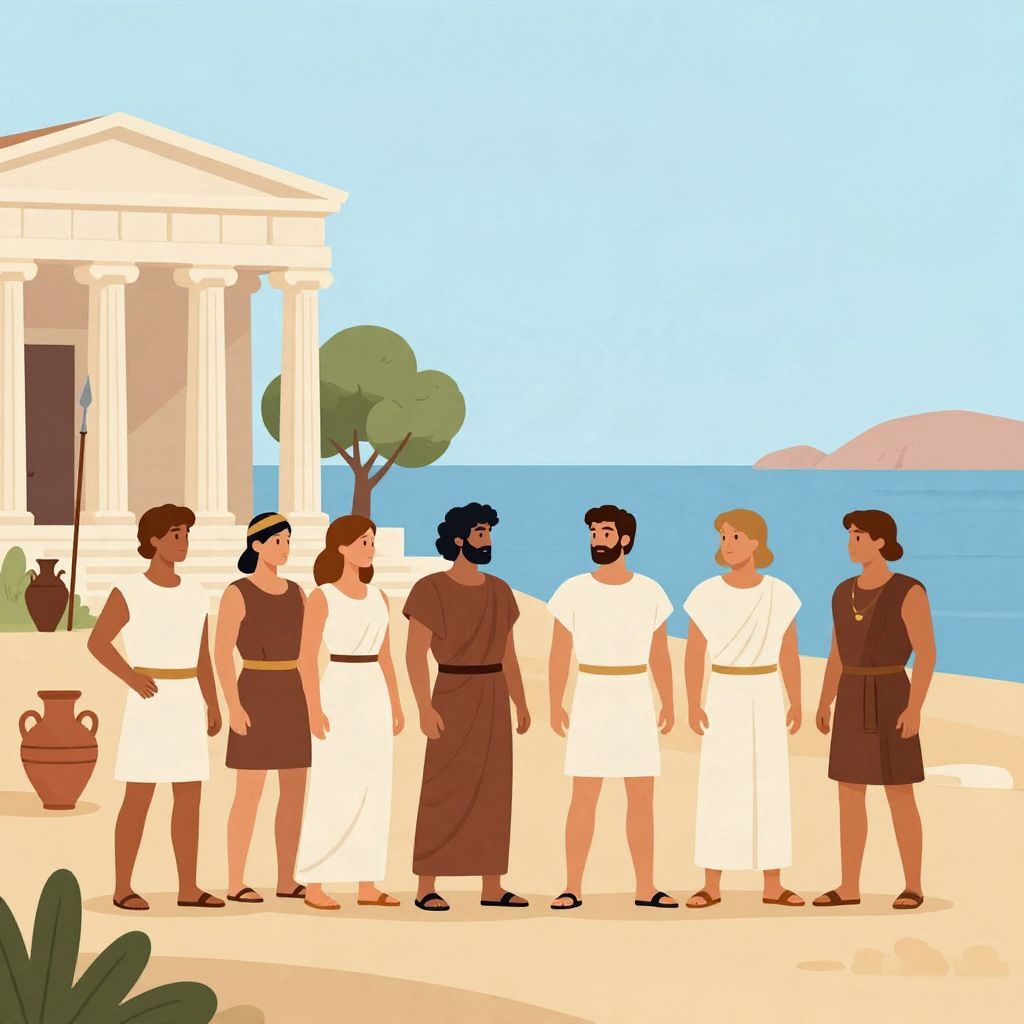
What did ancient Greeks look like? The short answer is that there was no single “Greek look.” Ancient Greece was a collection of city-states spread across the Aegean, mainland Greece, the islands, and later colonies around the Mediterranean, so appearance varied by region, class, age, and era. What we know comes from sculpture, painted pottery, coins, texts, and burials—not from photographs or modern racial categories.
Still, ancient art and archaeology let historians build a careful picture of how Greeks likely appeared in everyday life and how they chose to represent beauty, status, and identity.
What Did Ancient Greeks Look Like?
Ancient Greeks were generally Mediterranean people with a wide range of appearances, including varied skin tones, hair colors, and facial features. Artistic ideals often showed men with athletic bodies and women with balanced, graceful proportions, but these images were stylized. Real people likely differed from the polished figures seen in temples and vases.
The Ancient Greek Body in Art and Reality
Idealized beauty in sculpture and vase painting
The most famous Greek statues do not show ordinary people exactly as they were. Sculptors aimed for harmony, proportion, youth, and physical excellence. Male figures were often shown with broad shoulders, narrow waists, and well-developed muscles. Female figures were usually shown with smooth faces, arranged hair, and elegant drapery. These works reveal Greek ideals more than exact physical averages.
What archaeology suggests about real people
Burials, skeletal remains, and surviving portraits suggest that ancient Greeks were not all identical in appearance. Diet, labor, health, and local ancestry affected height, build, and facial structure. Many people were likely leaner than modern populations because of hard physical work and different nutrition, though elite individuals may have had better diets and health than laborers and slaves.
Skin, Hair, and Eyes: What Can We Actually Know?
Skin tone and sunlight
Ancient Greek art often depicts skin in symbolic ways rather than realistic ones. In vase painting, men are frequently shown with darker or red-brown skin, while women are often shown lighter. This convention reflected social roles—men outdoors, women indoors—not exact complexion. Greeks probably ranged from light olive to darker Mediterranean complexions, as people do across the eastern Mediterranean today.
Hair color and style
Ancient sources and art suggest a variety of hair colors, including dark brown and black, which were likely common. Some texts mention blond or reddish hair, especially in poetic or heroic contexts, but those descriptions may have been idealized or exceptional. Hair was often worn long in earlier periods and later styled in shorter or more controlled forms, especially among men in the classical era.
Eyes and facial features
We cannot reconstruct a single Greek eye color or facial type. Ancient art rarely records eye color accurately, and written descriptions are selective. Like other populations of the eastern Mediterranean, Greeks likely showed a broad mix of features. The idea of one fixed “Greek face” is a modern simplification rather than a historical reality.
How Ancient Greeks Chose to Present Themselves
Clothing as identity
Clothing tells us as much about ancient Greeks as bone structure does. Men commonly wore a chiton, a tunic-like garment, and sometimes a himation, a cloak. Women also wore chitons, often longer and belted, with draped outer garments. Fabric, dye, and ornament signaled wealth and status. A well-dressed Greek in Athens looked very different from a rural farmer or a laborer on a ship.
Hair, grooming, and status
Hair and grooming practices changed over time. In some periods, elite men wore beards as signs of maturity and respectability; in others, clean-shaven faces became fashionable. Women’s hairstyles could be elaborate, especially among the wealthy. Oils, perfumes, combs, and pins were part of personal appearance, showing that “looking Greek” also meant participating in social customs.
Body ideals and athletics
Greek culture placed unusual emphasis on the trained male body, especially in athletic and civic settings. Gymnasia were central to elite male education in many poleis. This did not mean everyone looked like a statue of an athlete, but it helps explain why Greek art so often celebrates youth, symmetry, and physical discipline. The ideal body was tied to citizenship, honor, and self-control.
Did Ancient Greeks All Look the Same?
No. Ancient Greece was never biologically or culturally uniform. It included mainland communities, island populations, coastal settlers, and colonies from the Black Sea to southern Italy and North Africa. Local contact with Phoenicians, Egyptians, Persians, Thracians, Scythians, and others shaped appearance and culture over time. Greek identity was mainly linguistic, civic, and cultural, not based on one fixed physical type.
Regional differences
A person from Sparta, Athens, Miletus, Cyrene, or Sicily could have had different family histories and different local customs. Mountain communities, islanders, and colonial populations all lived in distinct environments. Trade and intermarriage further widened variation. Ancient Greeks therefore should be understood as a diverse population connected by language, religion, and shared traditions, not a single ethnic “look.”
Class, labor, and age
Physical appearance also depended on social position. An aristocrat, a potter, a sailor, a farmer, and an enslaved worker would not have looked the same in dress, posture, or health. Age mattered too: children, young adults, and elders were represented differently in art and likely differed in body shape and grooming. Ancient Greek appearance was shaped by work, diet, and life expectancy as much as by ancestry.
What Ancient Writers Said About Appearance
Literary descriptions were selective
Greek literature does sometimes describe physical traits, but usually in poetic or dramatic ways. Writers might praise beauty, youth, or strength, or use appearance to signal character. These descriptions are not neutral scientific observations. A hero might be described as tall and shining, while a villain might be marked by ugliness or deformity. Such language tells us about values, not reliable population statistics.
Beauty and the moral imagination
In Greek thought, outward appearance could be linked to inner qualities such as self-mastery, nobility, or divine favor. This does not mean the Greeks believed beauty always equaled goodness, but they did often connect bodily form with social and moral ideals. That connection influenced sculpture, athletics, and even political imagery.
How Greek Appearance Changed Over Time
Archaic Greece
In the Archaic period, roughly the 8th to early 5th centuries BCE, art often shows stylized figures with patterned hair and rigid poses. Male kouroi and female korai present idealized youth and symmetry. These statues were not portraits of ordinary people, but they do show how Greeks imagined the human body in a sacred and public setting.
Classical Greece
During the 5th and 4th centuries BCE, Greek art became more naturalistic. Sculptors studied movement, anatomy, and balance. This period produced the most influential images of the Greek body: calm faces, athletic men, and draped women. Even so, these works still idealized. They were meant to express order and excellence, not to document every wrinkle, scar, or local feature.
Hellenistic Greece
After the conquests of Alexander the Great in the late 4th century BCE, Greek culture spread widely and mixed with many others. Hellenistic art became more expressive and varied, showing children, old age, suffering, and individuality. This broader range suggests that Greek visual culture was no longer focused only on ideal youth. It also reflects a more connected Mediterranean world.
How the Greeks Influenced Later Ideas of Beauty
Ancient Greek art deeply shaped later Western ideas about proportion, anatomy, and classical beauty. Renaissance artists, neoclassical sculptors, and modern museums often presented Greek bodies as timeless ideals. But this later admiration can distort history if it makes ancient Greeks seem more uniform than they were. Their actual appearance was diverse, while their art often transformed that diversity into ideal forms.
So, What Did Ancient Greeks Look Like in Everyday Life?
If you had walked through an ancient Greek market, you would likely have seen a wide range of people with Mediterranean features, different skin tones, dark hair common but not universal, and clothing that immediately signaled gender, age, class, and occupation. Some were clean-shaven, some bearded; some wore elaborate garments, others simple work clothes. They would not have looked like marble statues, but their art helps us see what they admired.
The most accurate answer is that ancient Greeks looked like a diverse eastern Mediterranean people whose appearance varied across time, place, and social rank. Their sculpture and literature reveal ideals of beauty and citizenship, while archaeology reminds us that real lives were more varied and ordinary. For related ancient-world comparisons, see what ancient Egyptians looked like and what Julius Caesar looked like.