
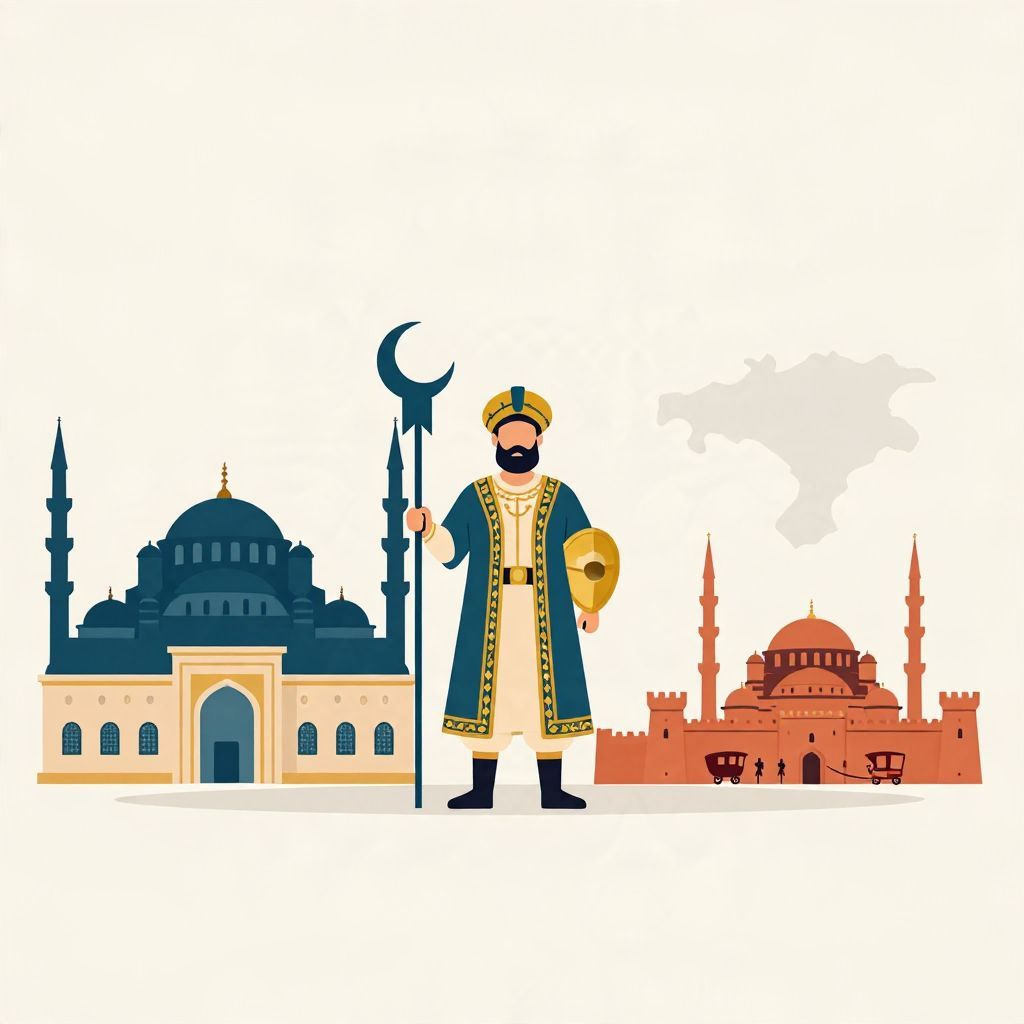
The Ottoman Empire lasted for about 623 years, from around 1299 to 1922. Its long history stretched from a small frontier principality in northwestern Anatolia to a vast imperial state that ruled parts of southeastern Europe, western Asia, and North Africa.
Because its origins were gradual and its end came in stages, historians sometimes give slightly different starting points. But the standard answer is that the Ottoman Empire endured from the late 13th century until the end of World War I and the abolition of the sultanate in 1922.
How long did the Ottoman Empire last?
The Ottoman Empire lasted roughly 623 years, usually dated from 1299 to 1922. That span begins with the rise of Osman I and ends when the Ottoman sultanate was formally abolished. The empire itself was transformed many times, but it remained a major political power for more than six centuries.
When did the Ottoman Empire begin?
The commonly accepted founding date is 1299, associated with Osman I, the dynasty’s namesake. In reality, the Ottoman state emerged gradually from a small Turkish frontier principality in Anatolia after the decline of the Seljuk order and amid the weakening Byzantine frontier. The exact “start” is therefore a historical convention, not a single dramatic founding moment.
Why historians use 1299
There is no surviving founding charter that marks the precise birth of the empire. The date 1299 became standard because it roughly identifies the period when Osman’s household began acting as an independent power. Other dates appear in scholarship, but 1299 remains the most widely used benchmark for the empire’s beginning.
When did the Ottoman Empire end?
The empire ended in stages, but the decisive date is 1922, when the Ottoman sultanate was abolished by the Turkish nationalist government in Ankara. The last sultan, Mehmed VI, left Constantinople shortly afterward. The Ottoman Caliphate survived briefly until 1924, but the empire as a dynastic state had already come to an end.
Why the end was gradual
The Ottoman Empire did not collapse in a single battle. It lost territory over centuries, especially in the Balkans and the Arab provinces, and then suffered catastrophic defeat in World War I. After the war, the Turkish War of Independence and the rise of a new republic made the old imperial system impossible to restore.
How the Ottoman Empire rose to power
The Ottomans began as one of several Turkish principalities on the Byzantine frontier. Their early success came from military flexibility, strategic location, and the ability to absorb people from different backgrounds. Over time, they expanded through conquest, diplomacy, and incorporation of local elites rather than through force alone.
Early expansion in Anatolia and the Balkans
In the 14th century, the Ottomans crossed into Europe and established a durable foothold in the Balkans. They captured Gallipoli in the mid-1300s, expanded into Thrace, and later took Adrianople (Edirne), which became an important capital. Their position between Europe and Asia helped them grow into a transcontinental power.
The conquest of Constantinople
A defining moment came in 1453, when Mehmed II captured Constantinople, the capital of the Byzantine Empire. This victory ended the Byzantine Empire and gave the Ottomans a prestigious imperial center. Constantinople, later Istanbul, became one of the great cities of the early modern world.
The Ottoman Empire at its height
The empire reached its greatest extent and influence in the 16th century, especially under Suleiman the Magnificent. At its peak, Ottoman rule extended across southeastern Europe, Anatolia, the eastern Mediterranean, the Levant, Egypt, and much of North Africa. It was one of the most powerful states in the world.
What made the empire strong
- Centralized administration that linked the sultan, court, and provincial governors.
- Military institutions, including the Janissaries, which gave the state a disciplined core force.
- Tax systems that financed government and military campaigns.
- Religious and legal flexibility that allowed diverse communities to live under Ottoman rule.
- Control of key trade routes connecting Europe, Asia, and the Mediterranean.
How the empire governed diversity
The Ottomans ruled a multiethnic, multireligious population. Muslims, Christians, and Jews all lived within the empire, though not on equal terms. Local communities often kept their own religious leaders and internal customs. This system did not mean modern equality, but it did help the empire manage diversity over a very large territory.
Why did the Ottoman Empire decline?
Ottoman decline was not a simple story of sudden decay. The empire faced military defeats, economic pressures, administrative strain, and the rise of stronger European states. As warfare changed and global trade shifted, the Ottomans struggled to keep pace with rivals that had new technologies, larger fiscal systems, and expanding industrial economies.
Military and political challenges
From the late 17th century onward, the Ottomans increasingly lost ground to Habsburg, Russian, and other European powers. Repeated wars drained resources. At the same time, provincial autonomy grew, and the central government found it harder to control distant territories. Reform efforts helped in some periods, but they could not fully reverse the trend.
Reform and resistance
In the 18th and 19th centuries, Ottoman leaders tried to modernize the army, bureaucracy, and legal system. These reforms were often necessary, but they also created tension with entrenched interests and local populations. Nationalist movements in the Balkans and elsewhere further weakened imperial cohesion.
World War I and the final collapse
The Ottoman Empire entered World War I on the side of the Central Powers and suffered severe losses. The war intensified existing weaknesses and exposed the empire to occupation, rebellion, and partition plans by the victorious Allies. By the end of the conflict, the Ottoman state had effectively lost its independence.
The Treaty of Sèvres and the Turkish War of Independence
The postwar settlement attempted to divide much of the empire among foreign powers and new states. Turkish nationalists rejected this outcome and fought the Turkish War of Independence. Their victory led to the creation of the modern Republic of Turkey and the formal end of the Ottoman dynasty’s rule.
What was the Ottoman Empire’s legacy?
The Ottoman Empire left a deep legacy across the Balkans, the Middle East, North Africa, and Turkey. Its administrative traditions, architecture, cuisine, legal practices, and urban culture shaped the regions it ruled. Many modern borders and political tensions in these areas cannot be understood without the Ottoman past.
Lasting cultural and historical influence
Ottoman mosques, palaces, bridges, and markets still mark cities from Sarajevo to Istanbul. The empire also influenced language, law, and identity in places that once belonged to it. Even where Ottoman rule ended long ago, its history remains central to regional memory and modern politics.
So, how long did the Ottoman Empire last in historical terms?
In the simplest terms, the Ottoman Empire lasted from 1299 to 1922, or about 623 years. That makes it one of the longest-lasting empires in world history. Its longevity came from adaptability: the Ottomans expanded through conquest, governed a diverse population, and repeatedly reinvented their institutions until the pressures of the modern era overwhelmed them.
For readers interested in what brought the empire down, see how the Ottoman Empire fell, or compare its scale with the largest empire in history. The Ottoman story shows how a frontier principality could become a world power—and how even a long-lived empire could eventually give way to a new political order.