
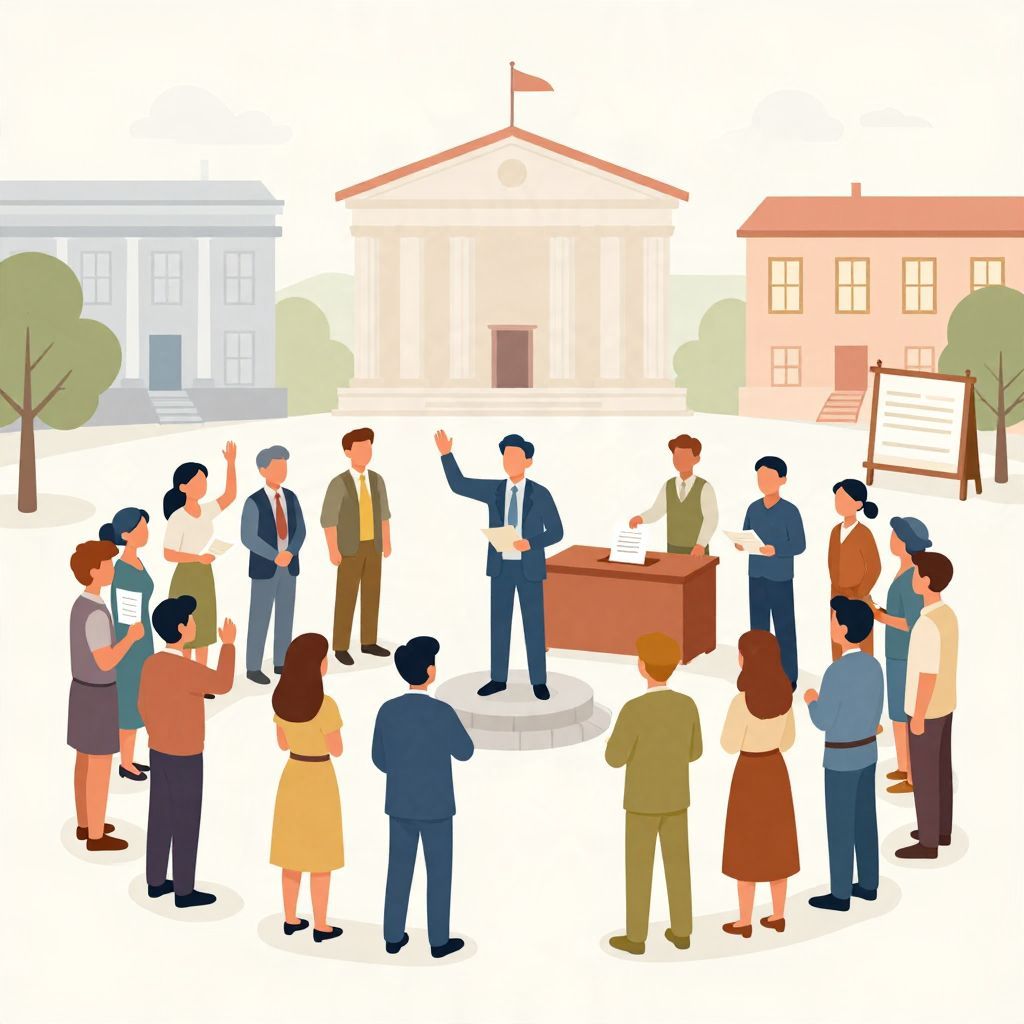
What is political engagement? In history, it means the ways people take part in public life to influence power, policy, and the direction of a state or community. It can include voting, protesting, petitioning, joining parties, attending meetings, writing pamphlets, organizing unions, or serving in office.
Its forms have changed over time, but the basic idea is old: ordinary people, elites, and social movements have long tried to shape government decisions and defend their interests. Political engagement is therefore both a historical practice and a measure of how open a society is to participation.
What Is Political Engagement?
Political engagement is active involvement in politics and civic life, especially efforts to influence laws, leaders, institutions, or public opinion. Historically, it ranges from formal participation such as voting and holding office to informal action such as demonstrations, boycotts, petitions, and public debate.
Core features of political engagement
- Participation: people do something rather than remain passive.
- Influence: the goal is to affect decisions, not just observe them.
- Public concern: the issue usually involves shared rules, rights, or resources.
- Collective impact: even individual acts often matter because they join wider movements.
Political engagement is not limited to democracies. In monarchies, empires, and authoritarian states, people still found ways to pressure rulers, appeal to authorities, or resist policies. The methods available depended on law, literacy, social hierarchy, and the level of repression.
How Did Political Engagement Develop Historically?
Political engagement developed as societies created institutions for governing larger populations. In ancient city-states, empires, and kingdoms, only a small share of people usually had formal political rights. Yet even where full participation was restricted, subjects used assemblies, councils, religious authority, riots, petitions, and patronage networks to make demands.
Ancient and classical beginnings
In ancient Athens, male citizens could speak and vote in the assembly, making political engagement unusually direct for its time. But this was limited by gender, slavery, and citizenship rules. In the Roman Republic, elite competition, public speeches, and popular assemblies created another model, though power still rested heavily with wealthy families. These systems show that political engagement has long been tied to who counted as a political actor.
Medieval and early modern participation
During the medieval period, political engagement often took the form of local custom, town charters, guild activity, and appeals to lords or kings. In many parts of Europe, representative bodies such as parliaments or estates emerged, though they usually served property holders and nobles more than the wider population. In Islamic, Asian, and African states as well, subjects could influence rulers through court petitions, religious networks, and local elites, though the structure varied widely.
From the 16th to 18th centuries, print culture expanded political engagement. Pamphlets, newspapers, sermons, and coffeehouse debate helped spread ideas about sovereignty, rights, and reform. The Reformation, the English Civil Wars, and the Enlightenment all encouraged new forms of political argument, even when governments tried to censor them.
Why Did Political Engagement Become More Important in the Modern Era?
Political engagement became more visible and widespread from the late 18th century onward because revolutions, industrialization, and mass literacy changed politics. States grew larger and more centralized, while new ideas about citizenship and rights encouraged broader participation. As more people demanded a voice, politics moved beyond courts and elites into streets, workplaces, newspapers, and ballot boxes.
Revolution and citizenship
The American and French Revolutions helped redefine political participation. They did not create universal democracy, but they made the language of rights, representation, and popular sovereignty central to modern politics. In the 19th century, movements for constitutional government, abolition, labor rights, women’s suffrage, and national independence all relied on organized political engagement.
Industrial society and mass politics
Industrialization brought urbanization, factory labor, and new class divisions. Workers organized unions, strikes, and socialist parties to demand wages, safety, and political representation. Middle-class reformers used newspapers, associations, and campaigns to press for education, temperance, or administrative change. Political engagement became more structured, with parties, trade unions, and pressure groups playing a growing role.
What Are the Main Forms of Political Engagement?
Political engagement has never had just one form. Different societies and eras have emphasized different methods, from direct assembly participation to modern digital activism. The most common forms can be grouped into institutional, collective, and individual actions.
Institutional engagement
- Voting: choosing representatives or approving measures in elections and referendums.
- Running for office: seeking formal political power.
- Party membership: helping organize campaigns, platforms, and leadership.
- Public service: serving in local councils, courts, bureaucracies, or legislatures.
Collective engagement
- Petitions and memorials: organized appeals to rulers or institutions.
- Protest and demonstration: public gatherings to express support or opposition.
- Strikes and boycotts: economic pressure used for political goals.
- Movements and campaigns: sustained efforts around rights, reform, or independence.
Individual engagement
- Writing letters, essays, or pamphlets: shaping public opinion.
- Attending meetings or debates: taking part in civic discussion.
- Volunteering: supporting candidates, charities, or advocacy groups.
- Everyday conversation: discussing politics in families, workplaces, and communities.
These forms often overlap. A petition may lead to a protest, a protest may inspire a party, and a party may later seek legal reform. Political engagement is best understood as a spectrum of participation rather than a single act.
Who Has Been Included or Excluded?
One of the most important historical facts about political engagement is that access has usually been unequal. For much of history, political rights were restricted by class, gender, race, property, religion, or legal status. The history of political engagement is therefore also the history of struggles to widen participation.
Expanding the franchise
In many countries, voting rights expanded slowly during the 19th and 20th centuries. Property requirements were reduced, then removed; secret ballots were introduced; and women won suffrage in stages across different states. In the United States, for example, the 15th Amendment in 1870 prohibited racial discrimination in voting on paper, but discriminatory practices continued for decades. In Britain, women over 30 gained the vote in 1918, and equal voting rights came later in 1928. These changes show that political engagement depends not only on willingness to participate, but on legal access.
Barriers and repression
Authoritarian governments often restrict political engagement through censorship, surveillance, imprisonment, or violence. Colonial regimes commonly limited participation by subject peoples while extracting labor and resources. Even in formally democratic systems, poll taxes, literacy tests, intimidation, and gerrymandering have historically narrowed who could influence politics. The struggle for engagement has therefore often been a struggle for civil rights.
How Did Political Engagement Shape Major Historical Changes?
Political engagement has repeatedly altered the course of history by forcing governments to respond to pressure. It has helped topple regimes, pass reforms, expand rights, and create new political identities. Some of the most important turning points in modern history were driven by organized participation from below.
Reform movements
Campaigns for abolition, labor protections, public education, and social welfare often began with activists outside government. Their success depended on sustained organizing, public persuasion, and alliances with sympathetic legislators. In many cases, reform came gradually because political engagement made previously ignored issues impossible to dismiss.
Nationalism and independence
In the 19th and 20th centuries, political engagement also fueled nationalist movements. People under imperial rule used newspapers, rallies, cultural associations, and underground networks to demand self-government. In places such as India, Ireland, Vietnam, and parts of Africa, political engagement became a tool for anti-colonial struggle as well as domestic reform.
Civil rights and social movements
The 20th century saw major expansions in political engagement around race, gender, and social justice. Civil rights movements, feminist movements, anti-war campaigns, and environmental activism all demonstrated that politics is not confined to elections. They showed that public pressure, moral argument, and collective organization can reshape law and public memory.
How Has Political Engagement Changed in the Digital Age?
In the late 20th and early 21st centuries, the internet changed how people engage politically. Social media, online petitions, livestreamed protests, and rapid news sharing made participation faster and more accessible. At the same time, digital politics introduced new problems, including misinformation, echo chambers, harassment, and surveillance.
Continuity and change
Digital tools have not replaced older forms of engagement. People still vote, march, donate, organize, and lobby. What has changed is the speed and scale of communication. A local issue can become national in hours, while governments and movements alike can mobilize supporters more quickly than in the print era. Yet the basic historical pattern remains the same: political engagement works best when people combine communication with organization and sustained effort.
Key Facts About Political Engagement
- Political engagement is participation in public life aimed at influencing power or policy.
- It includes both formal actions, like voting, and informal actions, like protest or petitioning.
- Its history is long, reaching back to ancient city-states and empires.
- For most of history, political engagement was limited to small elites.
- Modern mass politics expanded participation through reforms, parties, unions, and social movements.
- Struggles over race, class, gender, and citizenship have shaped who can participate.
- Digital media has transformed political engagement, but not replaced its older forms.
Why Does Political Engagement Matter Historically?
Political engagement matters because it reveals how power is contested. Governments do not simply act on their own; they are shaped by pressure from citizens, subjects, activists, and institutions. Studying political engagement helps explain why some reforms happen, why some regimes endure, and how ordinary people have influenced history even when they lacked formal authority.
In historical terms, political engagement is not just about elections or party politics. It is the broader story of how people try to shape the rules that govern their lives. If you want to explore related ideas, see what political ideology is and what political reform is.