
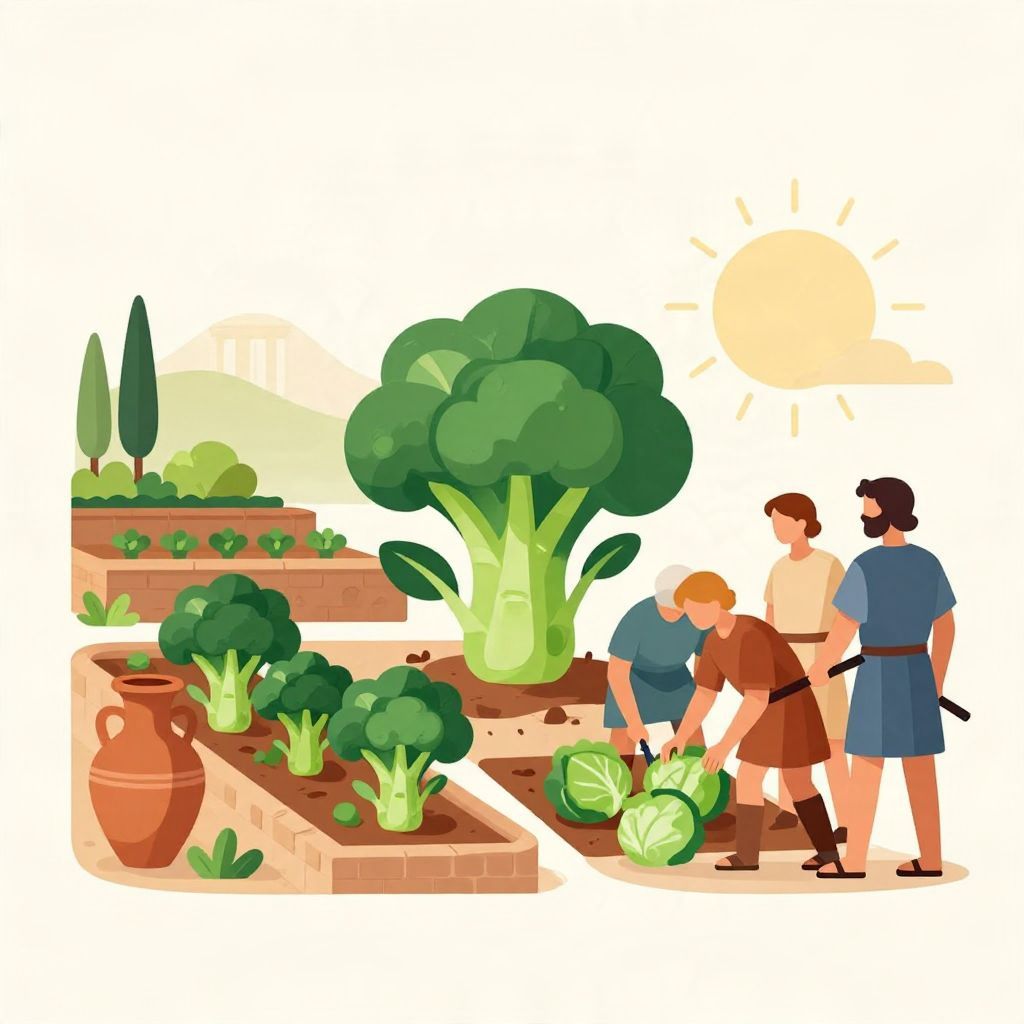
Where does broccoli come from? The short historical answer is that broccoli originated in the Mediterranean, most likely in ancient Italy, where farmers selectively bred it from wild cabbage over many generations. It is not a “natural” vegetable in the sense of appearing unchanged in the wild; it is a human-made crop shaped by long agricultural selection.
Its story reaches back to the Roman world and then forward through Italian farming traditions, early modern trade, and modern global agriculture. Broccoli’s history is also a reminder that many familiar foods are the result of patient cultivation, not sudden invention.
Where Does Broccoli Come From?
Broccoli comes from the Mediterranean, especially Italy, where it was developed from wild cabbage through selective breeding. Ancient and medieval growers gradually favored thicker flower buds and tender stems, creating the plant we now recognize as broccoli. From Italy, it spread across Europe and later to North America, where it became a common vegetable in the 20th century.
The Ancient Roots of Broccoli
Broccoli belongs to the species Brassica oleracea, the same plant family that gave rise to cabbage, cauliflower, kale, Brussels sprouts, and kohlrabi. In the wild, this plant grew along rocky coastal areas of the Mediterranean. Farmers in the region learned that by saving seeds from plants with useful traits, they could gradually change the crop’s appearance and taste.
This process, known as selective breeding, happened long before modern genetics. Over time, growers encouraged plants that produced larger edible flower heads and thick, tender stalks. Broccoli was therefore not “discovered” in one moment. It emerged slowly through agricultural practice.
Why Italy Matters
Italy is usually identified as broccoli’s place of origin because the clearest historical evidence for cultivated broccoli appears there. The word itself comes from Italian broccolo, meaning the flowering crest or sprout of a cabbage. That linguistic trail matters: when the name of a food is rooted in a place and language, it often points to where the crop was refined and popularized.
Roman agricultural writers did not describe broccoli in exactly the modern sense, but they did know and value related brassica plants. By the late classical and medieval periods, Italian growers had clearly developed forms of cabbage with edible flowering shoots. These were the ancestors of broccoli as we know it.
How Broccoli Developed from Wild Cabbage
Broccoli is one of the most striking examples of how humans can reshape a plant. Wild cabbage had no large green heads, no compact florets, and no supermarket appearance. Through repeated cultivation, growers selected for traits that made the plant more useful as food.
The Brassica Family Tree
The brassica family is famous because many of its vegetables are different forms of the same species. Depending on which part of the plant farmers emphasized, they produced distinct crops:
- Cabbage for dense leaves
- Cauliflower for a compact flowering head
- Broccoli for edible flower buds and stalks
- Kale for leafy growth
- Brussels sprouts for enlarged side buds
Broccoli’s development was not a single mutation that someone happened to notice. It was the result of generations of farmers choosing plants with the most desirable edible parts. That is why broccoli and cauliflower are close relatives but look so different.
What Made Broccoli Useful?
Broccoli was valued because it offered several advantages. The flower buds could be eaten before blooming, the stalks were nutritious, and the plant could grow in cooler seasons. In Mediterranean agriculture, where seasonal variation mattered, a crop like broccoli fit well into local food systems.
Its flavor also mattered. Broccoli has a stronger, more vegetal taste than some other brassicas, and that appealed to many cooks. As with many crops, usefulness in the kitchen helped determine which varieties survived and spread.
Broccoli in the Roman and Medieval Worlds
Although the exact early history is difficult to document in detail, broccoli-like plants were known in the broader Roman world. Ancient agricultural knowledge often focused on practical cultivation rather than fixed botanical categories, so the names and forms of vegetables could vary from place to place. What is clear is that by the medieval period, Italian growers were cultivating recognizable broccoli types.
By the Renaissance, broccoli had become established in parts of Italy, especially in the south. It appears in historical records as a regional vegetable rather than a luxury food. That is important: broccoli did not begin as an elite delicacy and then trickle down. It was, for much of its history, a practical garden crop.
From Local Crop to Regional Specialty
Italy’s varied climates helped broccoli diversify. Different regions favored different harvest times, plant sizes, and flavors. Some forms were closer to what we now call broccoli rabe or rapini, while others had the thicker central heads familiar today. The vegetable’s history is therefore not a single straight line but a family of related cultivated forms.
This helps explain why broccoli can be hard to define in older sources. Historical gardeners did not always separate vegetables the way modern supermarkets do. What mattered was how the plant grew, when it could be harvested, and how it tasted when cooked.
How Broccoli Spread Beyond Italy
Broccoli remained most closely associated with Italy for centuries, but it gradually moved into other European food cultures. Trade, migration, and the exchange of seeds all helped carry it across borders. Like many crops, broccoli spread not through conquest or a single voyage, but through everyday movement of people and plants.
Arrival in England and France
By the early modern period, broccoli was known in parts of France and England, though it was not yet a mainstream vegetable there. English gardeners sometimes referred to it as “Italian asparagus,” a name that shows both its foreign origin and its resemblance in texture to other spring vegetables.
It remained relatively unfamiliar in Britain for a long time, partly because local tastes and climates favored other crops. Broccoli was still a specialty item rather than an everyday staple.
Broccoli in North America
Broccoli arrived in North America through European settlers, but it did not become widely popular immediately. In the United States, it gained much greater prominence in the 20th century, especially as Italian-American communities continued to grow and as commercial agriculture improved distribution. Refrigerated transport and large-scale farming made it easier to sell broccoli far from where it was grown.
By the mid-20th century, broccoli had become a familiar vegetable in American kitchens. Its rise was helped by nutrition campaigns and changing tastes, which highlighted its health benefits and versatility.
Is Broccoli Ancient or Modern?
Broccoli is both ancient and modern, depending on how the question is framed. Its botanical ancestry is ancient, reaching back to the Mediterranean world of antiquity. But the broccoli sold today is the product of much later agricultural refinement, especially from Italian farming traditions and modern breeding practices.
That distinction matters. When people ask where broccoli comes from, they may mean one of three things:
- The wild plant from which it was bred
- The region where it was first cultivated as broccoli
- The modern crop that became globally popular in recent centuries
All three answers point to the Mediterranean, but they describe different stages of the vegetable’s history.
Broccoli and the History of Food Plant Breeding
Broccoli’s history is a useful example of how agriculture changes over time. Humans did not merely gather plants from nature; they transformed them. By selecting seeds from the best-performing plants, farmers created crops with larger edible parts, better flavor, and more reliable yields.
This kind of breeding was slow and cumulative. No single person “invented” broccoli in the modern sense. Instead, countless growers contributed to its development through ordinary farming decisions. That makes broccoli part of a much larger history of human ingenuity in food production.
What Broccoli Tells Us About Agriculture
Broccoli shows that many vegetables we think of as natural are actually historical creations. Its existence depends on long-term cultivation, local knowledge, and the steady exchange of seeds. It also shows how food history can cross boundaries: a plant rooted in ancient Mediterranean agriculture became a global commodity.
In that sense, broccoli is not just a vegetable. It is evidence of how people have shaped landscapes, diets, and markets over centuries.
Broccoli Facts and Common Questions
Several facts help clarify broccoli’s origin story and separate history from myth:
- Broccoli is not a wild plant; it was bred from wild cabbage.
- Its strongest historical association is with Italy, especially the Mediterranean south.
- The name comes from Italian, which supports its Italian development.
- It is closely related to cauliflower and cabbage because they come from the same species.
- Its global popularity is relatively recent, especially outside Europe.
There is no serious historical evidence that broccoli was first created in some distant, unrelated civilization and later borrowed by Italians. The most widely accepted historical picture places its development in the Mediterranean, with Italy as the clearest center of cultivation and naming.
Conclusion: The Real Origin of Broccoli
So, where does broccoli come from? Historically, it comes from the Mediterranean world, especially Italy, where farmers turned wild cabbage into a distinct edible crop through generations of selective breeding. Its roots are ancient, but its modern form is the result of long agricultural history, not a single invention. If you enjoy tracing the origins of everyday foods, you may also like reading about where pineapples originated and where gin is from.