
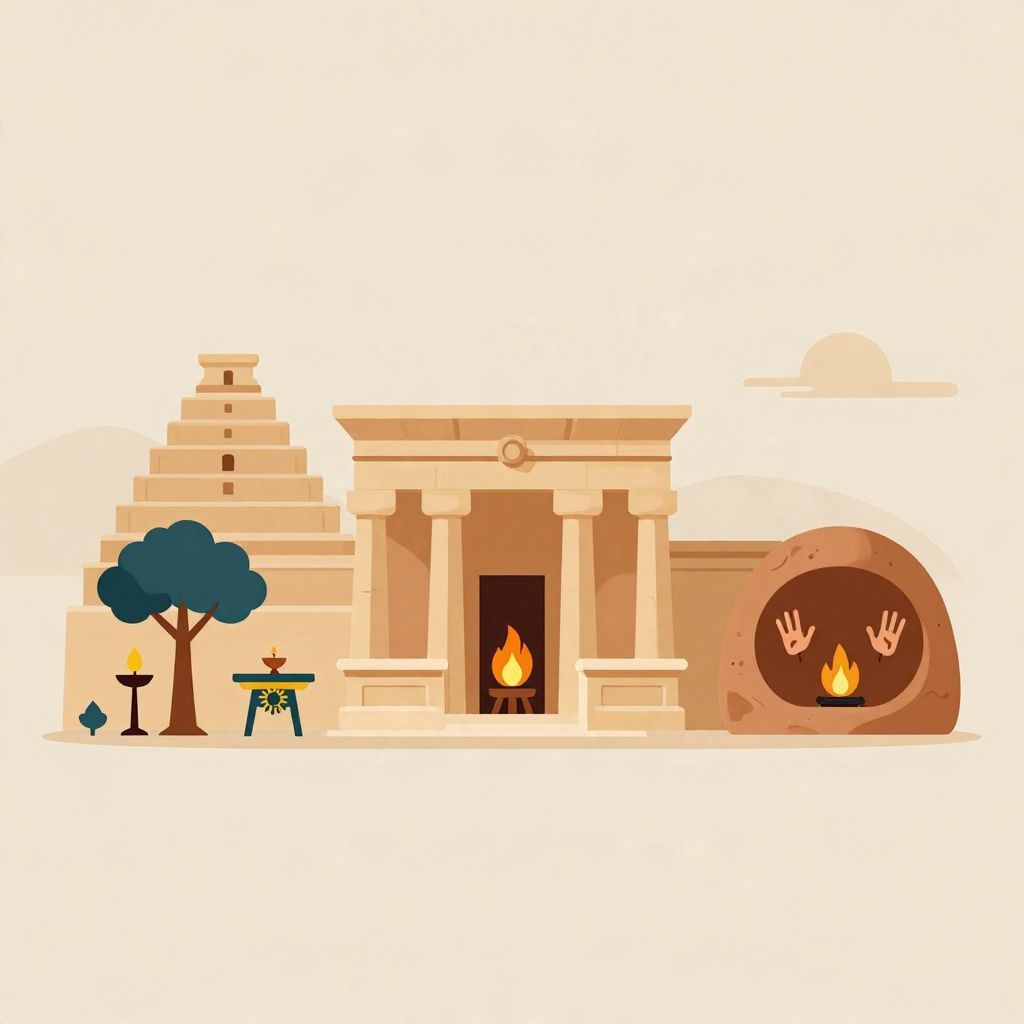
People often ask, “Which religion is the oldest?” because the answer seems like it should be simple. In reality, it depends on what you mean by “oldest”: the oldest surviving religion, the oldest organized tradition, or the oldest traceable beliefs in human history.
The best historical answer is that Hinduism is usually considered the oldest surviving major religion, with roots stretching back to the ancient Indus Valley and Vedic traditions of South Asia. But no single religion can be proven as the absolute first in human history, because early spiritual practices long predate written records.
Which Religion Is the Oldest?
Hinduism is generally regarded as the oldest surviving religion in the world. Its origins are ancient and layered, developing over many centuries from early South Asian beliefs, the Vedic tradition, and later philosophical and devotional movements. However, if “oldest” means the first religious beliefs ever held by humans, the question cannot be answered with certainty because prehistoric spirituality left no written record.
Why the Question Is Hard to Answer
Historians distinguish between religion as a living tradition and religion as an archaeological or textual record. Human beings likely practiced rituals, buried their dead, and used symbols tens of thousands of years ago, but those practices are not the same as a documented religion with named scriptures, institutions, and doctrines.
That is why the answer changes depending on the definition:
- Oldest known spiritual behavior: prehistoric ritual and burial customs, far older than written history
- Oldest surviving organized religion: usually identified as Hinduism
- Oldest monotheistic religion: often discussed in relation to ancient Judaism, though its earliest history is also complex
- Oldest religion with continuous practice and texts: Hinduism remains the strongest candidate
Why Hinduism Is Usually Considered the Oldest Surviving Religion
Hinduism did not begin with a single founder or a single founding date. Instead, it emerged gradually in South Asia over a long period. Its earliest roots are often linked to the Indus Valley Civilization (roughly 2600–1900 BCE) and to the later Vedic period, when Indo-Aryan-speaking communities composed the Vedas, the oldest sacred texts of the tradition. Because Hinduism developed over centuries rather than appearing all at once, historians see it as a cumulative religious tradition.
Its longevity matters. Many ancient religions disappeared, transformed beyond recognition, or were absorbed into later systems. Hinduism, by contrast, continued to evolve while preserving core ideas such as dharma, karma, rebirth, ritual duty, and devotion to multiple divine forms. That continuity is why it is usually described as the oldest surviving religion.
The Indus Valley and Early South Asian Religion
The Indus Valley Civilization produced cities, trade networks, seals, and symbols, but it left no deciphered religious texts. Archaeologists have found figurines, ritual bathing structures, and images that some scholars connect cautiously to later Hindu ideas. These findings are suggestive, not conclusive. It is safer to say that South Asia had complex religious life long before the classical forms of Hinduism appeared.
Because the script of the Indus civilization has not been securely deciphered, historians cannot directly prove that the people of Mohenjo-daro or Harappa practiced Hinduism in the later sense. Still, the civilization provides important background for the region in which Hindu traditions developed.
The Vedic Period and the Formation of Hindu Tradition
The clearest textual evidence begins with the Vedas, especially the Rigveda, often dated broadly to around 1500–1200 BCE, though exact dates remain debated. These texts reflect a ritual world centered on sacrifice, hymns, cosmic order, and divine powers. Over time, later texts such as the Upanishads shifted emphasis toward philosophy, meditation, and the nature of ultimate reality.
What we call Hinduism today grew from this long process. It absorbed ritual traditions, philosophical speculation, devotional worship, temple culture, and local practices. Because of that diversity, Hinduism is less a single invention than a historical civilization of religion.
Could Judaism Be Older?
Judaism is one of the world’s oldest monotheistic religions, and its history is deeply important. But it is not usually considered older than Hinduism. The earliest forms of Israelite religion developed in the ancient Near East during the second millennium BCE, with the Hebrew Bible reflecting traditions that were written, edited, and compiled over many centuries. The religion we now call Judaism took recognizable shape later, especially after the Babylonian Exile in the 6th century BCE.
This does not make Judaism “young” in any ordinary sense. It is an ancient tradition with profound historical continuity. But if the question is simply which surviving religion is oldest, Hinduism still comes first in most historical discussions.
Why Monotheism Complicates the Comparison
Some people ask whether the oldest religion should be the oldest belief in one God. That is a different question. Monotheism developed gradually and did not arise everywhere at the same time. Judaism is often treated as the earliest enduring monotheistic tradition, though scholars also note that early Israelite religion may have moved from polytheistic or henotheistic forms toward exclusive worship of one God over time.
So the answer depends on whether someone is asking about the oldest religion overall or the oldest monotheistic religion specifically.
What About Buddhism, Zoroastrianism, and Other Ancient Religions?
Several major religions are very old, but most are younger than Hinduism. Buddhism began in the 5th century BCE with Siddhartha Gautama in northern India. Jainism also took shape in ancient India and may preserve very old ascetic traditions, but its historical form is later than the earliest Vedic religion. Zoroastrianism is ancient and influential, likely emerging in the early first millennium BCE, though its precise dating is debated.
These traditions are among the world’s oldest living religions, yet none is generally placed earlier than the long development of Hinduism.
Ancient Religions That No Longer Survive in Their Original Form
Many religions are older than the major world faiths still practiced today, but they no longer exist as continuous living traditions. Examples include ancient Egyptian religion, Mesopotamian religions, Greek and Roman polytheism, and many local cults of the ancient world. These belief systems were highly developed and influential, but most were eventually replaced or transformed by later religions.
That is why “oldest religion” can mean very different things depending on whether one is asking about survival, origin, or influence.
The Oldest Evidence of Religion in Human History
If we move beyond named religions, the earliest evidence of religious behavior is much older than Hinduism or any other historical faith. Archaeologists have found signs of ritual behavior in prehistoric human communities, including burials, grave goods, cave art, and symbolic objects. These practices suggest belief in meaning beyond ordinary survival, perhaps involving ancestors, spirits, or a sacred cosmos.
However, historians cannot assign these practices to a specific religion because no texts or named traditions survive from that remote period. The evidence shows that religion is deeply ancient in humanity, but it does not identify a single “first religion.”
Prehistoric Rituals and Human Belief
Some of the earliest possible ritual evidence comes from Neanderthal and early Homo sapiens contexts, where burials and symbolic behavior appear tens of thousands of years ago. Cave paintings and ceremonial sites also point to complex spiritual imagination. Still, these are fragments of belief, not complete religions in the later historical sense.
In other words, religion is probably as old as human culture itself, but the oldest surviving religion is a different matter.
How Historians Decide What Counts as a Religion
Historians and scholars of religion use several criteria when comparing ancient traditions:
- Continuity: Has the tradition survived into the present?
- Texts: Are there sacred writings that can be dated?
- Community: Has there been an identifiable religious community over time?
- Belief and practice: Are there rituals, doctrines, and institutions?
- Change over time: Has the tradition evolved without losing its identity?
Hinduism scores strongly on continuity and depth of tradition, even though it is diverse and not centrally organized. Judaism also scores strongly, especially in textual continuity and community identity. Buddhism, Christianity, and Islam are younger but historically well documented and globally influential.
So, What Is the Final Answer?
If you are asking which religion is the oldest surviving major religion, the answer is usually Hinduism. If you are asking about the oldest monotheistic religion, the answer is usually Judaism. If you mean the earliest religious behavior in human history, then the answer is that religion is far older than any surviving named faith, but we cannot identify a single first religion with certainty.
That is the most careful historical answer: the “oldest religion” depends on definition, but Hinduism is generally regarded as the oldest living major religion, while human spirituality itself reaches back into prehistory. For more on its beginnings and later development, see where Hinduism began and how Hinduism spread.