
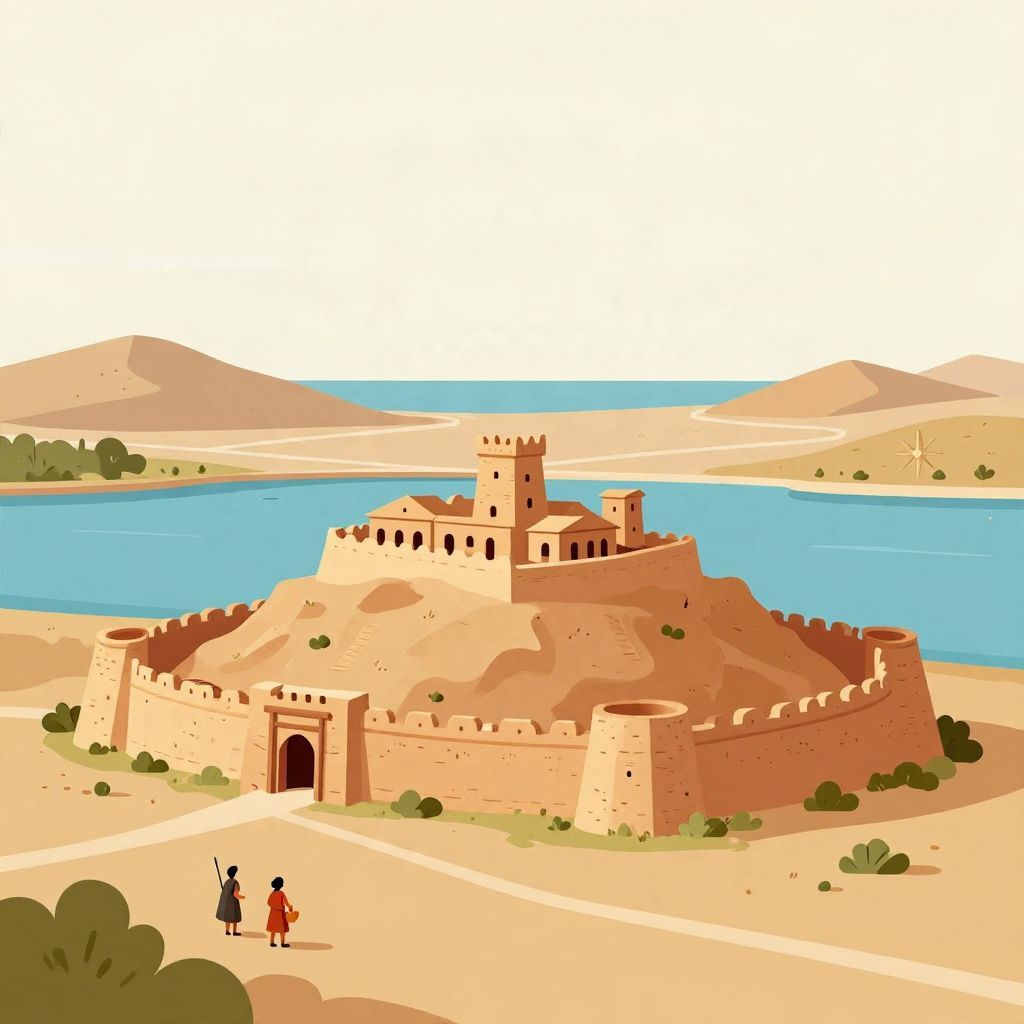
Where was Troy located? The ancient city of Troy stood in northwestern Anatolia, in what is now modern-day Turkey, near the Dardanelles strait and the entrance to the Aegean Sea. Its remains are identified with the archaeological site of Hisarlik, close to the modern village of Tevfikiye in Çanakkale Province.
Troy is famous from Homer’s Iliad, but the place itself was real. Archaeology shows a long-lived settlement at Hisarlik, though the exact relationship between the historical city and the epic tradition remains partly uncertain.
Where was Troy located?
Troy was located at Hisarlik in northwestern Turkey, on a strategic hill overlooking the plain near the Dardanelles. This position gave it control over routes linking the Aegean world with the interior of Anatolia and the Black Sea region. The site was valuable for trade, travel, and military movement, which helps explain why it mattered in antiquity.
The geographic setting
Hisarlik lies near the southwestern edge of the ancient Troad, a region in northwestern Anatolia. The city sat above the Scamander plain, not far from the coast in antiquity, though the shoreline has shifted over time because of sediment buildup. In Homeric terms, Troy was a city near the sea but not directly on the coast.
The nearby Dardanelles, known in antiquity as the Hellespont, formed a narrow passage between the Aegean and the Sea of Marmara. Any settlement in this area could benefit from watching or influencing movement through one of the most important waterways in the eastern Mediterranean.
Modern location today
Today, the site is in Turkey’s Çanakkale Province, near the village of Tevfikiye and the town of Çanakkale. Visitors can see the excavated remains at the archaeological park of Troy, which includes layers of settlements built one on top of another over many centuries.
Why Hisarlik is identified as Troy
The identification of Hisarlik with Troy is based on archaeology, ancient geography, and long scholarly comparison with classical texts. Excavations have revealed a major Bronze Age settlement at the site, including walls, buildings, and occupation layers that fit the time and importance expected of Troy in the late Bronze Age.
The strongest case comes from the fact that ancient writers placed Troy in the Troad, and Hisarlik matches that general location. While no single discovery “proves” the Homeric city in every detail, the archaeological evidence makes Hisarlik the accepted location of ancient Troy for most historians and archaeologists.
What the excavations showed
Excavations beginning in the 19th century uncovered a mound made up of many successive cities. Archaeologists usually refer to these as Troy I, Troy II, and so on, with Troy VI and Troy VII often discussed in relation to the late Bronze Age. This layered history shows that the site was occupied for a very long time, not just during the era of the legendary war.
The most famous early excavator was Heinrich Schliemann, whose work brought Troy to world attention. His methods were often destructive by modern standards, but later archaeologists refined the picture and established a more careful understanding of the site’s chronology.
Troy in history and legend
Troy occupies a unique place because it belongs to both history and literature. The city in Homer’s Iliad is the setting for the Trojan War, a legendary conflict between the Greeks and the Trojans. That story shaped how later generations imagined the ancient city, but the poem itself is not a straightforward historical record.
Most scholars believe there was a real Bronze Age settlement that inspired the tradition, but the details of the war, the heroes, and the famous wooden horse belong to epic poetry and myth. The historical Troy and the literary Troy overlap, yet they are not identical.
The Bronze Age city
The Troy that mattered in the late Bronze Age was part of a wider world of palace states, trade networks, and regional rivalries. Anatolia at that time included Hittite power inland, while coastal communities interacted with Aegean societies. Troy’s location made it well placed to profit from exchange and to defend itself against threats.
Archaeological evidence suggests that the city was fortified and prosperous during parts of the second millennium BCE. At various times, it may have served as a local center controlling the surrounding countryside and maritime routes.
The Homeric tradition
By the time Homer’s epics took shape, probably in the 8th century BCE or later, the original Bronze Age world was long gone. Oral tradition preserved memories of an age of heroes, but these memories were reshaped by centuries of storytelling. That is why the Iliad should be read as literature rooted in the distant past, not as a literal transcript of events.
What was Troy like in antiquity?
Troy was not a single city frozen in time. It was a settlement that changed repeatedly over thousands of years. Different layers reflect different periods, from the Early Bronze Age through the Greek, Roman, and later eras. The city’s importance rose and fell, but its location remained attractive because of geography.
Strategic importance
Control of the area around Troy meant influence over land routes and access to the straits. This made the site useful for commerce and defense. Even if Troy was not always a major empire, it was well positioned to be a regional stronghold.
Its hilltop setting also offered natural protection. Fortified walls and elevated ground made the settlement easier to defend than a low-lying coastal town.
Shifting coastline and landscape
One reason the site can be confusing is that the ancient landscape looked different from the modern one. Over centuries, rivers deposited silt across the plain, changing the shoreline and the local environment. As a result, Troy’s relationship to the sea in antiquity was different from what a visitor sees today.
This environmental change helps explain why ancient descriptions and modern geography do not always line up neatly. Troy was near the sea in the Bronze Age, but not necessarily on the coast in the way a modern map might suggest.
How scholars understand Troy today
Modern scholarship treats Troy as both an archaeological site and a cultural symbol. The physical remains at Hisarlik are real, but the legendary story attached to them was shaped by poetry, memory, and later interpretation. That distinction matters when answering where Troy was located.
There is broad agreement on the location, but some details remain debated. Scholars continue to discuss which archaeological layer best corresponds to the city remembered in Homer, how large the settlement was, and what historical events may have inspired the epic tradition.
Common points of agreement
- Troy was located at Hisarlik in northwestern Anatolia.
- The site is near the modern Dardanelles in present-day Turkey.
- The ancient city was part of the broader region known as the Troad.
- The Homeric Trojan War is legendary, but it likely reflects some historical memory of the Late Bronze Age.
Points that remain uncertain
- Which specific destruction layer, if any, matches the Troy of the Iliad.
- How closely the epic’s geography matches the Bronze Age landscape.
- Whether a single war inspired the tradition or whether several conflicts were blended together.
Why Troy still matters
Troy remains important because it sits at the intersection of archaeology, literature, and historical memory. It is one of the best-known examples of how a real ancient place can become larger than its material remains through storytelling. The site also illustrates how geography can shape history by making a settlement strategically valuable for centuries.
For visitors and readers alike, Troy is more than a legendary battlefield. It is a real place in Turkey with a long and complex history, preserved in layers of earth and in one of the most influential epics ever written.
In short, Troy was located at Hisarlik in northwestern Turkey, near the Dardanelles, and its fame comes from both its real Bronze Age history and its place in Greek legend. If you want to place Troy in its wider ancient world, you may also find it useful to read about Asia Minor and Canaan.