
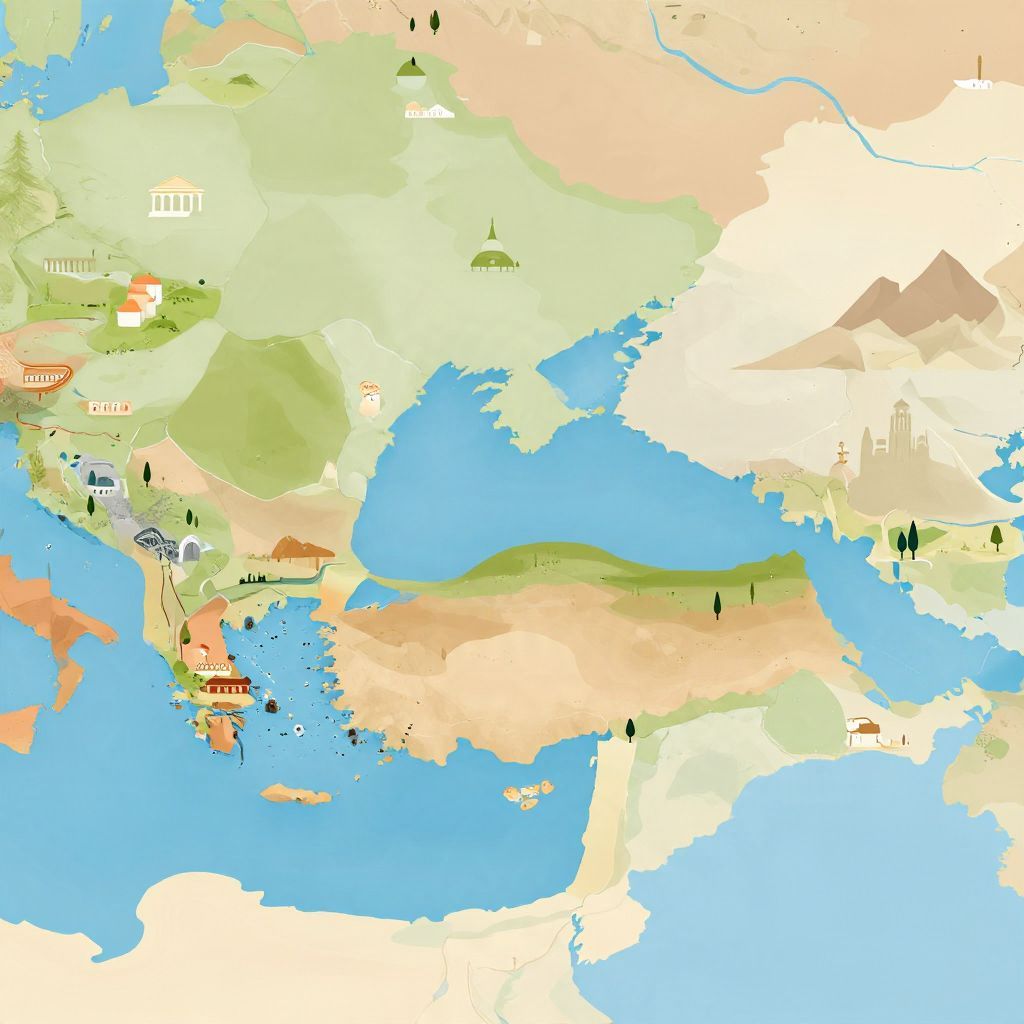
What is Asia Minor? The short answer is that Asia Minor is the historical name for the Anatolian peninsula, the large landmass that makes up most of modern-day Turkey. For thousands of years, it sat at the crossroads of Europe, Asia, and the eastern Mediterranean, which made it one of the most important regions in ancient history.
The term appears in Greek and Roman usage and later became common in European scholarship. It does not describe a single kingdom or empire, but a geographic and cultural region shaped by Hittites, Greeks, Persians, Romans, Byzantines, Seljuks, and Ottomans.
What Is Asia Minor?
Asia Minor is the traditional historical name for Anatolia, the broad peninsula between the Black Sea, the Aegean Sea, and the eastern Mediterranean. In ancient and medieval contexts, it usually refers to the Asian part of what is now Turkey. The name is geographic rather than political, and its boundaries varied depending on the writer and period.
Where Is Asia Minor Located?
Asia Minor occupies a strategic bridge between continents. It is bounded by the Bosphorus and Dardanelles straits to the northwest, the Black Sea to the north, the Aegean to the west, and the Mediterranean to the south. Inland, it contains high plateaus, mountain ranges, river valleys, and fertile coastal zones that supported dense settlement.
Why the region mattered
This geography helped make Asia Minor a crossroads for trade, migration, warfare, and empire-building. Routes linking Mesopotamia, the Levant, the Aegean world, and the Caucasus passed through it. Control of the region often meant control of movement between Europe and Asia, which is one reason so many powers fought over it.
Why Was It Called Asia Minor?
The phrase means “Little Asia” in Latin and later European languages. Ancient Greeks and Romans used terms that distinguished this peninsula from the larger continent of Asia. The label was not originally a formal state name; it was a convenient way to refer to the westernmost portion of Asia known to classical writers.
Ancient naming and later usage
In antiquity, “Asia” could mean different things depending on context. For Greek authors, it might refer to the lands east of the Aegean or to a Roman province named Asia in western Anatolia. “Asia Minor” became a broader geographic term in later historical writing, especially in modern scholarship, to distinguish the peninsula from the larger Asian continent.
The Earliest Peoples of Asia Minor
Asia Minor has a very long human history. Archaeological evidence shows settlement going back to the Neolithic period, thousands of years before written history. By the second millennium BCE, the region was home to complex societies, especially the Hittites, who built a powerful kingdom in central Anatolia.
Major early cultures
- Neolithic communities developed farming settlements in parts of Anatolia.
- Hattians and other early peoples lived in central regions before and alongside the Hittites.
- Hittites created one of the major Bronze Age states, with their capital at Hattusa.
- Coastal and western areas interacted closely with Aegean and eastern Mediterranean cultures.
The Hittite Empire, flourishing roughly in the second millennium BCE, became a major rival to Egypt and other Near Eastern powers. Its collapse around the end of the Bronze Age, around 1200 BCE, did not erase civilization in Anatolia, but it did open the way for new political formations.
Asia Minor in the Greek and Persian Worlds
From the first millennium BCE onward, Asia Minor became a meeting place of Greek, Persian, and local Anatolian cultures. Greek city-states established colonies along the Aegean coast, while inland kingdoms such as Lydia and Phrygia developed their own identities. In the 6th century BCE, the Achaemenid Persian Empire conquered much of the region.
Greek colonies and coastal cities
Greek settlers founded or expanded cities such as Miletus, Ephesus, and Smyrna on the western coast. These cities became centers of commerce, philosophy, and art. They were not isolated Greek outposts; they interacted with local populations and absorbed influences from Anatolian and Near Eastern traditions.
Persian rule
When the Persians took control, Asia Minor was divided into administrative districts called satrapies. Persian authority did not erase local customs, but it connected the region to a vast imperial system stretching from the Aegean to Central Asia. This period also set the stage for the Greco-Persian conflicts of the early 5th century BCE.
Asia Minor Under Alexander and the Hellenistic Kingdoms
Alexander the Great conquered Asia Minor in the 330s BCE during his campaign against Persia. After his death in 323 BCE, his empire fragmented, and Asia Minor became contested territory among Hellenistic dynasties. The most important of these included the Seleucids, Ptolemies, and the rulers of Pergamon.
Why the Hellenistic era mattered
This was a period of intense cultural blending. Greek language and urban institutions spread widely, but they coexisted with older Anatolian traditions and local religious practices. Cities grew in importance, and Asia Minor became one of the main centers of Hellenistic civilization.
Asia Minor in the Roman Empire
Rome gradually absorbed Asia Minor between the 2nd and 1st centuries BCE, first through alliances and client kingdoms, then through direct annexation. By the early imperial period, much of the peninsula had become part of the Roman world. The region was valuable for its cities, agriculture, trade routes, and strategic position.
Roman provinces and urban life
Roman rule brought roads, taxation, and provincial administration. Important cities such as Ephesus, Pergamon, and Antioch in Pisidia flourished as regional centers. Asia Minor also became significant in early Christian history, since many of the New Testament communities and missionary journeys were located there.
It is important not to oversimplify this era. “Romanization” did not mean that local cultures disappeared. Greek remained widely used in the east, local traditions continued, and Roman power often worked through existing urban elites rather than replacing them entirely.
Asia Minor in the Byzantine and Medieval Periods
After the division of the Roman Empire, Asia Minor became the heartland of the Byzantine Empire. For centuries, it served as the empire’s military and economic backbone. However, repeated wars, internal crises, and the rise of new powers gradually weakened Byzantine control.
Seljuk advances and Turkish settlement
A turning point came after the Battle of Manzikert in 1071, when the Seljuk Turks defeated the Byzantines. This did not instantly end Byzantine presence in the region, but it accelerated Turkish settlement and political change. Over time, many parts of Anatolia came under Turkish Muslim rule, while Byzantine authority survived mainly in selected coastal and western areas for a while longer.
From Anatolia to Ottoman power
By the late medieval period, several Turkish principalities emerged in Anatolia. One of them, the Ottomans, expanded rapidly and eventually absorbed the rest of the region. Asia Minor became the core of the Ottoman state and remained central to its military, administrative, and demographic life.
Asia Minor and Modern Turkey
In modern historical writing, “Asia Minor” is mostly a traditional or scholarly term. The region is now generally called Anatolia, and it forms the Asian portion of the Republic of Turkey. The older name is still useful when discussing ancient and medieval history, because it highlights the continuity of the peninsula across many different civilizations.
Why historians still use the term
Historians use “Asia Minor” when they want to discuss the region in a broad historical sense, especially before the modern era. It helps distinguish the peninsula’s ancient and medieval past from the modern nation-state. At the same time, the term can be imprecise, since its boundaries and meaning changed over time.
Key Facts About Asia Minor
- Asia Minor is the historical name for Anatolia, the main landmass of modern Turkey.
- The name means “Little Asia” and reflects ancient Greek and Roman geographic thinking.
- The region has been inhabited since prehistoric times and was home to the Hittite Empire.
- It later came under Greek, Persian, Hellenistic, Roman, Byzantine, Seljuk, and Ottoman rule.
- Its location made it a major crossroads of trade, migration, and warfare.
- Many ancient cities in the region were centers of religion, philosophy, commerce, and administration.
Why Asia Minor Matters in History
Asia Minor matters because it connects several major historical worlds. It linked the Mediterranean to the Near East, helped shape Greek and Roman civilization, and later became the center of Byzantine and Ottoman power. Few regions have experienced such long continuity, cultural diversity, and political transformation.
So, what is Asia Minor? It is the ancient and historical name for Anatolia, a peninsula whose importance came from its geography as much as from the peoples who lived there. If you want to place it within the wider ancient world, you may also find it useful to explore what Persia was and where it is now and what happened to Babylon.