
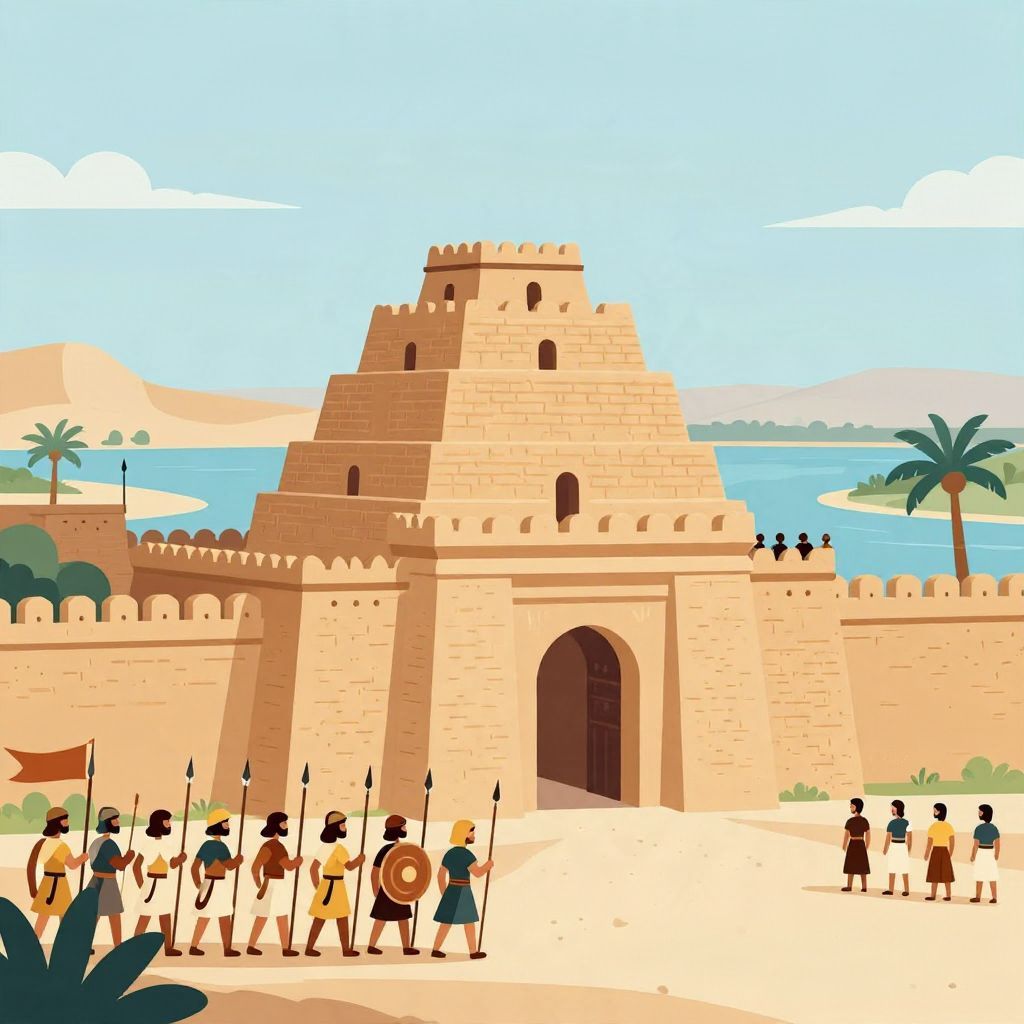
When did Babylon fall? The short answer is that the great city of Babylon was taken by the Persian king Cyrus the Great in 539 BCE. That conquest ended Babylon’s independence and brought the Neo-Babylonian Empire to a close.
But the story is more complicated than a single date. Babylon did not vanish overnight. It remained an important city for centuries afterward, even as its political power declined. To understand its fall, we need to look at the empire that ruled it, the crisis that weakened it, and the way Cyrus captured the city.
When did Babylon fall?
Babylon fell in 539 BCE, when Cyrus the Great of Persia conquered the city and absorbed the Babylonian Empire into his expanding realm. This was the end of Babylon as an independent imperial power, though the city itself continued to exist and remained significant under Persian rule.
What was Babylon before it fell?
Babylon was one of the most famous cities of the ancient world, located in southern Mesopotamia near the Euphrates River, in present-day Iraq. It had a long history, but its greatest political moment came under the Neo-Babylonian Empire in the 6th century BCE.
That empire was founded after the collapse of Assyrian power. Babylon then became the center of a major Near Eastern kingdom, especially under Nebuchadnezzar II (reigned c. 605–562 BCE), who expanded Babylonian power, fortified the city, and made it a symbol of wealth and prestige.
The city at its height
Ancient Babylon was renowned for monumental architecture, religious life, and administrative power. Later traditions associated it with the Ishtar Gate, the Processional Way, and the Hanging Gardens, though the gardens themselves remain uncertain in the historical record. What is clear is that Babylon was a major urban and cultural center before its conquest by Persia.
How did Babylon fall to Cyrus the Great?
Babylon fell to Cyrus the Great, founder of the Achaemenid Persian Empire, in a campaign that exploited Babylon’s internal weaknesses and military vulnerability. Ancient sources suggest that the city was captured with relatively little destruction, though the exact details vary by account.
The best-known ancient narrative comes from the Babylonian Chronicle and later Greek writers. These sources indicate that Persian forces defeated Babylonian resistance outside the city and entered Babylon itself in 539 BCE. The city appears to have been taken without a long siege, which helped Cyrus present himself not as a destroyer, but as a legitimate ruler chosen by the gods.
Why Babylon was vulnerable
- Political instability: The Babylonian court faced tension and uncertainty in the years before the conquest.
- Military pressure: Persia had already built a powerful empire and was expanding rapidly across the Near East.
- Religious and administrative concerns: Cyrus seems to have won support from some Babylonian elites by promising order and respect for local traditions.
Babylon’s fall was therefore not just a battlefield event. It was also the result of diplomacy, propaganda, and the wider collapse of Babylonian independence in the face of Persian expansion.
Was Babylon conquered in one night?
Popular retellings sometimes describe Babylon falling in a single dramatic night, but that version should be treated cautiously. Ancient sources do describe a sudden capture, and later traditions often dramatized the event. However, historians generally understand the conquest as part of a broader military and political process rather than a purely legendary overnight miracle.
Some accounts say Persian troops diverted the Euphrates and entered the city along the riverbed, but the reliability of this detail is debated. It may reflect a genuine tactic, a later embellishment, or a symbolic explanation for how such a mighty city could be taken so quickly.
What the sources actually show
The historical record supports the broad facts: Cyrus conquered Babylon in 539 BCE and became ruler of the city and its empire. The precise mechanics of the capture are less certain. Ancient sources were often written with political or religious aims, so historians compare them carefully rather than accepting every detail at face value.
What happened after Babylon fell?
After the conquest, Babylon became part of the Persian Empire. It did not cease to be inhabited, and it remained an important administrative and cultural center. What ended was Babylon’s status as an independent imperial capital.
Cyrus and his successors ruled through a vast empire that included many peoples and traditions. Babylon retained prestige because of its size, religious institutions, and strategic location. In other words, the city fell politically in 539 BCE, but it continued to matter for a long time afterward.
Babylon under Persian rule
The Persians often governed conquered lands by preserving local customs and using existing elites. Babylon’s temples and priesthoods remained influential, and the city continued to feature in imperial administration. This helps explain why Babylon’s “fall” should be understood as the end of sovereignty, not the end of urban life.
Why is 539 BCE the accepted date?
Historians use 539 BCE because it is supported by ancient chronological evidence, especially the Babylonian Chronicle and related Near Eastern records. These sources place Cyrus’s conquest in that year, making it the standard date for Babylon’s fall.
There is little serious disagreement about the year itself. The uncertainty lies more in how the conquest unfolded and how much resistance Babylon offered. The date is well established; the narrative details are more open to interpretation.
Babylon’s fall in the larger history of empires
The fall of Babylon mattered far beyond Mesopotamia. It marked one of the most important transitions in ancient Near Eastern history: the replacement of a Babylonian imperial center with the far larger Persian Empire. Cyrus’s victory helped create a new political order stretching across much of the known world.
This change also shaped later historical memory. Babylon became a symbol in Jewish, Greek, and later Christian traditions—sometimes as a place of grandeur, sometimes as a symbol of oppression or decadence. Those meanings came later, but they were rooted in the city’s dramatic political end.
Why the fall mattered
- It ended the Neo-Babylonian Empire.
- It expanded Persian control over Mesopotamia.
- It preserved Babylon as a major city while stripping it of independence.
- It became a landmark event in ancient political history and religious memory.
Babylon in memory and legend
Babylon’s fall was remembered in different ways by different cultures. For some, Cyrus was a liberator who restored order. For others, Babylon became a cautionary symbol of human pride and imperial power. These later meanings should not be confused with the historical event itself, but they show how influential the city remained long after its conquest.
The Bible, for example, connects Babylon with exile and imperial domination in the history of ancient Israel. Greek and Roman writers also used Babylon as a reference point for wealth, splendor, and moral decline. Such traditions shaped Babylon’s reputation far more than the bare military fact of its conquest.
So, when did Babylon fall?
Babylon fell in 539 BCE, when Cyrus the Great conquered the city and brought the Neo-Babylonian Empire to an end. The event was decisive, but not simple: Babylon lost its independence, not its existence. Its fall is best understood as the end of Babylonian imperial rule and the beginning of a new Persian age.
If you want to place Babylon’s fall in the wider sweep of ancient history, it sits alongside other major turning points in empire and conquest. For more context, you may also want to explore broader history topics and related discussions of ancient power and empire such as imperialism in world history.