
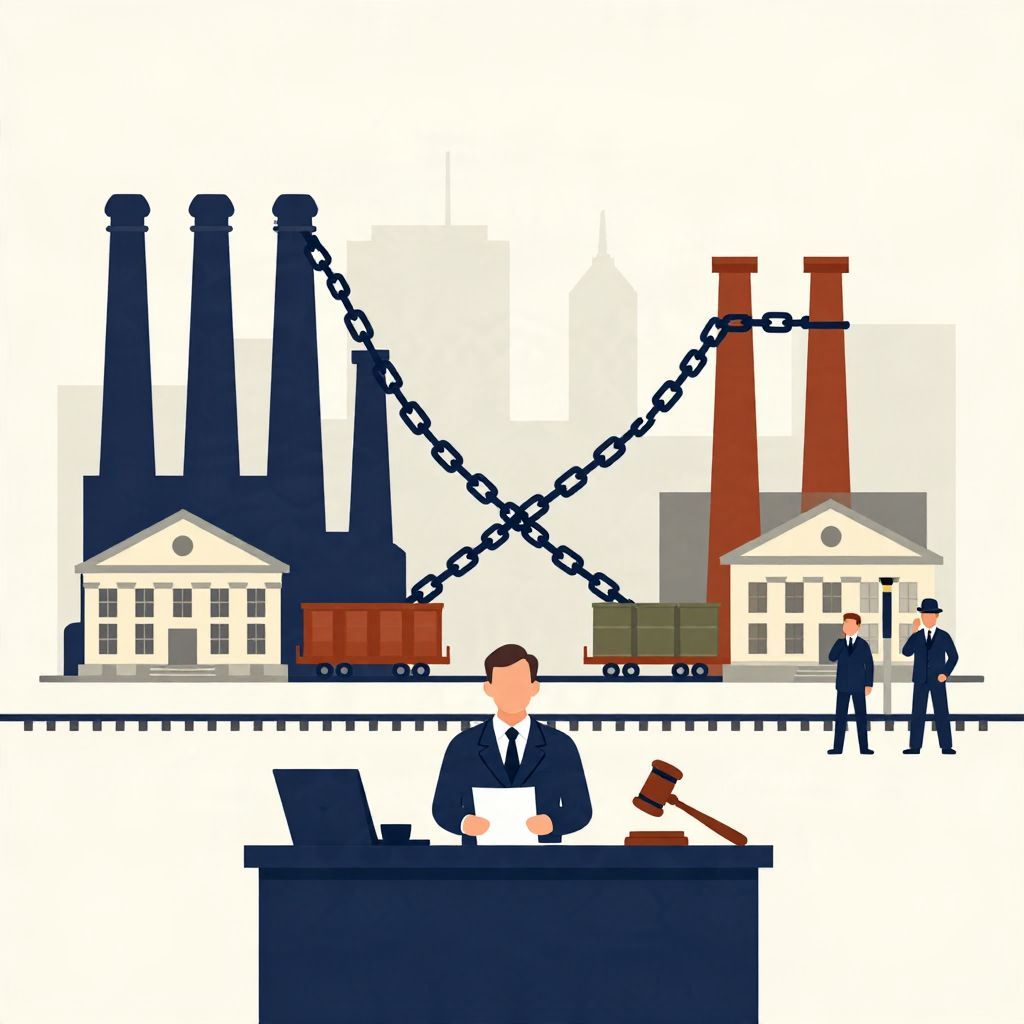
What is trust busting? In U.S. history, it refers to government efforts to break up or restrain large business combinations—especially monopolies and trusts—that were seen as limiting competition, raising prices, and concentrating economic power. The term became famous in the Progressive Era, when presidents and lawmakers tried to curb corporate control over railroads, oil, finance, and other industries.
Trust busting was not a single law or one-time event. It was a broader political and legal campaign that grew out of the late 19th century, when industrial capitalism produced giant firms and public concern over their influence. Its history helps explain how the United States came to regulate big business.
What Is Trust Busting?
Trust busting is the use of antitrust laws, court action, and executive power to stop companies from dominating markets unfairly. In practice, it meant challenging mergers, monopolies, and cartel-like arrangements that reduced competition. The goal was not to eliminate large firms entirely, but to prevent them from using size to control prices, wages, and access to markets.
Where Did Trust Busting Come From?
Trust busting emerged in the United States during the Gilded Age, roughly the 1870s through the 1890s, when industrial expansion created powerful corporations in railroads, oil, steel, meatpacking, and finance. Many Americans admired efficiency and growth, but others feared that a small number of “trusts” could manipulate markets and politics.
What was a “trust”?
Originally, a trust was a legal arrangement in which stockholders transferred control of their shares to trustees. Over time, the word came to describe any large business combination that seemed to operate as a monopoly or near-monopoly. By the 1880s and 1890s, “trust” had become a popular shorthand for corporate concentration.
Why did people oppose trusts?
Critics argued that trusts could:
- set prices above competitive levels
- drive smaller competitors out of business
- control wages and working conditions
- influence legislators and courts
- reduce consumer choice and innovation
Supporters of big business replied that large-scale firms could lower costs, standardize production, and stabilize supply. The debate was therefore not only economic, but also political and moral: how much power should private corporations hold in a democratic society?
The Legal Origins of Trust Busting
The first major federal response was the Sherman Antitrust Act of 1890. It declared contracts, combinations, and conspiracies “in restraint of trade” illegal and made monopolization unlawful. The law was broad, but for years it was applied unevenly and often weakly. Early court decisions sometimes limited its reach, and some prosecutions targeted labor unions as well as corporations.
Why did the Sherman Act matter?
Even though enforcement was inconsistent at first, the Sherman Act established a lasting principle: the federal government had the authority to regulate market power. That was a major shift in American political history. Before this, many Americans believed business competition should be left largely to the states or to the market itself.
Trust Busting in the Progressive Era
Trust busting became a major public issue during the Progressive Era, especially under President Theodore Roosevelt from 1901 to 1909. Roosevelt did not oppose all large corporations. Instead, he distinguished between “good” trusts, which he believed could be regulated, and “bad” trusts, which abused their power. His administration used federal lawsuits to challenge major combinations and to signal that no corporation was above the law.
Theodore Roosevelt and the “Square Deal”
Roosevelt’s “Square Deal” aimed to balance the interests of business, labor, and consumers. He believed the federal government should act as a referee when private power became too concentrated. One of the most famous cases was the breakup of the Northern Securities Company in 1904, a railroad holding company created by major financiers. The Supreme Court upheld the government’s action, making the case a landmark in antitrust history.
How did Roosevelt differ from earlier presidents?
Roosevelt was more willing than many predecessors to use executive authority against corporate concentration. He did not invent trust busting, but he made it politically visible. His approach helped define the presidency as an active force in economic regulation rather than a passive observer.
Key Facts About Trust Busting
Several important developments shaped the history of trust busting in the United States:
- 1890: Congress passes the Sherman Antitrust Act.
- 1902: Roosevelt’s administration files suit against Northern Securities.
- 1904: The Supreme Court orders Northern Securities dissolved.
- 1906–1909: Federal regulation expands under Roosevelt, especially in railroads and food and drug oversight.
- 1909–1913: President William Howard Taft pursues even more antitrust suits than Roosevelt, though with less political flair.
- 1914: Congress strengthens antitrust policy with the Clayton Antitrust Act and the Federal Trade Commission Act.
Was trust busting always about breaking companies up?
Not necessarily. Sometimes the government sought to dissolve a company into separate firms. In other cases, it aimed to regulate behavior, block anti-competitive mergers, or prevent abusive practices. Over time, antitrust policy became a mix of breakup, oversight, and legal deterrence.
Famous Trust Busting Cases
Trust busting is often associated with a few well-known corporate battles that symbolized the era’s struggle over economic power.
Standard Oil
The most famous case involved Standard Oil, the giant oil company associated with John D. Rockefeller. In 1911, the Supreme Court ordered Standard Oil broken into separate companies after finding it had violated antitrust law. This case became one of the clearest examples of trust busting in American history and remains central to discussions of monopoly power.
American Tobacco
Also in 1911, the Supreme Court ordered the breakup of the American Tobacco Company. Like Standard Oil, it had used aggressive consolidation and market control to dominate its industry. The case reinforced the idea that even highly successful corporations could be dismantled if they violated antitrust principles.
Railroads and finance
Railroads were among the earliest targets because they connected national markets and could influence shipping rates, access, and regional development. Financiers also came under scrutiny when their control over multiple companies raised fears of coordinated market power. Trust busting therefore reflected more than hostility to one industry; it was a response to the structure of modern corporate capitalism.
What Did Trust Busting Change?
Trust busting changed the relationship between government and business in the United States. It did not end large corporations, and it did not eliminate monopoly power altogether. But it established that the federal government could intervene when private economic concentration threatened competition or public confidence.
Economic consequences
The effects were mixed. Some breakups created more competition, while others simply produced several large firms instead of one giant one. In many industries, scale remained important, and regulators had to decide whether size itself was harmful or whether only abusive conduct should be punished. That question still shapes antitrust debates today.
Political consequences
Trust busting also strengthened the modern regulatory state. It encouraged the idea that elected officials and expert agencies should monitor markets, investigate abuses, and enforce rules. This was part of a broader Progressive Era belief that government could correct the excesses of industrial capitalism without abandoning capitalism itself.
Was Trust Busting Popular?
Public opinion was divided. Many farmers, workers, small business owners, and reformers supported trust busting because they felt squeezed by powerful corporations. At the same time, many business leaders and some economists argued that big firms were efficient and that aggressive antitrust policy could punish success or create uncertainty.
Why historians see it as more than anti-business sentiment
Trust busting was not simply a crusade against wealth. It reflected a larger concern about democratic control, fair competition, and the concentration of power. Progressive reformers often accepted capitalism but wanted to make it more accountable. That is why trust busting sits at the intersection of economics, politics, and social reform.
Trust Busting After the Progressive Era
Antitrust policy continued long after Roosevelt’s presidency. New laws in 1914 expanded enforcement tools, and later administrations used antitrust action in different ways. In the mid-20th century, antitrust policy sometimes focused on preserving market competition in manufacturing, communications, and other sectors. In the late 20th and early 21st centuries, debates over trust busting reappeared in discussions of technology platforms, mergers, and global corporations.
How the meaning evolved
Today, “trust busting” is often used more loosely to mean any effort to challenge monopoly power. Historically, however, it refers most specifically to the late 19th- and early 20th-century American campaign against trusts and monopolies, especially during the Progressive Era.
Why Trust Busting Still Matters
Trust busting matters because it helped define the modern role of government in the economy. It showed that market competition was not assumed to regulate itself and that corporate power could become a public issue. The movement also left a lasting legal framework that still shapes American business policy.
In historical terms, trust busting was the effort to curb the power of giant corporations when they seemed to threaten fair competition and democratic control. It began in response to the industrial transformations of the Gilded Age, reached its most famous form under Theodore Roosevelt and his successors, and left a permanent mark on U.S. law and politics. If you want to explore related reforms, you may also like reading about the Progressive Era and Theodore Roosevelt’s presidency.