
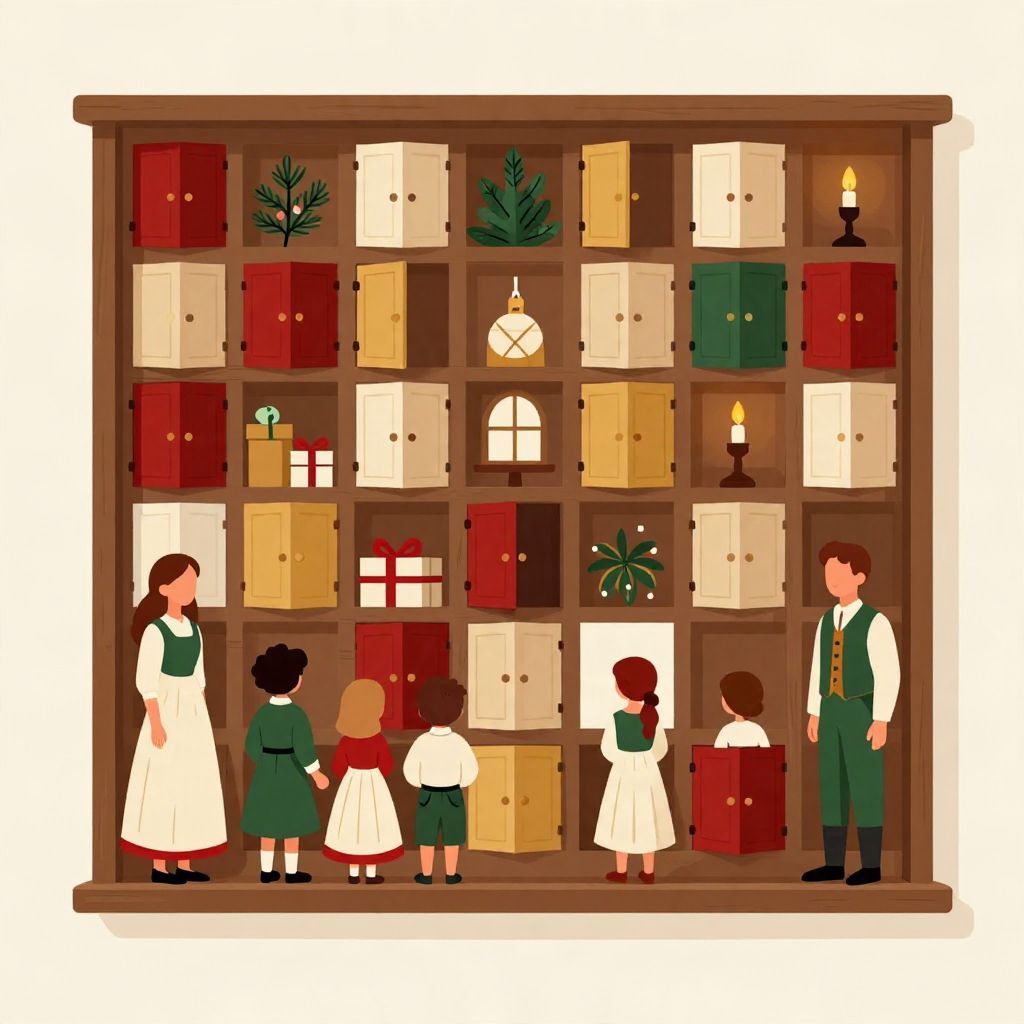
An advent calendar is a seasonal countdown device used in the Christian tradition to mark the days leading up to Christmas, usually from December 1 to December 24. Today it is often associated with small doors, pictures, chocolates, or gifts, but its deeper history reflects religious devotion, family ritual, and the commercialization of Christmas.
To answer what is advent calendar clearly: it is both a devotional calendar and a festive object that helps people count the days of Advent, the liturgical season before Christmas. Its modern form is relatively recent, but its roots lie in 19th-century German-speaking Europe and earlier Christian customs of preparing spiritually for Christmas.
What is an advent calendar?
An advent calendar is a calendar used to count down the days of Advent, the period before Christmas in Western Christian practice. It usually begins on December 1 and ends on Christmas Eve or Christmas Day, depending on the design. Each day reveals a small image, scripture, treat, or gift, making it both a religious reminder and a family tradition.
Advent as a season
The word Advent comes from the Latin adventus, meaning “arrival” or “coming.” In Christian theology, it refers to the anticipation of the birth of Jesus Christ and, in some traditions, his future return. The season developed in the early Church and became more formal over time, with customs of prayer, reflection, and preparation.
Because Advent is a season of waiting, the calendar became a practical and symbolic way to mark time. It turns an abstract religious period into a daily ritual. For many families, that ritual is now more cultural than strictly devotional, but its structure still reflects the older Christian idea of preparing for Christmas step by step.
Where did the advent calendar come from?
The modern advent calendar emerged in 19th-century Germany, where Protestant families developed ways to count the days before Christmas. Early forms were homemade and varied widely. They included chalk marks on doors, candles burned down one day at a time, paper images, and simple devotional charts. The familiar calendar with numbered doors came later.
Early German customs
German-speaking Protestants are often credited with shaping the advent calendar tradition, though there is no single inventor. Families used different methods to help children count the days until Christmas. Some households hung religious pictures; others gave children a new picture each day or made marks on a wall. These customs reflected both piety and anticipation.
One of the best-known early printed forms appeared in the early 20th century. In the 1900s, German publishers began producing calendars with doors that could be opened one by one. This made the tradition easier to share beyond the home and helped standardize the design that is now widely recognized.
Gerhard Lang and printed calendars
A name often associated with the commercial advent calendar is Gerhard Lang, a German publisher who helped popularize printed versions in the early 1900s. Popular retellings sometimes call him the “inventor,” but that is too simple. He was important in turning a home-made custom into a mass-produced product, not in creating the idea from nothing.
Lang’s calendars helped define the modern format: a printed board with numbered windows that conceal images or verses. This design spread because it was attractive, easy to sell, and suitable for children. Over time, the calendar moved from a mainly religious object to a broader Christmas tradition used by many secular households as well.
How did the advent calendar change over time?
The advent calendar changed from a private family practice into a widely marketed seasonal item. In the 20th century, especially after the First and Second World Wars, printed calendars became more common in Europe and later in North America. Manufacturers added chocolates, toys, cosmetics, and other surprises, broadening the calendar’s appeal.
From devotion to consumer culture
As Christmas became increasingly commercialized in the 20th century, the advent calendar followed the same path. Religious imagery remained important in some versions, but many calendars became purely festive. Chocolate-filled calendars, now among the most common, are especially associated with children and with the anticipation of small daily rewards.
This shift did not erase the calendar’s older meaning. Instead, it created a dual identity. For some users, the calendar still expresses Christian preparation for Christmas. For others, it is a family-friendly countdown that marks the holiday season in a cheerful, nonreligious way. That flexibility helps explain its lasting popularity.
Postwar expansion
After the mid-20th century, advent calendars spread widely through European and North American markets. Improved printing, advertising, and retail distribution made them easy to produce at scale. By the late 20th century, calendars appeared in many forms: cardboard doors, fabric pockets, luxury gift boxes, and themed versions tied to popular culture.
Today, advent calendars are used by Christians and non-Christians alike. Some churches and families still choose calendars with Bible verses or nativity scenes, while others prefer secular designs. The tradition’s survival depends partly on this adaptability: it can function as a religious practice, a family game, or a commercial product.
What do advent calendars contain?
Traditional advent calendars often contain religious images, short scripture passages, or symbols connected to the Nativity story. Modern calendars may include chocolate, candy, tea, toys, beauty products, miniature books, or even digital content. The contents vary by age group, region, and purpose, but the central idea remains the same: one reveal per day.
Common types of advent calendars
- Religious calendars with Bible verses, prayers, or nativity scenes
- Chocolate calendars designed mainly for children
- Gift calendars with toys, cosmetics, or small collectibles
- Reusable calendars made of cloth, wood, or fabric pockets
- Digital calendars that unlock online content each day
Some calendars end on December 24, the traditional Christmas Eve in many European countries. Others continue to December 25. In a few traditions, especially where Advent begins on the Sunday nearest November 30, the number of days can vary. This is why some calendars are fixed to 24 days while others are adapted to the liturgical calendar.
Why did the advent calendar become so popular?
The advent calendar became popular because it combines anticipation, routine, and surprise. For children, it makes waiting for Christmas tangible. For adults, it can evoke nostalgia, family memory, or spiritual reflection. Its daily rhythm also fits modern consumer habits, where small, repeatable purchases and seasonal marketing are highly effective.
A ritual of waiting
Historically, waiting was central to Advent. In Christian practice, the season was meant to encourage reflection, restraint, and preparation before the feast of Christmas. The calendar made that waiting visible. Instead of thinking about Christmas as a distant event, people could experience it day by day.
That simple structure gave the advent calendar unusual staying power. It is easy to understand, adaptable to different audiences, and emotionally satisfying. Each opening creates a small moment of expectation, which helps explain why the tradition moved so successfully from church and home into shops, schools, and media culture.
Is the advent calendar a religious or secular tradition?
The advent calendar began as a Christian tradition, but it is now both religious and secular. Its religious meaning is strongest in households and churches that use it to mark the Advent season. Its secular meaning is strongest in commercial and family settings, where it functions as a festive countdown to Christmas.
Different meanings in different places
In countries with strong Christian traditions, especially in parts of Europe, advent calendars may still be linked to prayer, scripture, and the Nativity. In other places, the calendar has become a general holiday custom. The same object can therefore carry different meanings depending on who uses it and why.
This is a common pattern in holiday history. Many customs begin with one purpose and later acquire new ones. The advent calendar is a good example of how religious practice, childhood memory, and commercial design can overlap without fully replacing one another.
Key facts about advent calendars
Several historical points help place the advent calendar in context. It is not an ancient Christian object, and it was not created in one single moment. Instead, it developed gradually from devotional habits and was later standardized by printing and mass production.
- Origin: 19th-century German-speaking Protestant households
- Printed form: popularized in the early 20th century
- Common length: 24 days, usually December 1 to 24
- Traditional purpose: counting down the days of Advent before Christmas
- Modern use: religious, family, and commercial versions
It is also worth noting that the exact “first” advent calendar is difficult to identify. Because early versions were homemade, historians rely on surviving examples, printed calendars, and descriptions rather than a single founding document. The tradition is therefore best understood as an evolving custom rather than a one-time invention.
What does the advent calendar tell us about Christmas history?
The history of the advent calendar shows how Christmas itself changed over time. It reveals the movement from church-centered observance to family-centered celebration and then to modern consumer culture. At the same time, it preserves an older religious rhythm of anticipation that still shapes the season for millions of people.
In that sense, the advent calendar is more than a novelty. It is a small historical object that carries traces of Protestant devotion, German domestic life, industrial printing, and modern holiday marketing. Its continuing popularity shows how traditions survive by changing form while keeping their basic emotional appeal.
If you want to place the advent calendar in the wider story of holiday customs, it pairs well with the history of the Christmas stocking and broader traditions of how people celebrate Christmas. The takeaway is simple: an advent calendar is a countdown to Christmas, but historically it is also a window into how religious practice became family ritual and then modern holiday culture.