
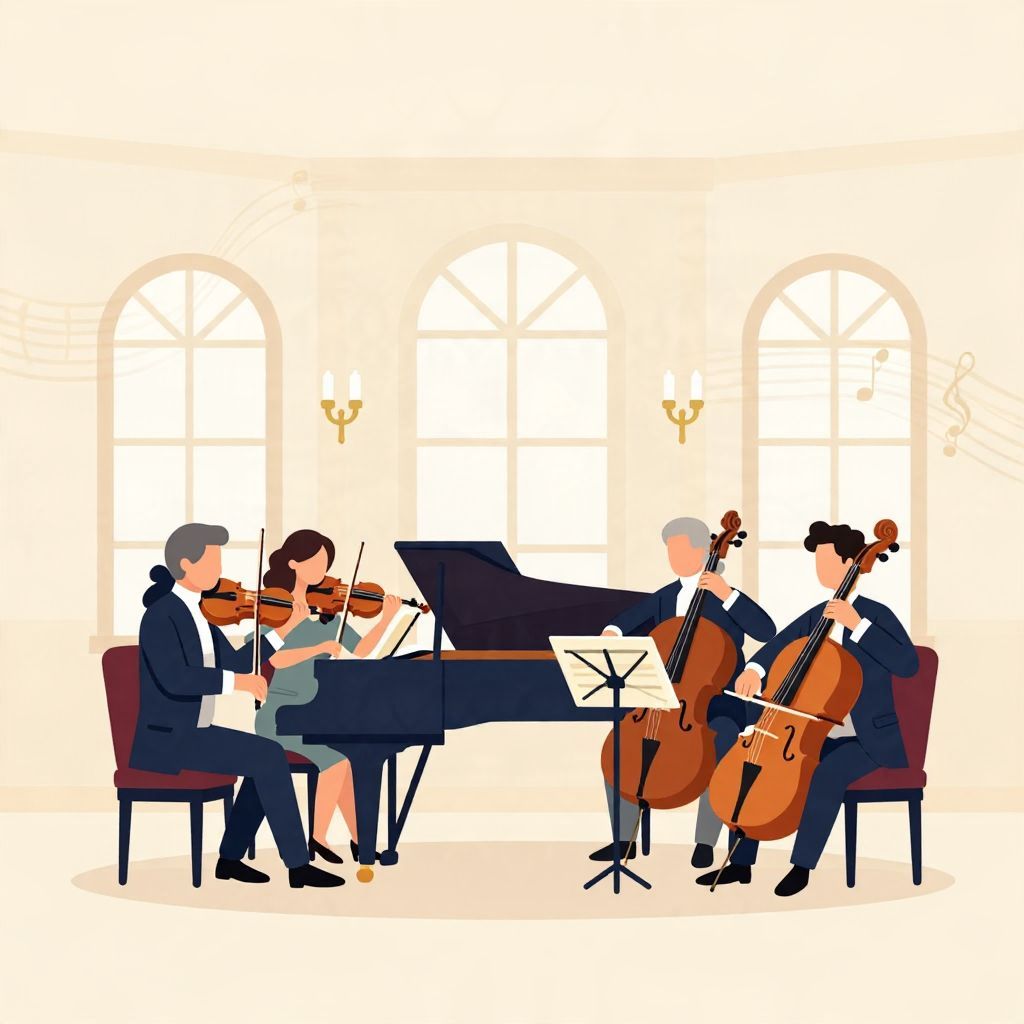
What is classical music? The phrase can mean two different things: music from the Western art-music tradition, and more specifically the late 18th-century “Classical period” associated with composers such as Haydn, Mozart, and early Beethoven. Because the term is used in both ways, its history is more complex than it first appears.
Understanding classical music means tracing how European court, church, and concert traditions developed over centuries, and how a later style name became a broad label for a whole tradition. It is a story of patronage, notation, changing audiences, and the rise of public concert life.
What Is Classical Music?
Classical music is usually the long-standing Western tradition of composed music written for performance in courts, churches, theaters, and concert halls. In a narrower historical sense, it also refers to the Classical period of roughly 1750 to 1820, when balance, clarity, and formal structure became especially important in European music.
In everyday speech, people often use “classical music” to mean any serious or art music that is not pop, jazz, or folk. Historically, however, that broad usage developed later. The music itself has roots in medieval and Renaissance Europe, while the style called “Classical” belongs to a specific era in the late 18th century.
Where Did Classical Music Come From?
Medieval foundations
The earliest foundations of Western classical music were laid in the Middle Ages, especially through the music of the Christian Church. Plainchant, often called Gregorian chant, used single melodic lines sung without instrumental accompaniment. Over time, musicians began to write down music in notation, which made it possible to preserve and develop more complex compositions.
This was a crucial turning point. Once music could be notated, composers were no longer limited to oral tradition. They could build on earlier works, create polyphony, and transmit pieces across regions and generations. That helped shape the idea of music as a written art, not just a performance practice.
Renaissance expansion
During the Renaissance, roughly the 15th and 16th centuries, composers such as Josquin des Prez and Palestrina helped refine polyphony, in which several independent melodic lines sound together. Music became more harmonically controlled and textually expressive. Secular genres also grew, including chansons, madrigals, and dance music.
Printing transformed this world. Music printing, which spread after the early 16th century, made compositions easier to distribute. As a result, styles circulated more widely across Europe, and composers increasingly wrote for audiences beyond a single court or church.
The Baroque era
The Baroque period, from about 1600 to 1750, set the stage for what most people now recognize as classical music. Composers such as Johann Sebastian Bach, George Frideric Handel, and Antonio Vivaldi developed larger forms, richer harmony, and more dramatic contrasts. Opera emerged and flourished, and instrumental music gained new prestige.
Baroque music also helped establish the orchestra and the solo concerto. Patronage from princes, churches, and wealthy institutions remained important, but public performances became more common. This gradual shift from private patronage to public listening would later shape the Classical period itself.
The Classical Period: The Core Historical Meaning
The Classical period in music usually refers to the decades from about 1750 to 1820. It is associated above all with Joseph Haydn, Wolfgang Amadeus Mozart, and the early works of Ludwig van Beethoven. Their music emphasized clear phrases, elegant melodies, balanced forms, and carefully organized harmony.
This style developed in the wider intellectual climate of the Enlightenment. Many listeners and composers valued order, proportion, and intelligibility. In music, that often meant shorter phrases, transparent textures, and forms such as the sonata, symphony, string quartet, and concerto.
Why the style changed
Several forces pushed music in this direction. Aristocratic courts still mattered, but public concerts were growing. Amateur musicians wanted music that was elegant and accessible, while professional composers sought forms that could be expanded and developed. Instrument makers also improved the piano, violin, and orchestral instruments, opening new expressive possibilities.
The result was not a sudden break from the past, but a gradual transformation. Baroque complexity did not disappear overnight, and many composers worked in overlapping styles. Still, the Classical period became distinctive enough that later historians and musicians gave it a separate name.
Key Features of Classical Music
Structure and form
One of the most important features of classical music is its attention to form. Composers often organized movements using recurring patterns and contrasts. The sonata form, for example, typically presents themes, develops them, and then returns to them in altered form. This gave music a sense of argument or journey.
Melody and harmony
Classical music often favors clear, singable melodies supported by functional harmony. Instead of dense layers of counterpoint throughout, many works highlight one main tune at a time. That does not mean the music is simple; rather, its complexity often lies in how themes are developed and transformed.
Instrumentation
Orchestras became more standardized during the Classical era, though not yet as large as many modern orchestras. Strings remained central, with winds and brass adding color and contrast. The piano gradually replaced the harpsichord as the major keyboard instrument because it allowed dynamic shading and expressive control.
Public and private settings
Classical music was performed in churches, aristocratic salons, opera houses, and public concert halls. This variety matters historically because it shaped the music’s purpose. Some works were written for worship, some for entertainment, and some for serious listening by paying audiences. The modern concert tradition grew from this mixed environment.
Important Composers and Their Historical Role
Haydn
Joseph Haydn is often called the “father” of the symphony and string quartet, though that title should be understood as shorthand rather than a literal invention claim. He did not create these forms from nothing, but he helped define them through long and influential work. His career shows how patronage and innovation could coexist.
Mozart
Mozart was a prodigy whose music combined technical mastery with dramatic insight. He wrote in many genres, including opera, chamber music, symphonies, and sacred works. His career also reflects a changing musical economy: he was not simply a court employee, but a composer navigating a more independent, public musical world.
Beethoven
Beethoven stands at the boundary between the Classical and Romantic eras. His early works fit within Classical conventions, but his later music expanded scale, emotional intensity, and formal ambition. Because of this, he is often seen as both the culmination of the Classical tradition and a bridge to the 19th century.
How Classical Music Spread Beyond the Classical Period
After 1820, composers continued to write in Classical forms even as Romantic music became dominant. The term “classical music” eventually widened to include the entire Western art-music tradition from medieval chant to modern symphonies. This broader usage became common in the 19th and 20th centuries, especially as concert institutions and music education expanded.
That broader label can be useful, but it also blurs history. A Bach fugue, a Mozart symphony, and a Stravinsky ballet are all often called classical music, yet they belong to different periods, styles, and social worlds. Historical precision matters because each arose from distinct cultural conditions.
Why Classical Music Mattered Historically
Classical music mattered not only as art, but as a social institution. It reflected the power of churches and courts, the rise of bourgeois public culture, and the growth of music publishing and concert life. It also became a marker of education and status in many societies, especially in Europe and later in the Americas.
Its influence extended beyond Europe through colonialism, migration, and global cultural exchange. Conservatories, orchestras, and opera houses spread internationally, and composers outside Europe adapted Western classical forms to local traditions. That global history is part of the music’s legacy, even when the tradition remains rooted in European origins.
Common Misunderstandings
- “Classical music” does not only mean old music. It can refer to a living tradition that continues today.
- It is not the same as the Classical period. The period is only one chapter within the larger tradition.
- It is not defined by being “serious” or “highbrow.” That is a social judgment, not a historical definition.
- It is not purely European in modern practice. While its origins are European, it became global over time.
Classical Music in Historical Perspective
So, what is classical music? Historically, it is the Western written-art tradition that grew from medieval church music, Renaissance polyphony, Baroque complexity, and the elegant forms of the late 18th-century Classical period. The term now covers much more than that specific era, but its deepest roots lie in centuries of European musical development.
In that sense, classical music is both a style and a tradition: a set of historical practices, institutions, and ideals that shaped how music was composed, performed, and heard. If you want to explore the wider cultural setting behind it, you may also find it useful to read about cultural divergence and the feudal system, both of which help explain the societies in which early European music developed.