
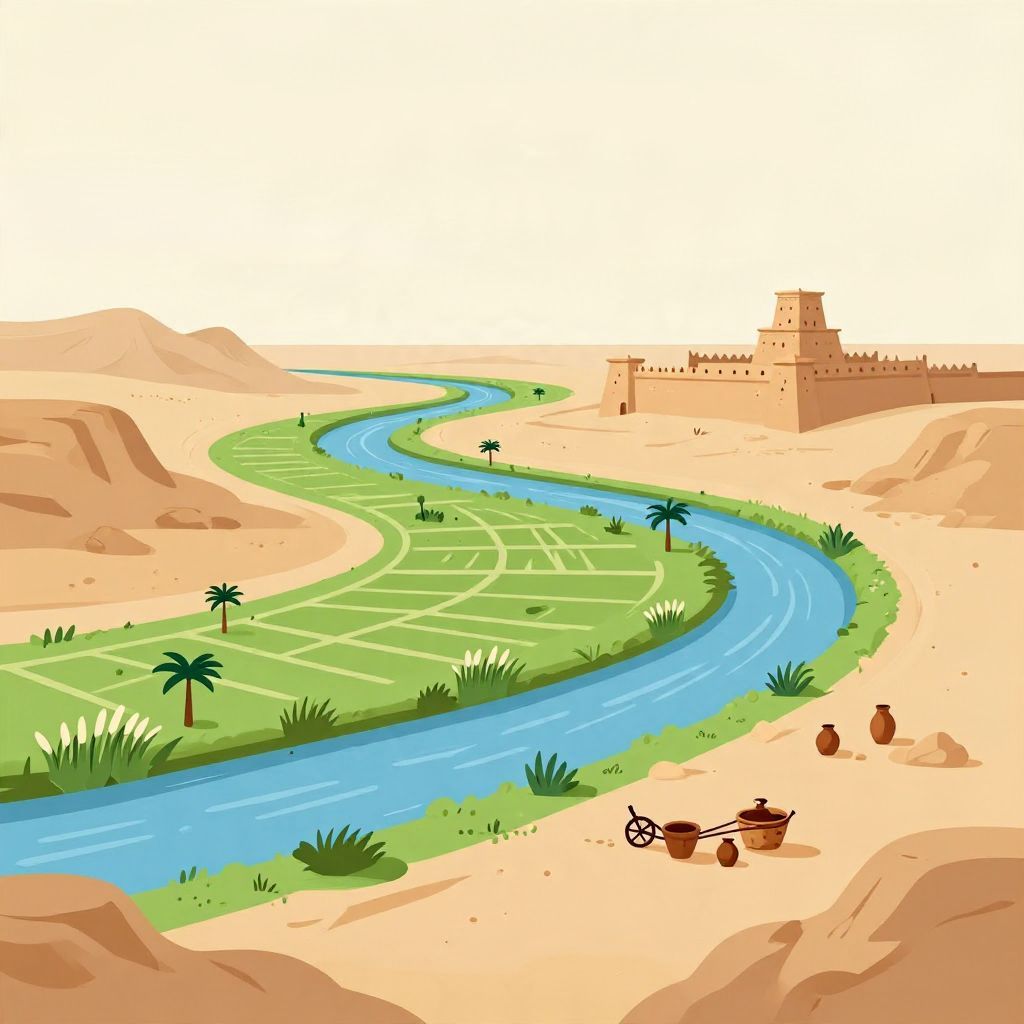
What is the Fertile Crescent, and why does it matter so much in ancient history? The term refers to a broad arc of relatively fertile land in Southwest Asia where some of the earliest farming villages, cities, states, and writing systems developed. It is one of the most important geographic regions in world history.
Its significance comes from both its environment and its human story: river valleys, seasonal rainfall, and varied landscapes helped people settle, farm, trade, and build complex societies long before many other parts of the world.
What Is The Fertile Crescent?
The Fertile Crescent is a crescent-shaped region stretching from the eastern Mediterranean through the Levant and northern Mesopotamia to the Persian Gulf. It is not a single kingdom or civilization, but a historical-geographical zone where early agriculture and some of the world’s first urban societies emerged.
Where Was the Fertile Crescent Located?
The Fertile Crescent generally included parts of modern-day Iraq, Syria, Lebanon, Israel, Palestine, Jordan, and southeastern Turkey, with connections to western Iran and Egypt’s northeastern frontier. Its outline is approximate, not fixed, because historians use the term to describe a broad ecological and cultural zone rather than strict political borders.
The main regions within it
- Mesopotamia — the land between the Tigris and Euphrates rivers, especially important for early cities and states.
- The Levant — the eastern Mediterranean coast and inland areas, including ancient Canaan and later Israelite, Phoenician, and Aramean lands.
- Northern Syria and southeastern Anatolia — areas where early farming communities and trade routes connected highlands and river plains.
Why Was It Called “Fertile”?
The region earned its name because parts of it were more suitable for agriculture than the surrounding deserts and steppe lands. Rainfall in some areas supported dry farming, while the Tigris and Euphrates rivers made irrigation possible in others. This combination helped people grow wheat, barley, lentils, and other crops and support larger settlements.
That said, “fertile” can be misleading if taken too literally. Much of the region is arid or semi-arid, and farming often depended on careful water management, seasonal floods, and human labor. The land was productive in some places, but not naturally easy everywhere.
Why Is the Fertile Crescent Important in History?
The Fertile Crescent is important because it was one of the earliest centers of the Neolithic Revolution, when humans shifted from hunting and gathering to farming and herding. This change, beginning roughly around 10,000 BCE in several nearby areas, encouraged permanent villages, population growth, specialization of labor, and eventually cities, states, and empires.
Major historical developments associated with the region
- Early agriculture — domestication of plants and animals began in multiple parts of the region.
- Permanent settlements — villages became more stable as people relied on farming.
- Urbanization — cities such as Uruk grew in southern Mesopotamia.
- Writing — cuneiform developed in Mesopotamia by the late fourth millennium BCE.
- States and empires — rulers organized taxation, armies, law codes, and administration.
When Did Human Settlement Begin There?
Human communities lived in the Fertile Crescent long before farming, but the region became especially important during the transition to agriculture after the end of the last Ice Age. Archaeologists usually date the earliest farming experiments to around 10,000–8,000 BCE, though the process was gradual and differed from place to place.
Key early cultures and sites
- Natufian culture — a late hunter-gatherer society in the Levant that showed signs of increasing settlement before full agriculture.
- Pre-Pottery Neolithic communities — early farming villages in the Levant and Upper Mesopotamia.
- Çatalhöyük and related sites — not always included in the strictest definitions of the Fertile Crescent, but often discussed in the wider story of early farming in the region.
These communities did not “invent civilization” overnight. Instead, they slowly developed new ways of living as climate, resources, and social needs changed. Farming spread unevenly, and some groups kept mobile lifeways for a long time.
How Did Geography Shape the Fertile Crescent?
Geography shaped the region’s history in powerful ways. River valleys supported irrigation, uplands offered wild grains and grazing land, and trade routes linked inland communities to the Mediterranean, Anatolia, and the Arabian Peninsula. This diversity encouraged exchange, competition, and cultural mixing.
Environmental advantages and challenges
In the north and west, rainfall could support crops without heavy irrigation. In southern Mesopotamia, however, farming depended more on canals and organized water control. Flooding could enrich fields, but it could also destroy crops and settlements. These conditions rewarded cooperation, planning, and political organization.
The same geography also made the region vulnerable to conflict. Control of water, land, and trade routes often became a cause of rivalry among cities and states.
What Civilizations Arose in the Fertile Crescent?
Many of the best-known ancient civilizations developed in the Fertile Crescent. Among them were the Sumerians, Akkadians, Babylonians, Assyrians, Phoenicians, and various peoples of Canaan and the Levant. These groups did not all share one identity, language, or government, but they were connected through trade, warfare, migration, and shared technologies.
Important civilizations and their contributions
- Sumer — among the earliest urban societies, with city-states such as Uruk and Ur.
- Akkad — associated with one of the earliest known empires under Sargon in the late third millennium BCE.
- Babylonia — famous for Hammurabi and later for major cultural and scientific traditions.
- Assyria — a powerful militarized state known for its imperial expansion.
- Phoenicia — coastal city-states influential in trade and alphabetic writing traditions.
- Canaanite societies — diverse communities in the Levant that played a central role in regional history and religion.
What Did People Invent or Develop There?
The Fertile Crescent is associated with several major developments in human history, though many of them emerged gradually and in more than one place. Among the most important were agriculture, irrigation, the wheel, writing, law codes, mathematics, and complex religious institutions.
Notable innovations
- Irrigation systems that made large-scale farming possible in drier areas.
- Cuneiform writing, first used for record-keeping and administration.
- Urban planning in early cities with temples, workshops, and administrative centers.
- Legal traditions, including famous law collections such as the Code of Hammurabi.
- Trade networks connecting the region to Anatolia, Egypt, the Persian Gulf, and beyond.
These innovations were not the product of one “inventor” or one city alone. They came from long-term social development, competition among communities, and the practical needs of managing land, labor, and resources.
How Did Religion and Culture Develop in the Fertile Crescent?
Religion was central to life in the ancient Fertile Crescent. Cities often centered on temples, and people believed that gods or divine forces influenced fertility, kingship, weather, war, and justice. Religious traditions varied widely, but many shared themes such as sacred mountains, rivers, fertility, and divine authority.
The region also became a major setting for the histories and traditions of Judaism, Christianity, and Islam. Important biblical narratives are linked to the Levant and Mesopotamia, though historians distinguish between religious tradition and archaeological evidence when discussing the past.
Culture and belief
Temples were not only religious buildings; they were also economic and administrative centers. Priests, scribes, and rulers often worked together to manage offerings, land, and labor. Art, literature, and ritual helped shape identity and political legitimacy.
What Is the Difference Between the Fertile Crescent and Mesopotamia?
Mesopotamia is only one part of the Fertile Crescent. It refers specifically to the land between the Tigris and Euphrates rivers, while the Fertile Crescent includes Mesopotamia plus the Levant and other adjoining fertile zones. In other words, Mesopotamia is a core region within the larger crescent-shaped historical area.
This distinction matters because many people use the terms interchangeably, but they are not the same. The Fertile Crescent is broader and includes a wider range of cultures and landscapes.
Is the Fertile Crescent Still a Useful Term?
Yes, but with caution. Historians and archaeologists still use the term because it helps explain why early farming and civilization developed where they did. At the same time, modern scholars recognize that the phrase can oversimplify a very diverse region and may imply a neat boundary that never really existed.
Today, the term remains useful as a teaching tool and as a shorthand for a major zone of early human development. But it should be understood as a broad historical concept, not a precise map.
Why the Fertile Crescent Still Matters
The Fertile Crescent matters because so much of early world history unfolded there: agriculture, cities, writing, law, empires, and major religious traditions. It was not the only place where human civilization developed, but it was one of the most influential. Its history shows how environment, technology, and social organization can shape the course of human life over thousands of years.
For readers interested in the broader ancient Near East, the history of Babylon and the geography of Canaan offer useful next steps into the same world. The Fertile Crescent was not just a region on a map; it was one of the great starting points of recorded history.