
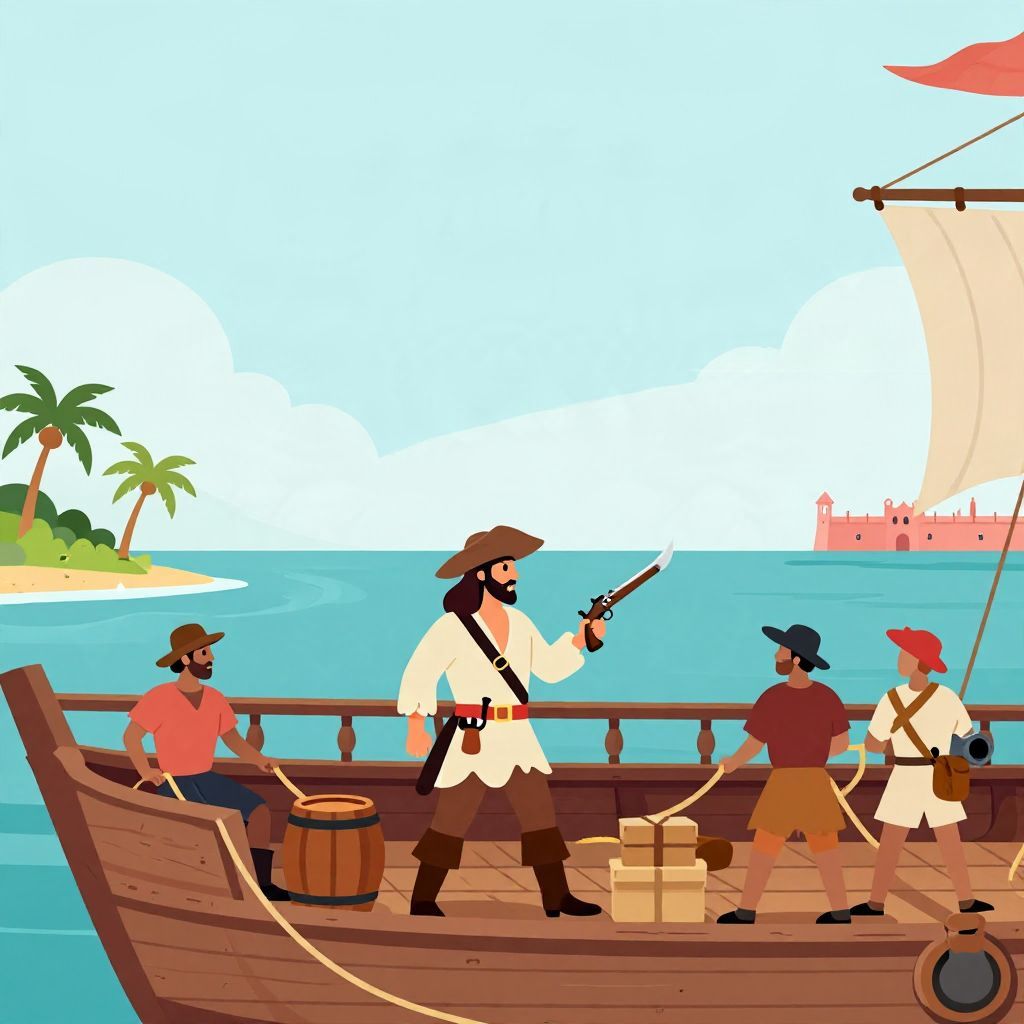
What is a buccaneer? In history, the word usually refers to a seaborne raider active in the Caribbean during the 17th century, especially men who attacked Spanish ships and settlements with a semi-legal or loosely tolerated status. Buccaneers were not simply “pirates” in the modern sense, though many did pirate-like work.
Their world grew out of imperial rivalry, war, and the profitable trade routes of the Atlantic. Some buccaneers served governments at times; others drifted into outright piracy. Their story helps explain how European empires fought for wealth, territory, and control of the sea.
What Is a Buccaneer?
A buccaneer was a Caribbean raider, usually active in the 1600s, who preyed on Spanish shipping and coastal towns. The term originally described hunters on Hispaniola and nearby islands, but it came to mean privateers and pirates operating in the Caribbean, especially during periods of Anglo-Spanish conflict.
Where Did the Word “Buccaneer” Come From?
The word has a practical, local origin. It likely comes from the French boucan, meaning a wooden frame used to smoke meat. Early buccaneers were hunters on Hispaniola who preserved meat for sale to passing ships. Over time, the term shifted from smokehouse hunter to armed sea raider.
From hunters to raiders
In the early 1600s, Europeans, escaped servants, and other migrants lived on or near islands in the Caribbean and hunted wild cattle and pigs. They smoked the meat and sold it to sailors. Because Spanish power in the region was strong but uneven, these communities developed in frontier spaces where law was weak and opportunity was high.
As conflict with Spain intensified, some of these hunters turned to raiding. They had knowledge of the islands, access to weapons, and experience surviving outside formal authority. That transition is one reason the word “buccaneer” became linked to maritime violence.
The Historical Background: Why Buccaneers Appeared
Buccaneers emerged from the wider struggle between European empires in the Atlantic. Spain claimed much of the Caribbean and mainland Americas, but English, French, and Dutch rivals challenged that dominance. The Caribbean became a zone of war, trade, smuggling, and opportunism, especially in the 17th century.
Imperial rivalry in the Caribbean
Spain’s American empire shipped silver, sugar, and other wealth across the Atlantic. Rival powers wanted access to that wealth but often lacked the naval strength to fight Spain directly. Private raiders offered a cheaper solution: they could attack Spanish commerce while blurring the line between war and crime.
At the same time, Caribbean colonies were still fragile. Settlers needed food, labor, ships, and protection. Governors sometimes tolerated raiders because they weakened Spain and brought in captured goods. This practical tolerance helped buccaneering flourish.
Buccaneers, Privateers, and Pirates: What Is the Difference?
These terms overlap, but they are not identical. A pirate attacks ships or settlements without legal authorization. A privateer has a government commission, called a letter of marque, allowing attacks on enemy shipping during war. A buccaneer was often somewhere in between: sometimes legally authorized, sometimes tolerated, and sometimes plainly illegal.
Why the distinction matters
In practice, the line was blurry. A man might begin as a privateer, continue raiding after a war ended, and then be branded a pirate. Colonial authorities often changed their minds depending on political needs. What was legal in one year could become criminal in the next.
This ambiguity is central to understanding buccaneers. They were products of imperial warfare, not romantic outlaws floating outside history. Their careers depended on shifting alliances, local governors, and the changing needs of European states.
When Were Buccaneers Most Active?
Buccaneering is most closely associated with the mid-1600s through the early 1700s. Its peak came roughly between the 1650s and 1680s, when Caribbean warfare, weak colonial control, and rich Spanish targets created ideal conditions for raiding.
A rough chronology
- Early 1600s: Hunting communities form on Hispaniola and nearby islands.
- 1650s–1660s: Buccaneers expand into organized raiding against Spanish shipping and ports.
- 1670s: Some of the most famous buccaneer expeditions reach their height.
- Late 1600s to early 1700s: European states tighten control, and buccaneering declines into broader piracy.
The decline was not sudden. As empires strengthened their navies and colonial administrations, they became less willing to tolerate semi-independent raiders. Increased patrols, treaties, and colonial consolidation made buccaneering less viable.
Who Were the Buccaneers?
Buccaneers came from varied backgrounds. Many were Europeans—especially French and English men—but the Caribbean world was mixed and mobile. Some had been sailors, soldiers, runaway servants, or adventurers. Others were former hunters or laborers who found raiding more profitable than farming or wage work.
Not a single social class
They were not all hardened criminals from the start. Some joined because they had few alternatives. Others were drawn by profit, revenge, or the chance to gain status in a frontier society. The buccaneer world was harsh, but it also offered mobility in a period when many people had little.
Women were largely excluded from buccaneer crews, though women lived in Caribbean colonial societies affected by raiding, capture, ransom, and wartime disruption. The buccaneer story is therefore not only about men at sea; it is also about the broader colonial communities they threatened.
How Did Buccaneers Operate?
Buccaneers used small, fast ships and intimate knowledge of Caribbean waters. They relied on surprise, speed, and cooperation. Their attacks were often aimed at vulnerable merchant vessels, poorly defended ports, or inland settlements reached by river or overland routes.
Common tactics
- Ambushing ships near harbors or shipping lanes
- Landing troops to attack coastal towns
- Using local pilots and guides to navigate reefs and inlets
- Sharing loot among crews according to agreed rules
Because they were usually outnumbered by the states they attacked, buccaneers depended on intelligence and audacity. They also depended on markets. Captured goods had to be sold, traded, or consumed, which meant buccaneering was tied to ports, smugglers, and colonial officials willing to look the other way.
Famous Buccaneers in History
Several names became famous in later accounts, though legend often exaggerates their exploits. Among the best-known are Henry Morgan, François l’Olonnais, and Michel de Grammont. Their careers show how buccaneering blended warfare, piracy, and political opportunism.
Henry Morgan
Henry Morgan, a Welsh buccaneer active in the 1660s and 1670s, is one of the most famous figures associated with Caribbean raiding. He led attacks on Spanish targets, including the notorious raid on Panama in 1671. Later, he was knighted and became lieutenant governor of Jamaica, showing how a raider could be absorbed into colonial power.
François l’Olonnais
François l’Olonnais gained a fearsome reputation for brutality in Spanish accounts and later pirate lore. As with many buccaneers, the surviving stories mix fact, propaganda, and sensationalism. Spanish observers had reason to depict raiders as monstrous enemies, while later writers often amplified the violence for dramatic effect.
Michel de Grammont and others
Michel de Grammont was another prominent raider whose career reflected the shifting alliances of the Caribbean. Many buccaneers moved between French, English, and Dutch spheres, depending on opportunity. Their loyalties were often practical rather than ideological.
Were Buccaneers the Same as Pirates?
Not exactly. All buccaneers could be called pirates in a broad sense if they attacked ships illegally, but historically the term “buccaneer” refers to a specific Caribbean context. Buccaneers were tied to a particular era, geography, and political environment. Pirates, by contrast, can refer to sea raiders in many periods and regions.
Why the popular image is misleading
Modern culture often collapses buccaneers, pirates, and privateers into one swashbuckling stereotype. That image is colorful, but it hides the historical reality. Buccaneers were part of colonial conflict, not simply adventurers chasing treasure. Their violence was shaped by empire, trade, and state power.
What Role Did Buccaneers Play in History?
Buccaneers mattered because they helped destabilize Spanish control in the Caribbean and exposed the limits of imperial power. They were useful to rival European states, but they were also difficult to control. In that sense, they were both tools of empire and threats to order.
Consequences for the Caribbean
Their raids contributed to insecurity in Spanish America and encouraged stronger fortifications, naval patrols, and colonial administration. Over time, European powers built more formal imperial systems, making irregular raiding less acceptable. Buccaneering helped push the Caribbean toward a more militarized and regulated colonial world.
They also left a cultural legacy. The buccaneer became a symbol of reckless freedom, violence, and maritime daring. That image survives in novels, films, and popular history, even though the real people were often desperate, opportunistic, and deeply entangled in imperial politics.
Why Did Buccaneering Decline?
Buccaneering declined because the conditions that supported it changed. European states became stronger, colonial governments more organized, and naval patrols more effective. Peace treaties also reduced the legal cover that private raiders had once enjoyed.
From tolerated raiding to criminality
Once colonial authorities no longer needed buccaneers as wartime allies, many were hunted as criminals. Some returned to ordinary seafaring or colonial life; others continued raiding elsewhere. The broader “Golden Age of Piracy” in the late 1600s and early 1700s grew partly out of this transition, as former privateers and buccaneers lost official protection.
What Is a Buccaneer in Simple Terms?
In simple terms, a buccaneer was a Caribbean raider from the age of European empire, usually in the 1600s. Buccaneers began as hunters, became armed seafarers, and often attacked Spanish targets with at least some local tolerance. They were not just pirates, but they were not fully lawful either.
Their history shows how war, trade, and empire created unstable spaces where people could move between survival, service, and crime. If you want to explore the wider world that produced them, related topics like do pirates still exist? and what is mercantilism? help explain the long economic and political forces behind buccaneering.