
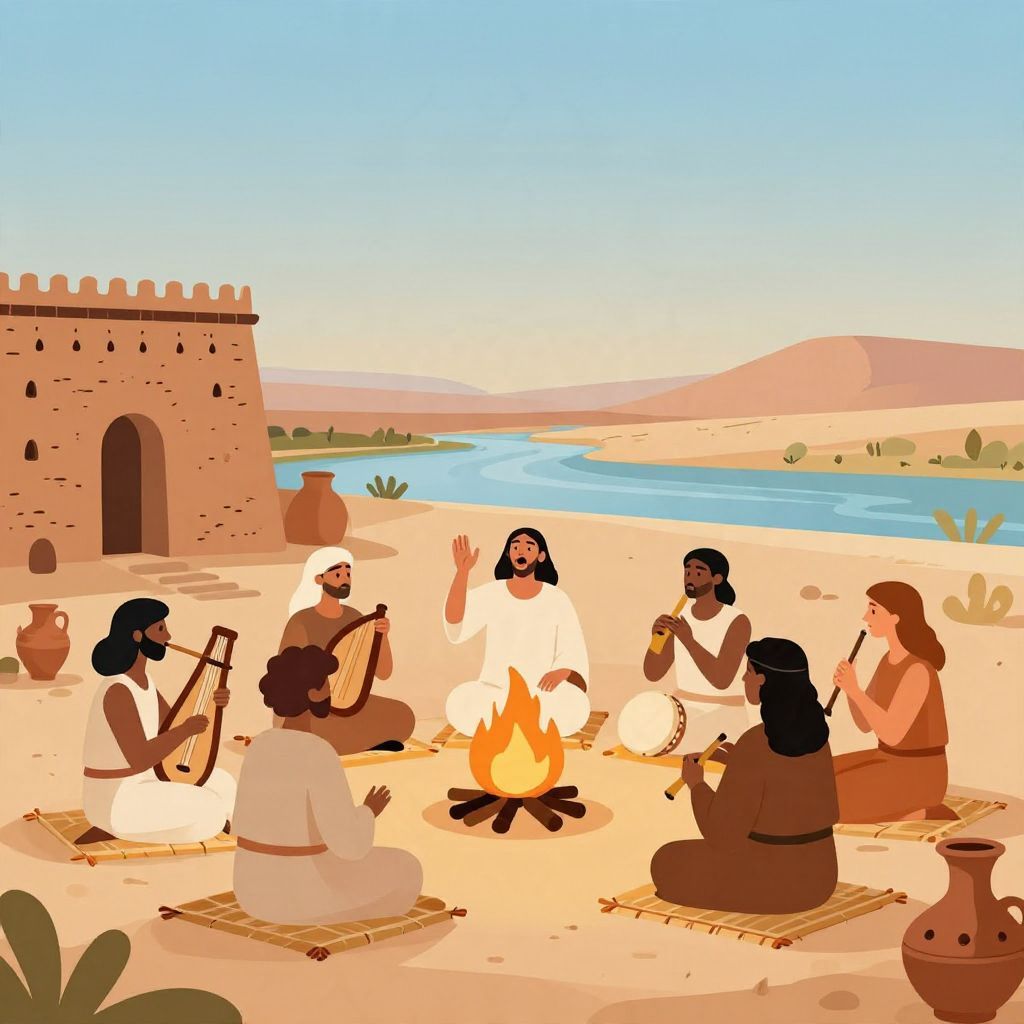
What was the first song ever made? The honest historical answer is that no one can name a single “first song” with certainty. Song likely began long before writing, in prehistoric communities where rhythm, voice, ritual, and memory blended together. What we can study are the oldest surviving songs and the earliest evidence that humans were singing thousands of years ago.
So the question is less about one identifiable invention and more about how music emerged as a human practice. The earliest written songs come from ancient Mesopotamia, Egypt, and later Greece, but the act of singing itself almost certainly predates those records by many millennia.
What was the first song ever made?
There is no known single “first song ever made.” Song almost certainly arose gradually in prehistoric human societies, before writing existed. The oldest surviving notated music comes from ancient Mesopotamia, especially a Hurrian hymn from around 1400 BCE, but that is only the earliest song we can partly reconstruct, not the first one humans ever sang.
Why historians cannot identify one first song
Music leaves few traces unless people write it down, carve it, or preserve the instruments used to make it. For most of human history, songs were passed orally. That means the earliest songs were likely lost as soon as the groups that sang them disappeared, changed, or mixed with others. The “first song” may have been a lullaby, chant, work song, ritual call, or improvised melody.
Song likely came before writing
Writing appeared only about 5,000 years ago, while Homo sapiens have existed for roughly 300,000 years. Many scholars think music and speech developed together, because singing can help with memory, social bonding, and emotional expression. In that sense, song is probably one of humanity’s oldest cultural behaviors, even if its true beginning cannot be dated.
What counts as a song?
Definitions matter. A “song” may mean any vocal music, or it may mean a piece with lyrics, melody, and structure. If the definition is broad, the first song could have been a repeated chant or call. If it is narrow, the earliest known examples are formal compositions from the ancient Near East. Because the definition changes the answer, historians avoid naming a single universal first song.
The oldest surviving songs we know about
While we cannot identify the first song ever made, we can identify some of the oldest surviving songs from the ancient world. These are the earliest pieces of music that scholars can study from written or notated evidence. They show that organized song was already well developed in early civilizations.
The Hurrian Hymn No. 6
The most famous candidate for the oldest surviving song is the Hurrian Hymn No. 6, found on clay tablets at Ugarit, in modern Syria, and dated to around 1400 BCE. It is dedicated to the goddess Nikkal. The tablet includes instructions for tuning and performance, making it one of the earliest examples of written music we can partially interpret.
Even so, it is not the “first song ever made.” It is simply the oldest substantially preserved song known to modern scholarship. The melody is incomplete and reconstructed from ancient notation, so modern performances are educated interpretations rather than exact reproductions.
Egyptian and Mesopotamian musical traditions
Long before the Hurrian hymn, people in Mesopotamia and Egypt used music in temples, courts, and daily life. Texts, images, and instruments such as lyres and harps show that singing was part of religious ceremony and elite culture. However, the melodies themselves were usually not written down in a way that survives clearly enough for us to recover them.
Ancient Greek song and poetry
In ancient Greece, song and poetry were closely linked. Epics, hymns, and lyric poetry were often performed with musical accompaniment. Greek thinkers later wrote about music theory, rhythm, and modes, but most early Greek songs survive only as texts, not as complete melodies. This makes them important historically, but not candidates for the first song overall.
How song may have begun in prehistoric times
Because the earliest songs were not written down, historians and archaeologists rely on indirect evidence. Human singing may have started as a way to communicate emotion, coordinate labor, soothe children, or reinforce group identity. These uses would have given song practical value long before it became an art form.
Possible functions of the earliest songs
- Ritual: chants and repeated vocal patterns may have accompanied ceremonies or beliefs about spirits and the natural world.
- Work: rhythm could help people move together while rowing, lifting, grinding, or marching.
- Bonding: singing together strengthens social ties and shared identity.
- Memory: melody and repetition make stories, laws, and traditions easier to remember.
- Soothing: lullabies and calming vocal sounds may have been among the earliest uses of song in family life.
Music before instruments
Song does not require instruments. The human voice itself is an instrument, and it is likely that vocal music came first. Instruments such as flutes, drums, and lyres later expanded what music could do, but early singing may have depended only on breath, pitch, rhythm, and repetition. That is one reason the origins of song are so hard to trace archaeologically.
What the earliest evidence tells us
The oldest evidence does not reveal a single inventor or a single birthplace for song. Instead, it shows that music developed across many early societies. By the time writing appeared, song already had social, religious, and artistic importance. The surviving record points to a long prehistory rather than a sudden invention.
Key milestones in the history of early song
- Prehistory: humans likely used vocal music long before writing.
- Early civilizations: songs became part of ritual, labor, and entertainment.
- c. 1400 BCE: the Hurrian Hymn No. 6 appears in written form.
- Classical antiquity: Greek and other Mediterranean cultures develop richer written traditions about music.
- Later centuries: musical notation improves, allowing more songs to survive in recognizable form.
Why the “first song” question remains popular
People often ask about the first song because it touches a deeper curiosity: when did humans begin to create art? Song sits at the intersection of language, emotion, religion, and community. Unlike tools or weapons, it leaves little physical evidence, so it feels mysterious. That mystery is part of why the question remains so appealing.
Popular myths versus historical evidence
Some popular accounts try to name a specific ancient tune as the first song in the world. Those claims usually confuse the oldest surviving written song with the first song ever created. History supports the former, not the latter. The difference is important: the oldest preserved song is not the same as the origin of song itself.
So what is the best answer?
The best historical answer is that the first song ever made is unknown and probably unknowable. Song likely emerged gradually in prehistoric human culture, long before writing. The oldest surviving song we can study is usually identified as the Hurrian Hymn No. 6, from around 1400 BCE, but it is not the first song humans ever sang.
In other words, the origin of song belongs to deep prehistory, while the oldest recoverable songs belong to ancient civilizations. If you want to explore that distinction further, you may also be interested in what the oldest song in the world is and what the first word ever said was.