
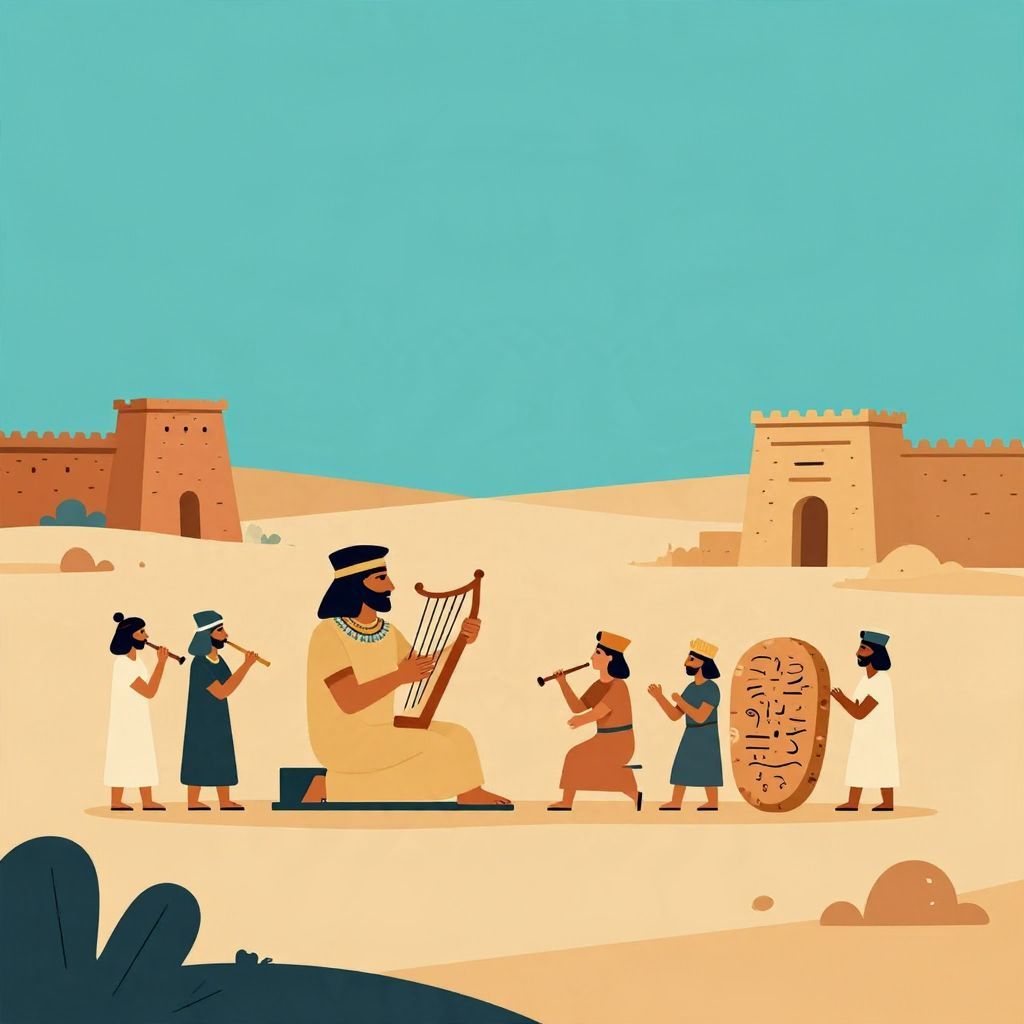
What is the oldest song in the world? The short answer is that no one can prove a single “first song,” because music existed long before writing. But the oldest surviving song that can be reconstructed with confidence is usually identified as a Hurrian hymn from ancient Ugarit, written down around 1400 BCE in what is now Syria.
That said, the answer depends on what counts as a song: a melody, lyrics, notation, or a complete performance. Ancient music survives only in fragments, so historians and musicologists work with evidence, interpretation, and a fair amount of caution.
What Is The Oldest Song In The World?
The oldest surviving song generally accepted by scholars is the Hurrian Hymn No. 6, a cuneiform tablet from ancient Ugarit dated to roughly 1400 BCE. It includes instructions for tuning and a hymn dedicated to the goddess Nikkal. Because the tablet preserves both text and musical notation, it is the earliest known notated song that can be studied today.
Why There Is No Single “First Song”
Humans almost certainly sang long before they developed writing. Vocal music may be as old as language itself, but prehistoric songs left no direct record. Because of that, historians can identify only the oldest surviving written or notated songs, not the first song ever sung by human beings.
Music before writing
Archaeology shows that early humans used flutes, drums, and other sound-making tools thousands of years before the earliest written songs. These finds suggest rich musical traditions in prehistory, but they do not preserve actual melodies in a way we can reconstruct with certainty.
What counts as a song?
The question becomes even more complicated when scholars compare different ancient sources. A song may be:
- a text meant to be sung,
- a melody written in symbols,
- a hymn with words and musical instructions, or
- a later reconstruction from fragmentary evidence.
For this reason, “oldest song” can mean different things in different contexts.
The Hurrian Hymn No. 6: The Oldest Known Notated Song
The strongest candidate for the world’s oldest surviving song is the Hurrian Hymn No. 6, discovered among the ruins of ancient Ugarit on the Mediterranean coast of modern Syria. It is written in the Hurrian language on a clay tablet and is generally dated to around 1400 BCE. The tablet includes musical notation and performance instructions, making it uniquely valuable.
What the tablet says
The hymn is dedicated to Nikkal, a goddess associated with orchards and fertility. The text is incomplete, and the notation is difficult to interpret because ancient Mesopotamian musical systems do not map neatly onto modern notation. Even so, the tablet provides rare evidence of how music may have been composed and performed in the ancient Near East.
Where it was found
Ugarit was a prosperous port city and cultural crossroads in the Late Bronze Age. Its archives preserved diplomatic letters, myths, legal texts, and religious material in several languages. The city’s scribes were highly educated, and their tablets offer one of the best windows into ancient music theory and ritual practice.
Why scholars value it
The Hurrian hymn matters because it is not just a poem about music. It is one of the earliest surviving attempts to notate a melody or musical framework. That makes it the closest thing we have to an “oldest song” in the modern sense of a preserved musical composition.
Other Ancient Songs Often Mentioned in the Debate
Several other ancient compositions are sometimes called the oldest song in the world, but they do not usually have the same claim as the Hurrian hymn. Some are older as texts, while others are later but better preserved.
The Seikilos epitaph
The Seikilos epitaph, from ancient Greece, is often famous because it is the oldest surviving complete musical composition with both words and notation that can be read with relative confidence. It dates to around the 1st century CE, making it much later than the Hurrian hymn, but easier to interpret. Its famous opening line is often translated as a reminder to live joyfully, though translations vary.
Egyptian and Mesopotamian ritual texts
Ancient Egypt and Mesopotamia produced many hymns, prayers, and liturgical songs. Some are very old as literary texts, but they usually lack enough musical notation to reconstruct the tune. In those cases, we know the words survived, but not the exact music.
Chinese and other early traditions
Ancient China, India, and other civilizations had deep musical traditions, but the surviving evidence is often later than the earliest Near Eastern examples or survives in forms that are difficult to compare directly. This does not mean those cultures lacked ancient music; it means the historical record is uneven.
How Scholars Reconstruct Ancient Music
Reconstructing the oldest songs is part archaeology, part linguistics, and part music theory. Scholars compare tablets, inscriptions, tuning systems, and the structure of ancient instruments to estimate how a piece may have sounded. The result is always an informed reconstruction, not a perfect recording.
Why ancient notation is hard to read
Ancient musical notation often used symbols that referred to strings, intervals, or tuning patterns rather than exact modern pitches. In the case of the Hurrian hymn, scholars must interpret the tablet through the lens of ancient Mesopotamian theory, which is only partly understood. Different reconstructions can therefore sound different from one another.
What we can know with confidence
Even when the exact melody is uncertain, historians can still say important things with confidence:
- the approximate date of the tablet,
- the language and cultural setting,
- the religious purpose of the song, and
- the fact that ancient musicians used systems of tuning and notation.
What the Oldest Song Tells Us About Ancient Civilizations
The oldest surviving song is more than a curiosity. It shows that music was deeply embedded in religion, education, and elite culture in the ancient Near East. Songs were not only entertainment; they were part of worship, identity, and the organization of knowledge.
Music and religion
In many ancient societies, music served sacred purposes. Hymns were offered to gods and goddesses, and performance may have accompanied ritual events in temples or palaces. The Hurrian hymn fits this pattern, linking music to devotion and ceremony.
Music and scribal culture
Writing down music required trained scribes and a system for preserving performance. That means the oldest surviving song comes from a literate administrative world, not from a folk tradition that left no written trace. This is one reason the historical record is biased toward powerful urban civilizations.
So, Is the Hurrian Hymn Really the Oldest Song?
It is the oldest surviving notated song generally recognized by scholars, but not necessarily the oldest song ever composed. Because earlier music was probably transmitted orally, we cannot identify the very first song in human history. The Hurrian hymn is the earliest known example that survives in a form we can still study.
Why the wording matters
Popular articles often say “oldest song in the world” without explaining the difference between:
- the oldest song ever sung,
- the oldest song text,
- the oldest surviving notation, and
- the oldest song that can be performed today.
Only the third category can be answered with some confidence, and even then the answer is approximate.
Key Facts About the Oldest Known Song
- Name: Hurrian Hymn No. 6
- Date: around 1400 BCE
- Place: Ugarit, in modern-day Syria
- Language: Hurrian
- Subject: a hymn to the goddess Nikkal
- Importance: oldest surviving notated song known to scholars
The Lasting Significance of the Oldest Song
The oldest song in the world matters because it reveals how ancient people thought about sound, ritual, and memory. It also reminds us that music is one of humanity’s oldest arts, even if the earliest performances have vanished without a trace. The surviving tablet is only a fragment, but it connects modern listeners to a world more than 3,000 years old.
If you are interested in the broader world that produced ancient music, you may also enjoy reading about how old Latin is and what the oldest city in America is. Both topics help place early language and civilization in the wider historical landscape. In the end, the oldest song we know is not the first song humanity ever sang, but it is the earliest one history has managed to preserve.