
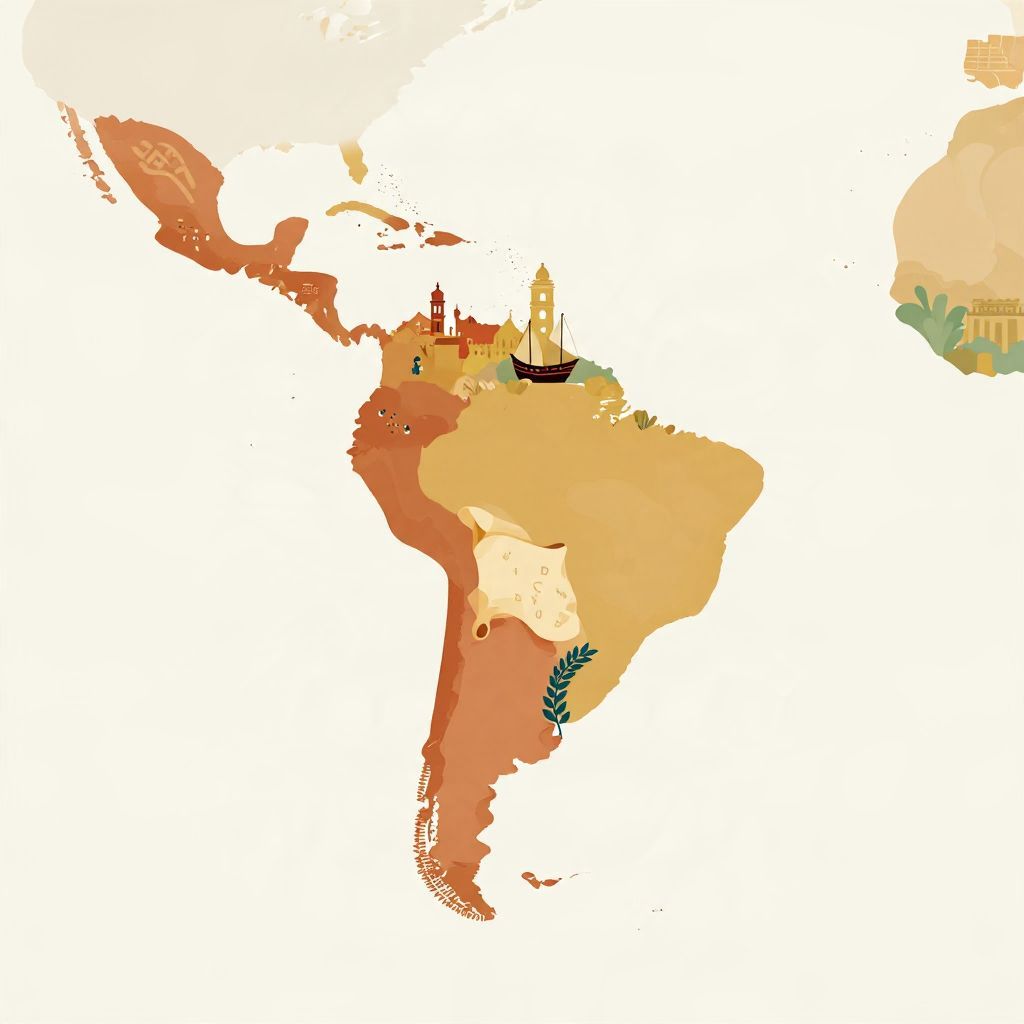
Why is it called Latin America? The short answer is that the name refers to the region’s Romance-language heritage—especially Spanish and Portuguese, and sometimes French—languages descended from Latin. The term did not arise in the colonial period itself, but in the 19th century, when intellectuals and politicians were trying to define the Americas in cultural and geopolitical terms.
That makes the name both linguistic and political. It describes a broad region shaped by Iberian colonization, Indigenous civilizations, African diasporas, and later migrations, while also reflecting debates over identity, empire, and power.
Why Is It Called Latin America?
It is called Latin America because many of its countries use languages derived from Latin—mainly Spanish and Portuguese, and in some definitions French. The label emerged in the 1800s to distinguish these countries from English-speaking “Anglo-America” and to emphasize a shared cultural and historical background shaped by European colonization.
The Historical Origins of the Term
A 19th-century idea, not a colonial-era name
The phrase Latin America is relatively modern. It was not the name used by Indigenous peoples, nor was it the standard label during the first centuries of Spanish and Portuguese rule. The term became common in the mid-19th century, especially in intellectual and political circles in Europe and the Americas, as nations in the region were forming after independence.
That timing matters. After the Spanish American wars of independence in the early 1800s, new republics needed ways to define themselves. At the same time, the United States was expanding across North America, and European powers were still competing for influence in the hemisphere. “Latin America” helped frame the region as a distinct civilizational bloc.
Why “Latin”?
The word “Latin” points to the Roman roots of Spanish, Portuguese, and French. These languages developed from spoken Latin after the fall of the Roman Empire. In the 19th century, thinkers used “Latin” to group peoples whose languages and cultures were seen as sharing a common heritage, in contrast to “Anglo-Saxon” or English-speaking societies.
In practice, the term was never purely linguistic. It also carried ideas about religion, law, literature, and political identity. Because most of the region had been colonized by Catholic powers—especially Spain and Portugal—“Latin” suggested a shared Iberian and Catholic past.
Who Popularized the Name?
French intellectual and imperial interests
Several scholars and writers helped popularize the term, and there is no single inventor accepted by all historians. One important figure often associated with the idea is the Chilean thinker Francisco Bilbao, who used related language in the 1850s. Around the same time, French intellectuals and officials promoted the concept of “Latin America” to support France’s cultural and political influence in the region.
For France, the term had strategic value. If the Americas were divided into “Latin” and “Anglo-Saxon” zones, then French influence could be presented as natural and legitimate in the “Latin” half. This was especially relevant during the reign of Napoleon III, when France intervened in Mexico in the 1860s and briefly installed Emperor Maximilian.
A name with political uses
The term was attractive because it did more than describe language. It suggested a family of nations with common interests. That idea could be used in different ways: by Latin American elites seeking solidarity, by European imperial powers seeking influence, and later by pan-American thinkers trying to resist outside domination.
So while the name sounds descriptive, it was also ideological. It helped create a regional identity that was never fully neutral.
What Regions Does “Latin America” Include?
The broadest definition
In the broadest sense, Latin America includes the countries in the Americas where Romance languages are dominant. That usually means:
- Spanish-speaking countries in Mexico, Central America, South America, and the Caribbean
- Portuguese-speaking Brazil
- Sometimes French-speaking areas such as Haiti, French Guiana, and parts of the Caribbean, depending on the context
Because definitions vary, the term is not perfectly fixed. Some people use it to mean all of Spanish- and Portuguese-speaking America. Others include French-speaking territories because French is also a Romance language. In everyday use, however, many speakers primarily think of Spanish America plus Brazil.
Why Brazil is included
Brazil is part of Latin America because Portuguese is a Romance language descended from Latin. Although Brazil’s history differs from that of Spanish America in important ways, it shares the same broad colonial framework: European conquest, plantation economies, slavery, Catholic influence, and independence in the 19th century.
Brazil’s inclusion is a reminder that “Latin America” is a cultural and linguistic category, not a single political system or ethnic identity.
Why the Term Became Useful in the 1800s
Independence and new national identities
After independence, the former Spanish colonies were no longer part of a single empire. New states such as Mexico, Colombia, Argentina, Chile, and Peru had to define themselves both individually and collectively. The term “Latin America” offered a way to express unity without erasing national differences.
It also helped intellectuals think about the region as something more than a collection of former colonies. They could argue that these countries shared a historical experience shaped by conquest, Catholicism, plantation labor, and mixed populations, even if each nation had its own political path.
Distinguishing the region from the United States and Britain
In the 19th century, the Americas were also being divided by language, empire, and race in political discourse. “Anglo-America” referred to English-speaking North America, especially the United States and Canada. “Latin America” became the counterpart: the Spanish-, Portuguese-, and sometimes French-speaking south and center of the hemisphere.
This contrast was not merely academic. It reflected real competition over trade, territory, and influence. The name gave Latin American elites a vocabulary for asserting a separate identity in a hemisphere increasingly dominated by the United States.
What the Name Leaves Out
Indigenous peoples and African descendants
One limitation of the term is that it emphasizes European languages and ancestry while obscuring older and equally important histories. Long before Spanish and Portuguese conquest, the Americas were home to major Indigenous civilizations such as the Maya, Mexica (Aztec), Inca, and many others. Their languages, political systems, and cultural traditions remain central to the region’s history.
The term also does not fully reflect the African presence in the Americas. Millions of Africans were forcibly brought to the region through the Atlantic slave trade, and African-descended communities have profoundly shaped language, religion, music, food, and politics across Latin America.
A useful label, but not a complete description
Because of this, historians often treat “Latin America” as a practical category rather than a complete explanation of the region. It is useful for discussing colonial legacies and language families, but it can flatten enormous diversity. The region includes deserts, rainforests, highland empires, plantation colonies, major cities, and many distinct peoples.
In other words, the name tells part of the story, but not all of it.
How the Meaning Changed Over Time
From imperial language to regional identity
In the 19th century, the term could be used by outsiders to justify influence, especially French imperial projects. Over time, however, Latin American writers, politicians, and activists also adopted it for their own purposes. They used it to promote solidarity, anti-imperialism, and shared development goals.
By the 20th century, “Latin America” had become a standard term in diplomacy, scholarship, journalism, and education. It no longer belonged to one political project. Instead, it became a broad regional label used in many contexts, from economics to literature to migration studies.
Related terms you may hear
- Ibero-America: usually refers to Spanish- and Portuguese-speaking countries of the Americas, emphasizing Iberian roots
- Hispanic America: usually refers only to Spanish-speaking countries, excluding Brazil
- Anglo-America: generally refers to English-speaking North America
These terms overlap, but they are not identical. The differences show how naming the Americas has always involved choices about language, empire, and identity.
The Deeper Historical Context
Colonization and language spread
The reason the region is “Latin” begins with European expansion after 1492. Spain and Portugal conquered vast territories in the Americas and established colonial societies where their languages, legal systems, and Catholic institutions became dominant. Over centuries, Spanish and Portuguese spread through administration, trade, conversion, intermarriage, and coercion.
Yet this spread did not erase earlier cultures. Many Indigenous languages survived, and in some places they remain widely spoken today. The region’s linguistic map is therefore the result of conquest, resistance, adaptation, and mixing.
Race, class, and nation-building
The label “Latin America” also reflects the social hierarchies created in colonial society. European-born elites, creole elites, Indigenous communities, enslaved Africans, and mixed-race populations all lived within systems of unequal power. After independence, new nations inherited many of those inequalities.
Because of that, the term has sometimes been used to suggest a shared civilization while ignoring internal divisions. Modern historians are careful to treat it as a historical construct rather than a timeless identity.
So, Why Is It Called Latin America?
It is called Latin America because the region is dominated by languages derived from Latin, especially Spanish and Portuguese, and because 19th-century thinkers used that linguistic fact to define a cultural and political region distinct from Anglo-America. The name reflects colonial history, post-independence identity, and international power politics all at once.
That is why the term has endured: it is useful, recognizable, and historically meaningful, even though it simplifies a very diverse part of the world. If you want to explore the region’s linguistic history further, see why Brazilians speak Portuguese and the broader background in why it is called Latin America.