
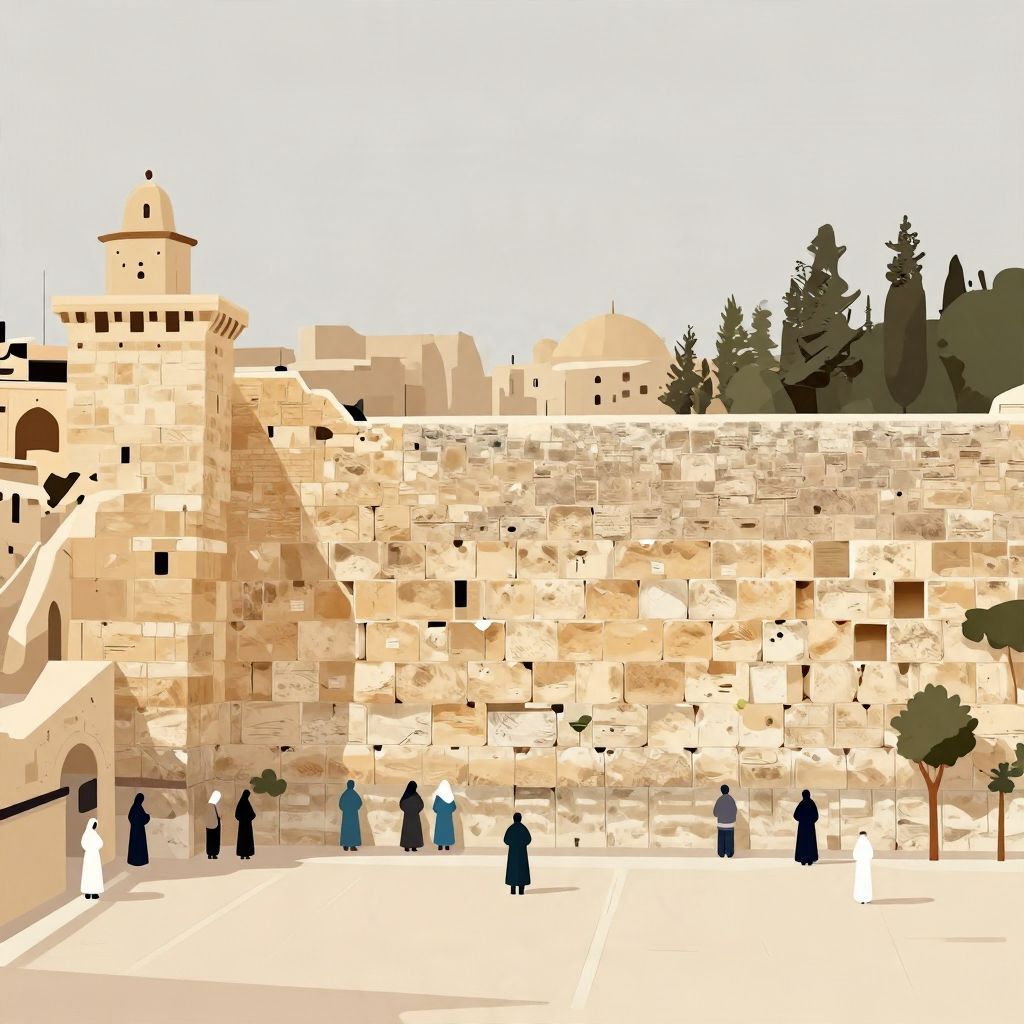
The Western Wall is one of the most important religious and historical sites in Jerusalem. It is best known as a place of Jewish prayer, mourning, and pilgrimage, but its meaning reaches far beyond the stone itself.
To understand what the Western Wall is, you need to know that it is a surviving retaining wall from the Second Temple period, built to support the expanded Temple Mount platform in the late first century BCE. It is not the wall of the ancient Temple itself, but a remnant of the monumental complex that surrounded it.
What Is the Western Wall?
The Western Wall is an ancient limestone retaining wall on the western side of the Temple Mount in Jerusalem. Built under Herod the Great around the late first century BCE, it supported the enlarged platform of the Second Temple. It became a sacred place of Jewish devotion after the Temple’s destruction in 70 CE.
Origins of the Western Wall
Herod’s Temple expansion
The Western Wall dates to the reign of Herod the Great, the client king of Judea under Roman rule. Around 20–19 BCE, Herod began a massive rebuilding and expansion of the Second Temple complex. He enlarged the Temple Mount by constructing huge retaining walls on all four sides and filling in the space behind them to create a broad, level platform.
The wall visible today is part of that engineering project. It was designed to hold back the earth and support the expanded sacred precinct, not to serve as a standalone monument. The Temple itself stood above and within this enclosure, closer to the center of the platform.
A wall that survived destruction
When the Romans destroyed Jerusalem and the Second Temple in 70 CE, much of the temple complex was demolished. The retaining walls, however, were partly left standing because of their massive construction and structural role. Over time, the western retaining wall became the most visible and accessible surviving remnant of the Herodian Temple complex.
That survival shaped its later significance. For Jews, the wall came to symbolize the loss of the Temple and the endurance of the people’s connection to Jerusalem. For historians, it is also a major archaeological witness to Herodian architecture and Roman-era Jerusalem.
Why the Western Wall Matters in Jewish History
A place of memory and mourning
After the destruction of the Temple, Jewish religious life changed profoundly. Sacrifice at the Temple could no longer continue, and prayer, study, and communal worship became central. The Western Wall became associated with lamentation over the Temple’s loss and with hope for restoration. In Jewish tradition, it is often called the Kotel, meaning “wall.”
The wall’s importance grew over centuries rather than appearing all at once. Different periods of rule in Jerusalem—Roman, Byzantine, Islamic, Crusader, Mamluk, Ottoman, British, Jordanian, and Israeli—each affected access to the site. Yet the wall remained a powerful symbol of continuity for Jews in the diaspora and in the land of Israel.
Prayer and pilgrimage
By the medieval period, Jewish travelers and writers were describing the Western Wall as a place where worshippers gathered to pray near the remains of the Temple. In later centuries, especially under Ottoman rule, Jewish access was limited and sometimes contested, but the site retained deep devotional meaning.
Today, the Western Wall is one of the most visited religious sites in the world. Visitors place written prayers into the cracks between the stones, a modern custom that reflects the wall’s role as a place of petition and remembrance.
What the Wall Actually Is: Archaeology and Architecture
Not the Temple wall itself
A common misunderstanding is that the Western Wall was once a wall of the Temple building itself. In fact, it is a retaining wall for the Temple Mount platform. The Temple stood above and within the enclosure, while the wall helped create and stabilize the vast raised area on which the sanctuary complex sat.
This distinction matters historically. It explains why the wall survived when the Temple did not, and why the site is both an architectural remnant and a sacred symbol.
Massive stone construction
The visible wall is built from large limestone blocks, many of them carefully dressed and fitted without mortar in the Herodian style. Archaeologists have identified different construction phases, with the lower courses generally associated with Herod’s period and upper sections added in later eras. The wall extends much farther underground than what is visible at street level.
Some of the exposed stones are among the most impressive examples of ancient masonry in Jerusalem. Their size and precision reflect the ambitions of Herod’s building program, which also included extensive work on the Temple platform and other monumental projects across the region.
How the Western Wall Became a Sacred Site
From ruin to ritual center
The Western Wall did not become sacred simply because it was old. Its religious importance developed through Jewish memory, liturgy, and repeated association with the destroyed Temple. Over time, the wall became the most accessible surviving point near the former Holy of Holies area, the most sacred part of the ancient Temple complex.
Because the exact location of the Holy of Holies is traditionally associated with the Temple Mount, many Jews regard the area around the wall with exceptional reverence. At the same time, Jewish law and custom have varied over time regarding how close one should approach the Temple Mount itself, which has contributed to the wall’s special role as a place of prayer outside the most sensitive inner precincts.
Medieval and early modern accounts
Travelers from the medieval Jewish world often described the wall as a place of weeping, prayer, and longing for redemption. These accounts helped reinforce its status in the collective imagination. Under Ottoman rule, the wall area was generally accessible to Jews, though the conditions of access could be restrictive and politically sensitive.
By the nineteenth and early twentieth centuries, the Western Wall had become a focal point of Jewish communal life in Jerusalem and a site of increasing political tension as competing national and religious claims to the city intensified.
The Western Wall in the Modern Era
British Mandate and rising conflict
During the British Mandate period after World War I, disputes over access and rights at the Western Wall became more pronounced. Tensions between Jewish and Muslim communities in Jerusalem, as well as broader nationalist conflict in the region, made the site politically charged. The wall was no longer only a religious landmark; it had become a symbol in a larger struggle over sovereignty and identity.
1948 to 1967
After the 1948 Arab-Israeli War, the Old City of Jerusalem and the Western Wall came under Jordanian control. Jewish access to the site was cut off for nearly two decades. This period deepened the wall’s symbolic importance in Jewish memory, especially as a lost place of prayer.
In 1967, during the Six-Day War, Israel captured East Jerusalem, including the Old City. The Western Wall was then opened to Jewish worshippers again. The area in front of the wall was cleared and reorganized into the large prayer plaza seen today.
The wall today
Today, the Western Wall is a major site of worship, national ceremony, tourism, and archaeological study. It is managed in a way that reflects both religious practice and political sensitivity. The plaza is divided according to Orthodox Jewish custom, with separate prayer sections for men and women, though this arrangement has also been the subject of debate in modern Jewish life.
Because the site lies in one of the world’s most contested cities, it remains both spiritually central and politically sensitive. Its meaning can differ depending on whether one approaches it as a believer, a historian, an archaeologist, or a visitor.
Key Facts About the Western Wall
- Location: Western side of the Temple Mount in Jerusalem
- Original period: Late first century BCE, during Herod the Great’s reign
- Function: Retaining wall supporting the Temple Mount platform
- Religious significance: One of Judaism’s holiest accessible prayer sites
- Historic turning point: Survived the Roman destruction of the Second Temple in 70 CE
- Modern significance: Symbol of Jewish continuity, memory, and national identity
Common Misconceptions About the Western Wall
It is not the “Wailing Wall” in a literal sense
The term “Wailing Wall” is a popular English name that reflects the sight of Jews mourning the Temple’s destruction at the site. Many Jews prefer “Western Wall” or “Kotel,” since the older label can sound misleading or reductive. The wall is not simply a place of sorrow; it is also a place of prayer, celebration, and historical identity.
It is not the only surviving part of the Temple complex
The Western Wall is the most famous surviving remnant, but it is not the only one. Other archaeological remains from the Herodian Temple Mount area survive underground or around the perimeter. Still, the Western Wall became the most visible and symbolically powerful because of its accessibility and later religious use.
Its meaning has changed over time
The wall’s significance was not fixed in antiquity. It became a sacred focus through centuries of religious practice, historical loss, and communal memory. That long development is part of what makes the site so important to understanding Jerusalem’s past.
Why the Western Wall Still Matters
The Western Wall is important because it connects architecture, religion, and history in one place. It is a surviving piece of Herodian Jerusalem, a witness to the Roman destruction of the Second Temple, and a living sacred site for Jewish prayer. Few ancient structures have remained so physically present while also accumulating so much symbolic meaning.
In that sense, the Western Wall is more than a wall. It is a historical remnant that became a religious landmark, a national symbol, and a reminder of how places can carry memory across millennia. For related background, you may also want to read about the Ark of the Covenant and what a kippah is.