
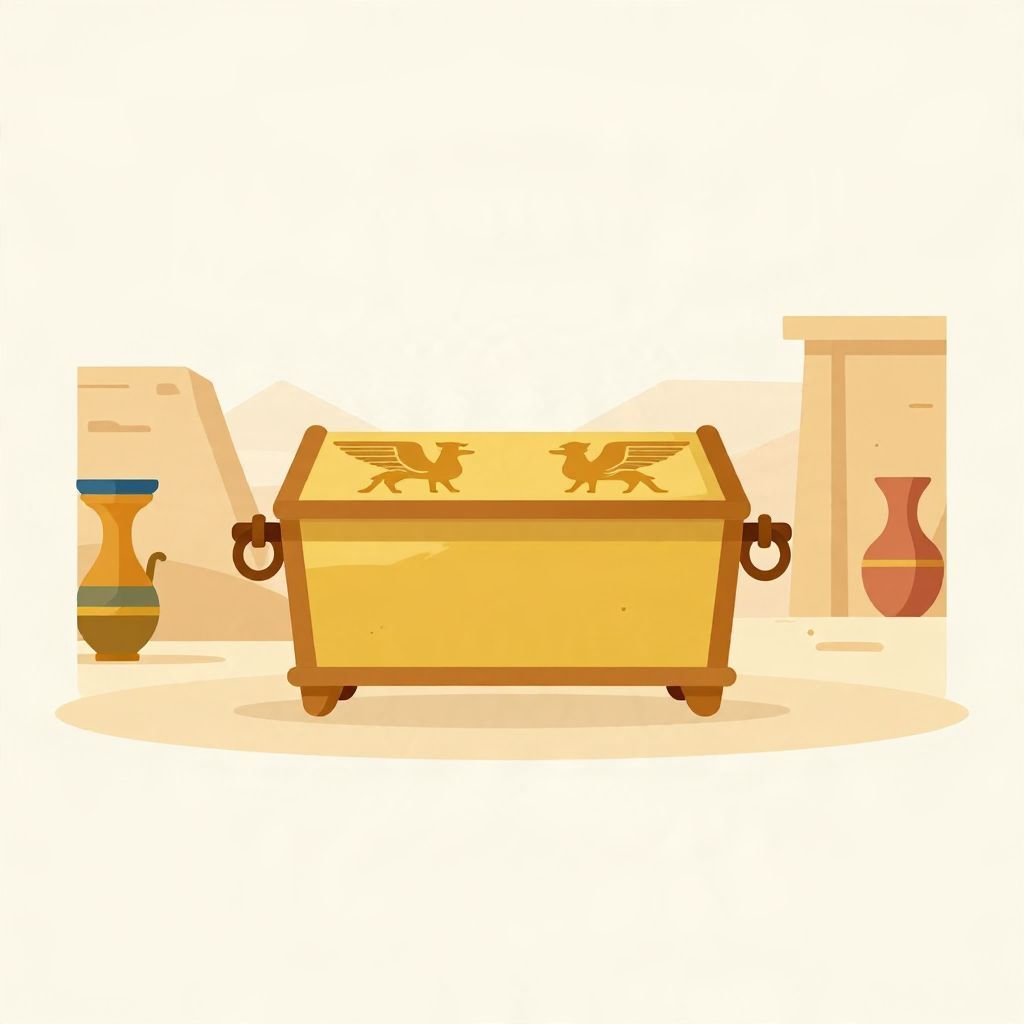
The Ark of the Covenant is one of the most famous sacred objects in biblical history, but its exact appearance is known only through ancient textual descriptions, not surviving remains. According to the Hebrew Bible, it was a small, gold-covered chest with a lid called the mercy seat and two winged figures on top.
Because the Ark has never been securely identified archaeologically, most modern images are reconstructions based on the biblical text and later tradition. That means the question “What does the Ark of the Covenant look like?” has a fairly clear textual answer, but a much less certain historical one.
What Does the Ark of the Covenant Look Like?
The Ark of the Covenant is described as a rectangular wooden chest, overlaid with gold inside and out, with four gold rings for carrying poles. Its lid, the mercy seat, was topped by two cherubim facing each other with outstretched wings. In biblical terms, it was about 2.5 cubits long, 1.5 cubits wide, and 1.5 cubits high.
The Biblical Description of the Ark
The most detailed description appears in the book of Exodus, where the Ark is presented as a sacred container built for the Israelites’ wilderness sanctuary. The text gives its materials, measurements, and ritual purpose, making it one of the clearest objects in ancient religious literature.
Materials and form
According to the biblical account, the Ark was made of acacia wood and covered with gold. It was not a large chest but a portable sacred box designed to be carried by poles rather than touched directly. This portability mattered, because the Ark was associated with a people in movement before the construction of the Jerusalem Temple.
Approximate size
The measurements are usually given as cubits, an ancient unit based on the forearm. If a cubit is roughly 18 inches, the Ark would have been about 45 inches long, 27 inches wide, and 27 inches high. Exact conversion is uncertain because cubit length varied by place and period.
The lid and the cherubim
The lid is often called the mercy seat, a translation that reflects its ritual significance rather than a literal chair. On top stood two cherubim, stylized heavenly beings, with wings spread upward and inward. Their faces were said to look toward the center of the lid, creating a visually dramatic and symbolically charged image.
How the Ark Was Used in Ancient Israel
The Ark was not just decorative; it was a central cult object. In biblical tradition, it held the tablets of the covenant, and it represented the presence of Israel’s God among the people. Its appearance was therefore tied to holiness, restricted access, and ritual handling.
Carrying the Ark
The Ark was carried by Levites using poles inserted through rings at its sides. This detail suggests both practicality and reverence, since direct contact with the Ark was forbidden. The poles also helped preserve the Ark’s sanctity by keeping human hands away from the sacred object.
Placement in sacred space
In the tabernacle and later the Temple, the Ark was placed in the innermost sanctuary. Its hidden location reinforced the idea that it was not an ordinary object to be displayed casually. In biblical imagination, the Ark’s appearance was linked to divine presence rather than public exhibition.
What We Know from History and Archaeology
Historically, the Ark is best understood as a textually attested object from ancient Israelite religion. There is no universally accepted archaeological discovery of the Ark itself, and no surviving artifact can be confidently identified as it. That means our knowledge comes from scripture, later Jewish tradition, and comparative study of ancient Near Eastern ritual objects.
Textual evidence versus physical evidence
The biblical account gives the clearest description, but scholars treat it as a religious text shaped by theology and liturgy, not as a neutral inventory. It may preserve memories of an actual cult object, yet the exact historical form of that object cannot be verified independently.
Why reconstructions differ
Artists and filmmakers often vary in how they depict the Ark. Some show a simple gold chest with ornate handles; others emphasize the cherubim as large, winged figures. These differences reflect interpretation, because the ancient text leaves room for imagination in details such as the style of the cherubim, the thickness of the gold, and the decorative finish.
What the Ark Probably Did Not Look Like
Popular culture has sometimes turned the Ark into a glowing, elaborate, or even weapon-like object. Those images are modern inventions. The biblical description points instead to a sacred ceremonial chest, impressive because of its holiness and craftsmanship, not because of mechanical complexity.
Not a coffin or a throne
Although some scholars have compared the Ark to a throne footstool or divine pedestal, the text itself presents it as a container and ritual centerpiece. It is not described as a coffin, machine, or weapon. Any such idea comes from later speculation, fiction, or symbolic interpretation.
Not necessarily huge
The Ark was important, but it was not massive. Its size suggests something manageable for transport by a small group of priests or Levites. That scale fits the broader pattern of portable sacred objects in the ancient Near East.
Why the Ark’s Appearance Matters Historically
The way the Ark is described reveals a great deal about ancient Israelite religion. Gold signaled sanctity and royal or divine status. The cherubim suggested heavenly guardianship. The hidden placement of the Ark emphasized the danger and power associated with sacred presence.
Symbolism in the object itself
Every feature of the Ark carried meaning. The wood provided a practical core; the gold marked it as holy; the poles expressed distance and reverence; and the lid marked the place where divine-human encounter was imagined to occur. In this sense, the Ark’s appearance was theology in material form.
Links to the Temple tradition
Later Jewish tradition connected the Ark to the First Temple in Jerusalem, where it was said to have rested in the Holy of Holies. Whether every detail of that tradition is historically exact remains debated, but the Ark clearly became a central symbol of covenant, kingship, and sacred memory.
How Later Traditions Shaped the Image of the Ark
Over time, the Ark acquired layers of interpretation in Judaism, Christianity, and popular culture. Some traditions focused on its holiness and hiddenness, while others imagined dramatic powers. These later ideas often tell us more about the communities that retold the story than about the original object itself.
Jewish tradition
In Jewish memory, the Ark became a symbol of the covenant and the lost sanctity of the Temple. Its disappearance after the destruction of the First Temple in 586 BCE, or possibly earlier, became part of a larger historical and theological loss. The object’s absence only increased its symbolic power.
Christian and modern popular imagery
Christian art and later adventure stories often made the Ark more elaborate than the biblical text suggests. Films and novels have especially influenced modern expectations, sometimes presenting the Ark as radiant, dangerous, or supernatural in ways that go beyond the ancient sources.
The Most Accurate Short Answer
If you want the most historically grounded answer, the Ark of the Covenant looked like a small gold-covered wooden chest with carrying poles, a gold lid, and two winged cherubim on top. That is the description preserved in the biblical text. Beyond that, the exact visual details are uncertain because the Ark itself has not been identified archaeologically.
Key Facts at a Glance
- Shape: Rectangular chest or box
- Material: Acacia wood overlaid with gold
- Size: About 2.5 x 1.5 x 1.5 cubits, approximately 45 x 27 x 27 inches
- Top: A lid known as the mercy seat
- Decoration: Two cherubim with outstretched wings
- Function: Sacred container associated with the covenant and divine presence
Conclusion
The Ark of the Covenant is best understood as a portable sacred chest described in ancient Israelite scripture: gold-covered, carefully measured, and crowned with cherubim. Its exact historical appearance cannot be confirmed beyond the text, but its symbolic meaning is clear. For related background, you may also want to read about where the Ark is believed to be located and the original language of the Bible.