
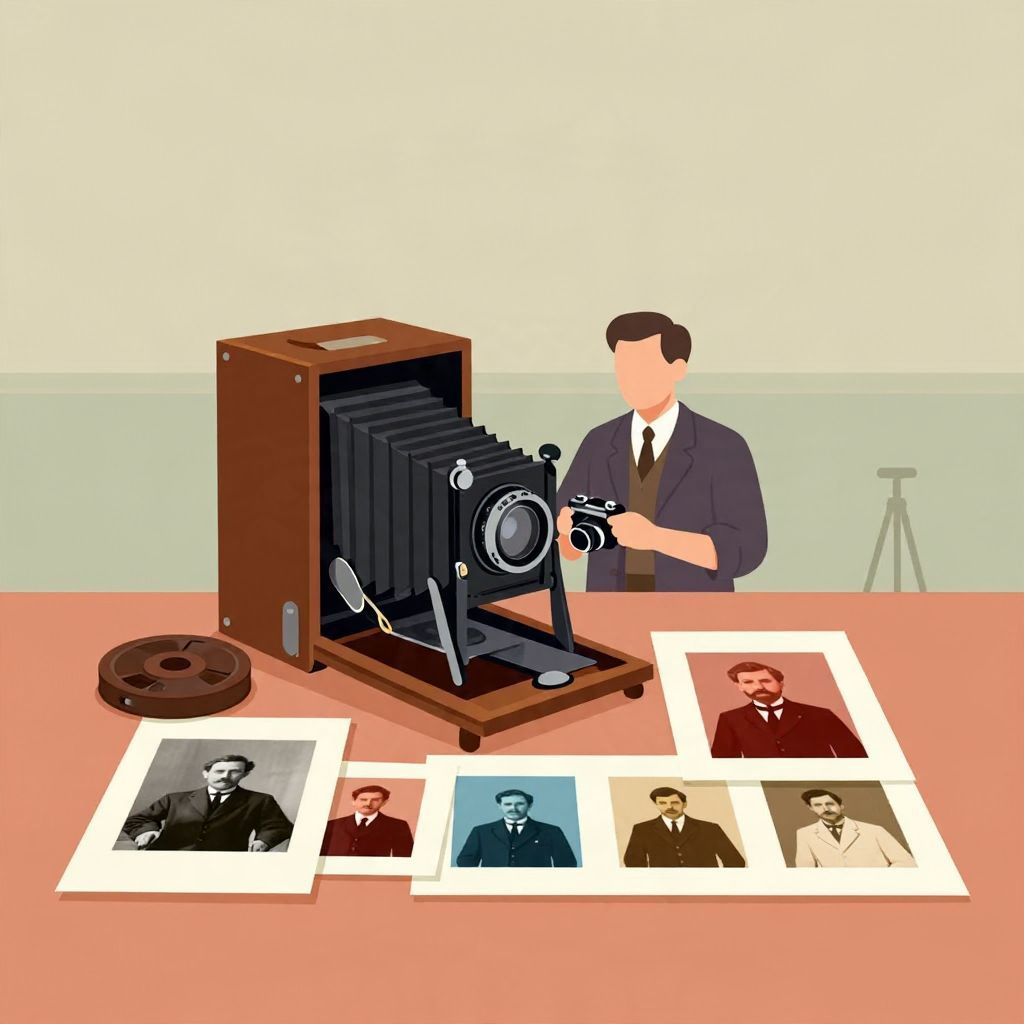
When did color photos come out? The short answer is that color photography emerged in the late 19th century, but it did not become practical for everyday use until the early 20th century. The first successful color photograph is usually credited to James Clerk Maxwell in 1861, while the first widely usable color film arrived much later.
So the story is not a single “release date.” Color photos developed in stages, moving from scientific experiments to commercial products and, eventually, to the snapshots people know today.
When did color photos come out?
Color photos first appeared as experimental images in 1861, but color photography did not become broadly available to the public until the early 1900s. A major breakthrough came with Autochrome, introduced commercially in 1907, and everyday color film became truly common only in the 1930s and after World War II.
The first color photograph: 1861
The earliest widely recognized successful color photograph was demonstrated by the Scottish physicist James Clerk Maxwell in 1861. Working with photographer Thomas Sutton, Maxwell used three separate black-and-white exposures through red, green, and blue filters, then recombined them to simulate color. This was a scientific proof of concept, not a simple one-shot color photo like modern cameras produce.
Why Maxwell’s image mattered
Maxwell’s experiment showed that color could be reproduced by mixing three primary light colors, a principle that became foundational for later color imaging. It was an important step in the history of photography because it proved that color was not just a matter of hand-tinting prints; it could be captured and reconstructed through optics and chemistry.
Still, the method was slow, technically demanding, and not practical for ordinary use. Photographic plates were not equally sensitive to all colors, so early attempts often produced inaccurate results. In other words, the idea of color photography existed, but the technology was not yet ready for mass adoption.
Why early color photography took so long to develop
Black-and-white photography arrived in the 1830s and 1840s, but capturing color was much harder. Early photographic materials were mainly sensitive to blue light and poorly responsive to red and green. That meant a camera could record brightness, but not the full range of colors the human eye sees.
The technical obstacles
- Limited light sensitivity: early plates did not respond evenly to different wavelengths.
- Long exposure times: color methods often required multiple exposures, making moving subjects difficult.
- Complex processing: many early systems needed special filters, plates, or projection methods.
- Unstable results: colors could fade, shift, or appear unnatural.
Because of these problems, inventors pursued several different paths. Some tried additive methods, combining images taken through color filters. Others developed subtractive processes, which used dyes or pigments to create color prints. The eventual success of color photography came from improvements in both chemistry and manufacturing.
From experiment to public novelty: the 1870s to 1900s
After Maxwell, inventors and photographers continued refining color processes throughout the late 19th century. These early systems were often impressive but inconvenient. They could produce beautiful results under ideal conditions, yet they were too expensive, too slow, or too fragile for everyday photography.
Early pioneers and approaches
Several inventors contributed to the development of color photography, including Louis Ducos du Hauron in France and Hermann Wilhelm Vogel in Germany, whose work helped improve color sensitivity and printing methods. Their experiments were important, but no single invention immediately solved the problem.
By the end of the 1800s, the public could see color photographs in exhibitions, scientific demonstrations, and special publications. But these images were still rare. For most people, photography remained a black-and-white medium, with color added later by hand if desired.
The first practical commercial color process: Autochrome in 1907
The first commercially successful color photography process is generally considered to be Autochrome Lumière, introduced by the Lumière brothers in 1907 and sold beginning in 1907–1908. Autochrome used tiny dyed potato starch grains as a color filter layer, allowing photographers to create color transparencies with a single exposure.
Why Autochrome was a breakthrough
Autochrome mattered because it made color photography more practical and accessible, even if it was still expensive and not ideal for fast action. It produced soft, painterly color images that appealed to artists, scientists, and wealthy amateurs. For the first time, color photography was not just a laboratory curiosity; it was a real product.
However, Autochrome had limits. It required long exposure times, special viewing methods, and glass plates rather than flexible film. The images were beautiful but not easy to reproduce in books or newspapers. That meant color photography still had a long way to go before it became part of everyday life.
When color photos became common
If the question is about when color photos became widely available to ordinary people, the best answer is the 1930s to 1950s. During this period, color film improved dramatically, especially with the introduction of Kodachrome in 1935. Color photography then spread through consumer cameras, magazines, advertising, and family snapshots.
Kodachrome and the consumer era
Kodachrome was a major milestone because it produced rich, stable color on motion-picture film and later still photography formats. It was not the first color film, but it became one of the most famous and influential. Its success helped normalize color images in popular culture.
After World War II, color photography expanded rapidly. Better film stocks, cheaper processing, improved printing, and mass-market cameras made color increasingly ordinary. By the 1950s and 1960s, color photos were no longer a novelty reserved for specialists or professionals. They were becoming the standard for personal photography.
A simple timeline of color photography
Here is the basic chronology of how color photos came out and developed:
- 1830s–1840s: black-and-white photography is invented and refined.
- 1861: James Clerk Maxwell demonstrates the first successful color photograph using three-color projection.
- Late 1800s: inventors improve color processes, but most remain experimental or impractical.
- 1907: Autochrome becomes the first commercially successful color photography process.
- 1935: Kodachrome helps bring practical color film to a wider audience.
- Post-1945: color photography becomes increasingly common for consumers and the media.
Did color photos appear all at once?
No. The history of color photography is a gradual transition rather than a single invention. Depending on how you define “came out,” the answer changes:
- First successful color image: 1861
- First practical commercial color process: 1907
- When color became common for consumers: roughly the 1930s to 1950s
This is why historians usually avoid giving just one date. A scientific demonstration, a commercial product, and a mass-market standard are three different milestones. Each matters, but they answer slightly different versions of the question.
Why color photography changed history
Color photography transformed how people remembered the world. Black-and-white images can be powerful, but color adds detail about clothing, landscapes, interiors, products, and daily life. It changed journalism, advertising, science, art, and family memory.
Lasting impact
In the 20th century, color photography helped shape modern visual culture. Newspapers and magazines used it to attract readers. Scientists used it to study plants, skin, stars, and microscopic life. Families used it to preserve birthdays, vacations, and everyday moments in a more lifelike way.
Color also changed expectations. Once people became used to seeing the world in color photographs, black-and-white images began to feel historical, artistic, or documentary rather than standard. That shift still influences how we view the past today.
The bottom line
Color photos “came out” in stages: first as a scientific breakthrough in 1861, then as a commercial process in 1907, and finally as a common part of everyday life in the mid-20th century. If you want the shortest accurate answer, say that color photography first appeared in the 1860s, but became practical and widely available much later. For more historical context, you may also want to explore what happened in 1924 and what happened in 1926.