
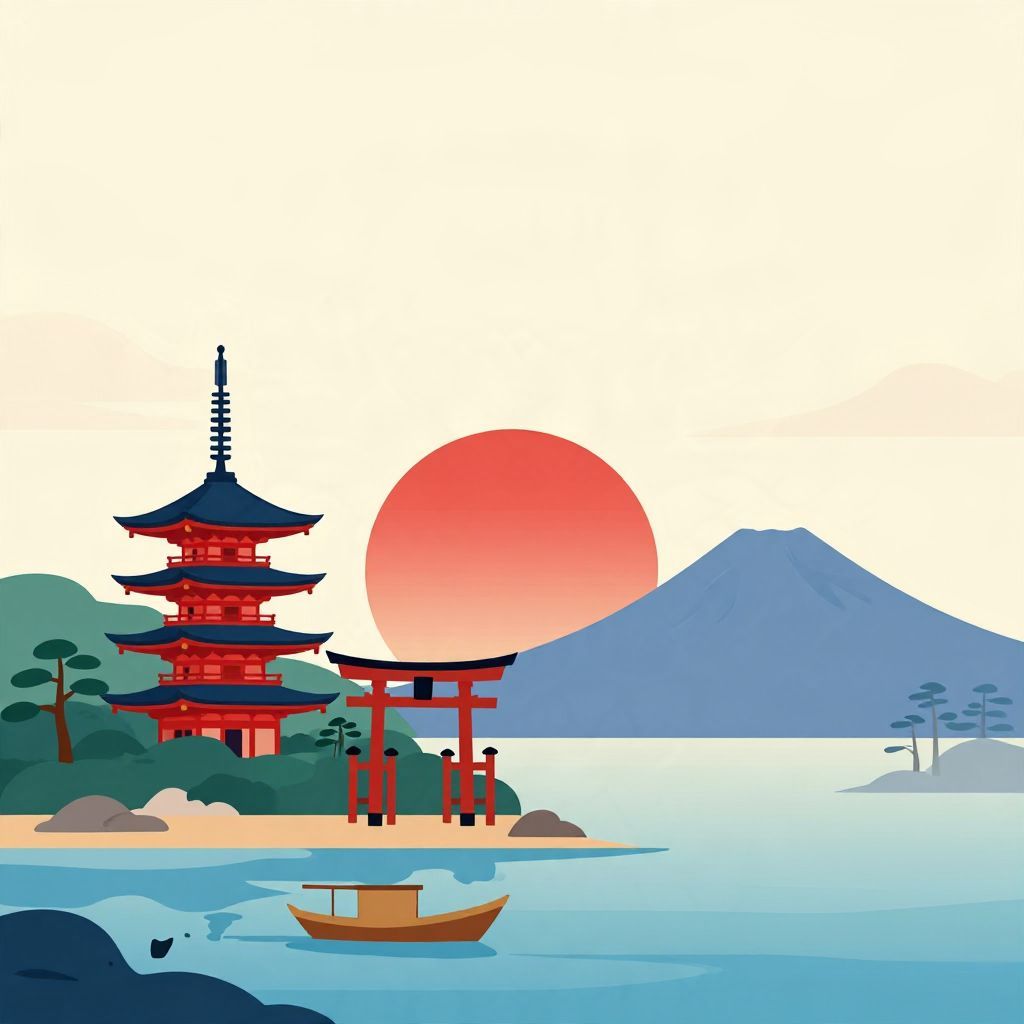
“The Land of the Rising Sun” is a poetic name for Japan. It reflects Japan’s position to the east of the Asian continent, where the sun appears to rise first from the perspective of China and Korea. The phrase is deeply tied to Japanese identity, diplomacy, and cultural symbolism, but it is not a literal ancient geographic label.
To understand it properly, we need to look at how the name developed, what it meant in different historical periods, and why it became so closely associated with Japan in both Japanese and foreign usage.
What Is The Land Of The Rising Sun?
The “Land of the Rising Sun” is a traditional poetic description of Japan. It comes from the country’s eastward location relative to mainland Asia and from the Japanese name Nihon or Nippon, which means “origin of the sun.” In historical and cultural terms, the phrase refers to Japan as the place where the sun rises first.
Why Is Japan Called the Land of the Rising Sun?
Japan is called the Land of the Rising Sun because of the meaning of its own name and its place on the map. The Chinese characters for Japan, 日本, can be read as “sun origin” or “source of the sun.” From the viewpoint of China, Japan lies to the east, where the sun rises. The phrase became a natural way to describe the country in both political and poetic language.
The meaning of “Nihon” and “Nippon”
Both Nihon and Nippon are standard Japanese readings of the same characters. In everyday speech, “Nihon” is more common, while “Nippon” often appears in formal settings, sports, currency, and state symbolism. The name does not mean that Japan literally owns the sunrise; rather, it expresses a geographic and cultural relationship to the east.
How the phrase works as a historical idea
The expression became especially meaningful because East Asian civilizations long used directional language in relation to the sun. In Chinese imperial thinking, lands east of China could be described in terms of sunrise. Japan adopted a name that placed it at the “beginning” of the sun’s path, which helped shape a distinct identity in relation to its neighbors.
Where Did the Name Come From?
The roots of the phrase lie in early diplomatic contact between Japan and China. The best-known historical association is with the early 7th century, when Japanese rulers began sending formal letters to the Chinese court. These letters used language that presented Japan as a country near the sun’s origin, though the exact wording and interpretation are debated by historians.
Prince Shōtoku and early state formation
Japanese state formation accelerated during the Asuka period, especially under reform-minded leaders such as Prince Shōtoku in the early 600s. Japan was building a centralized court system and seeking recognition from powerful neighbors. In that context, a name emphasizing the “origin of the sun” may have served both symbolic and diplomatic purposes.
Chinese records and the broader East Asian world
Chinese sources recorded Japan under names such as Wa in earlier periods, but over time “Japan” became the standard foreign term in many languages. The “Land of the Rising Sun” idea did not arise from a single moment alone. It grew out of centuries of exchange, translation, and political self-presentation.
Historical Background: Japan’s Place in East Asia
Japan’s identity as the Land of the Rising Sun makes sense only in a regional context. For much of its history, Japan was shaped by contact with China and Korea through trade, religion, writing, and diplomacy. At the same time, Japan remained an island archipelago with its own court culture, warrior elites, and later a centralized state.
Geography and symbolism
Because Japan lies east of the Asian mainland, the sun rises over it before it rises over China or Korea. That simple geographic fact became a powerful symbol. In many cultures, the rising sun suggests beginnings, renewal, and vitality. Japan’s rulers and writers used those associations to express national prestige and continuity.
Religious and cultural associations
The sun also held deep spiritual significance in Japan. In Shinto, the indigenous religious tradition, the sun goddess Amaterasu is one of the most important deities. This does not mean the national name was created purely from religion, but it helps explain why solar imagery resonated so strongly in Japanese culture.
How the Phrase Became Widely Known
The English phrase “Land of the Rising Sun” became widely used as Europeans learned more about East Asia. It was a convenient translation of Japan’s name and geography, and it fit Western ideas of poetic national epithets. Over time, the phrase entered travel writing, diplomacy, literature, and popular culture.
From foreign description to national symbol
By the modern era, Japan itself increasingly used solar imagery in official symbols and national identity. The rising sun flag, for example, became associated with the military and state power in the modern period, especially from the late 19th century onward. That symbol is historically important, but it also carries controversy because of Japan’s imperial expansion in the 20th century.
Modern nationalism and imperial imagery
During the Meiji era, after 1868, Japan transformed rapidly into a modern nation-state. As Japan expanded its influence in Asia, the “rising sun” image could suggest progress, strength, and destiny. In that context, a poetic phrase became tied to modern nationalism, empire, and military power as well as to older cultural meaning.
Is “Land of the Rising Sun” an Official Name?
No. “Land of the Rising Sun” is not Japan’s official state name. The official names are Nihon and Nippon in Japanese, usually translated as Japan in English. “Land of the Rising Sun” is a descriptive and poetic expression, not a formal constitutional title or legal designation.
Common misunderstanding
Some people assume the phrase is an ancient official title, but that is not strictly correct. It is better understood as a long-standing cultural nickname that reflects both language and geography. Like “the Emerald Isle” for Ireland or “the Old World” for Europe, it is meaningful but not administrative.
Key Facts About the Land of the Rising Sun
- Country: Japan
- Japanese name: Nihon or Nippon
- Meaning of the name: “Origin of the sun” or “source of the sun”
- Reason for the phrase: Japan lies east of mainland Asia, where the sun appears to rise first
- Historical context: Early diplomatic and cultural contact with China helped spread the idea
- Religious resonance: Shinto traditions include important solar symbolism, especially Amaterasu
- Modern significance: The phrase is linked to national identity, symbolism, and sometimes imperial history
Why the Phrase Still Matters Today
The phrase remains popular because it captures several layers of Japanese history at once: geography, language, religion, diplomacy, and modern identity. It is short, memorable, and culturally powerful. At the same time, historians treat it carefully because national symbols can change meaning over time.
Tourism, culture, and global recognition
Today, “Land of the Rising Sun” is often used in tourism, media, and international branding. It evokes cherry blossoms, temples, mountain landscapes, and modern cities, though those images are only part of Japan’s long and complex history. The phrase works because it blends beauty with historical depth.
A phrase with layered history
What began as a geographic and diplomatic description eventually became a broader symbol of Japan itself. That evolution shows how names can carry political meaning far beyond their literal words. In Japan’s case, the sunrise image has endured because it speaks to both place and identity.
Conclusion
The Land of the Rising Sun is Japan: a country whose name, geography, and cultural symbolism all point toward the east and the sunrise. The phrase is poetic rather than official, but it has deep historical roots in early East Asian diplomacy, Japanese self-understanding, and later national symbolism. For related context, you may also want to read about Japanese New Year traditions and whether samurai still exist.