
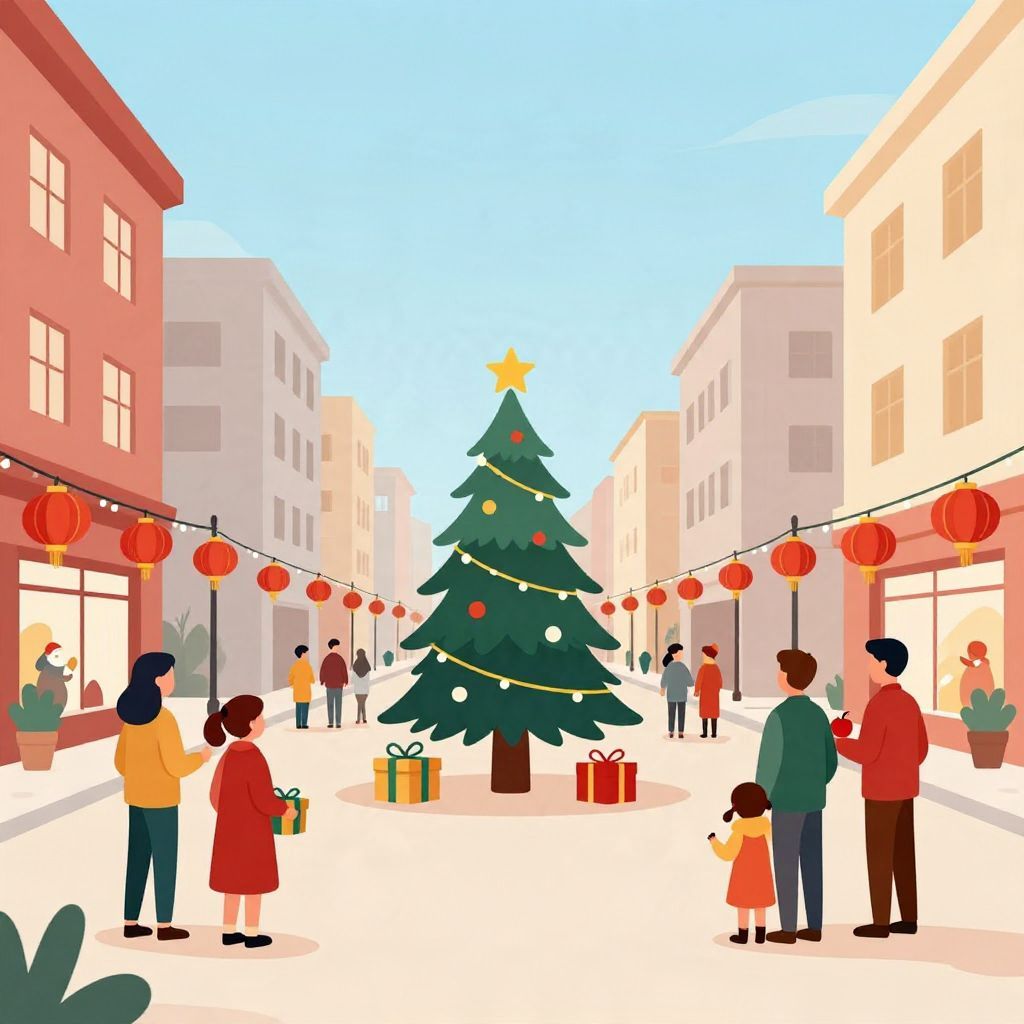
Do Chinese celebrate Christmas? The short historical answer is yes, but not in one single way. In China, Christmas has been adopted in different forms by Christians, urban consumers, schools, businesses, and young people, while many others treat it as an imported cultural event rather than a religious holiday.
The meaning of Christmas in China has changed over time, shaped by missionary history, state policy, globalization, and local custom. To understand it properly, we need to separate religious observance from commercial celebration and look at how the holiday entered Chinese society.
Do Chinese Celebrate Christmas?
Yes, many Chinese people celebrate Christmas, but usually as a cultural, commercial, or social occasion rather than a national religious holiday. Christians in China may attend church services and mark the birth of Jesus, while many non-Christians enjoy decorations, shopping, gifts, and festive outings without treating Christmas as a sacred festival.
How Christmas Arrived in China
Christmas first entered China through Christian missionaries, especially from the late Ming and Qing periods onward. Jesuit missionaries in the 16th and 17th centuries introduced Christian ideas to educated elites, but Christmas remained limited to small Christian communities. Wider public awareness grew much later, especially in treaty-port cities and modern urban centers.
Missionary roots and early Christian communities
Christianity had earlier contacts with China, but Christmas as a recognizable holiday became more visible with Catholic and Protestant missions in the early modern era. Missionaries built churches, schools, and hospitals, and Christmas services became part of church life. Even then, the holiday was not a mainstream Chinese festival; it belonged mainly to converts and foreign residents.
Urbanization and the modern public holiday culture
In the 19th and early 20th centuries, coastal cities such as Shanghai, Tianjin, and Guangzhou became places where foreign customs circulated more openly. Department stores, hotels, and restaurants began using Christmas imagery to attract customers. By the late 20th century, especially after economic reforms, Christmas had become visible in shopping districts, though mostly as a secular seasonal event.
What Christmas Looks Like in China Today
Modern Christmas in China is usually celebrated in highly varied ways. For Christians, it can mean worship, prayer, choir music, and church gatherings. For many others, it means exchanging small gifts, eating out, decorating homes or shops, and enjoying the festive atmosphere. In large cities, Christmas is often closer to a winter consumer holiday than a religious one.
Christian observance
China has a substantial Christian population, though estimates vary because of differences in registration, denomination, and method. Among Catholics and Protestants, Christmas may be one of the most important dates in the church calendar. Services often include carols, scripture readings, nativity scenes, and community events. In this sense, Christmas in China is not fundamentally different from Christmas elsewhere in the Christian world.
Secular and commercial celebration
For many non-Christians, Christmas is a social occasion rather than a spiritual one. Shopping malls, cafés, and entertainment venues often use lights, trees, Santa figures, and themed promotions. Young people may exchange gifts or go on dates, especially in cities. This commercial style of celebration has much more in common with global consumer culture than with traditional Chinese religious practice.
Regional and generational differences
Christmas is more visible in major cities than in rural areas, and more common among younger people than older ones. In some places, it is embraced as a fashionable event; in others, it passes with little notice. These differences matter because “Chinese celebrate Christmas” does not describe one uniform national custom. It describes multiple overlapping practices across a very large and diverse society.
Why Christmas Became Popular in Some Parts of China
Christmas spread in China not because it replaced local festivals, but because it fit certain modern social settings. Urban retail culture, international business, school life, and youth fashion all helped make it familiar. The holiday’s visual symbols—lights, trees, gifts, and red-and-white imagery—are easy to adapt even when the religious meaning is not shared.
Globalization and consumer culture
As China became more connected to the global economy, international holidays gained visibility in commercial spaces. Christmas was useful for advertising and seasonal sales, much as Valentine’s Day or Halloween became visible in some Chinese cities. Businesses often promoted the holiday because it created a festive mood and encouraged spending.
Education, media, and youth culture
Students and young professionals often encounter Christmas through language schools, international companies, social media, and popular entertainment. In this setting, the holiday can symbolize modernity, cosmopolitan life, or a chance to socialize. For many young Chinese people, especially in cities, Christmas is less about theology than about atmosphere and participation in global culture.
How the Chinese State Has Viewed Christmas
The Chinese government has generally treated Christmas as a religious or foreign cultural event rather than a public national holiday. China does not officially recognize Christmas as a nationwide day off. At the same time, the holiday is not uniformly banned; its visibility depends on local rules, institutions, and the broader political climate.
Religious control and public space
Because religion in China is regulated, Christian worship is subject to state oversight through approved institutions. Christmas services may be held in registered churches, while unregistered religious activity can face restrictions. Public celebration in shopping areas is often tolerated, but large-scale religious expression is more sensitive than commercial decoration.
National culture versus imported custom
In some periods and places, officials and commentators have emphasized traditional Chinese festivals such as Spring Festival, Mid-Autumn Festival, or Qingming over imported holidays. This does not mean Christmas disappears; rather, it shows that its place in China is debated. Some people see it as harmless fun, while others view it as a foreign influence that should not overshadow local traditions.
Is Christmas a Traditional Chinese Holiday?
No, Christmas is not a traditional Chinese holiday in the historical sense. Traditional Chinese festivals developed from agrarian cycles, ancestor veneration, imperial ritual, and local custom. Christmas entered China much later through Christianity and global exchange. Its present popularity in some cities is modern and selective, not ancient or nationally rooted.
Comparison with major Chinese festivals
Traditional Chinese holidays such as Lunar New Year, the Dragon Boat Festival, and the Mid-Autumn Festival are tied to long-standing cultural calendars and family rituals. Christmas, by contrast, does not have the same historical depth in Chinese society. That difference helps explain why it is often celebrated more as a seasonal event than as a core cultural tradition.
Religious meaning versus social meaning
One reason Christmas can appear “Chinese” in some settings is that celebrations are often stripped of explicit Christian theology. A decorated tree in a mall or a gift exchange among friends may look similar whether or not participants know the religious origin of the holiday. Historically, this is a common pattern when a festival crosses cultural boundaries.
Common Misunderstandings About Christmas in China
One common misunderstanding is that Christmas in China means the same thing as Christmas in Europe or North America. In fact, the holiday’s meaning depends on who is celebrating it. Another misunderstanding is that because it is visible in cities, it must be universally popular. In reality, many Chinese people ignore it entirely.
Not everyone celebrates it
China’s population is enormous and culturally diverse. Some people are Christians who observe Christmas seriously, some enjoy it as a social event, and many do not celebrate it at all. Rural communities, older generations, and those with little exposure to international consumer culture may have limited interest in the holiday.
Not the same as Western Christmas
In many Western countries, Christmas is both a religious and a cultural holiday with deep family traditions. In China, the religious element is usually smaller outside Christian communities, and the commercial element is often stronger in public spaces. That difference is important for understanding the holiday historically rather than assuming a single global model.
The Historical Significance of Christmas in China
The history of Christmas in China reveals how foreign customs are adapted, reshaped, and sometimes emptied of their original meaning. It also shows how religion, commerce, and modern identity interact in a changing society. Christmas became visible in China not through one event, but through centuries of contact, urban growth, and globalization.
What this tells us about cultural exchange
Christmas in China is a useful example of cultural borrowing without full cultural replacement. A holiday can spread as a symbol, a market opportunity, or a religious observance, depending on the setting. The Chinese case shows that global traditions do not travel unchanged; they are reinterpreted by local history and social needs.
So, do Chinese celebrate Christmas? Yes, many do—but in different ways, and often for reasons that are more social or commercial than religious. Historically, Christmas in China is best understood as an imported holiday that has been selectively adapted rather than fully nationalized. If you want to explore related customs, see how people celebrate Christmas and the meaning of the Christmas tree.