
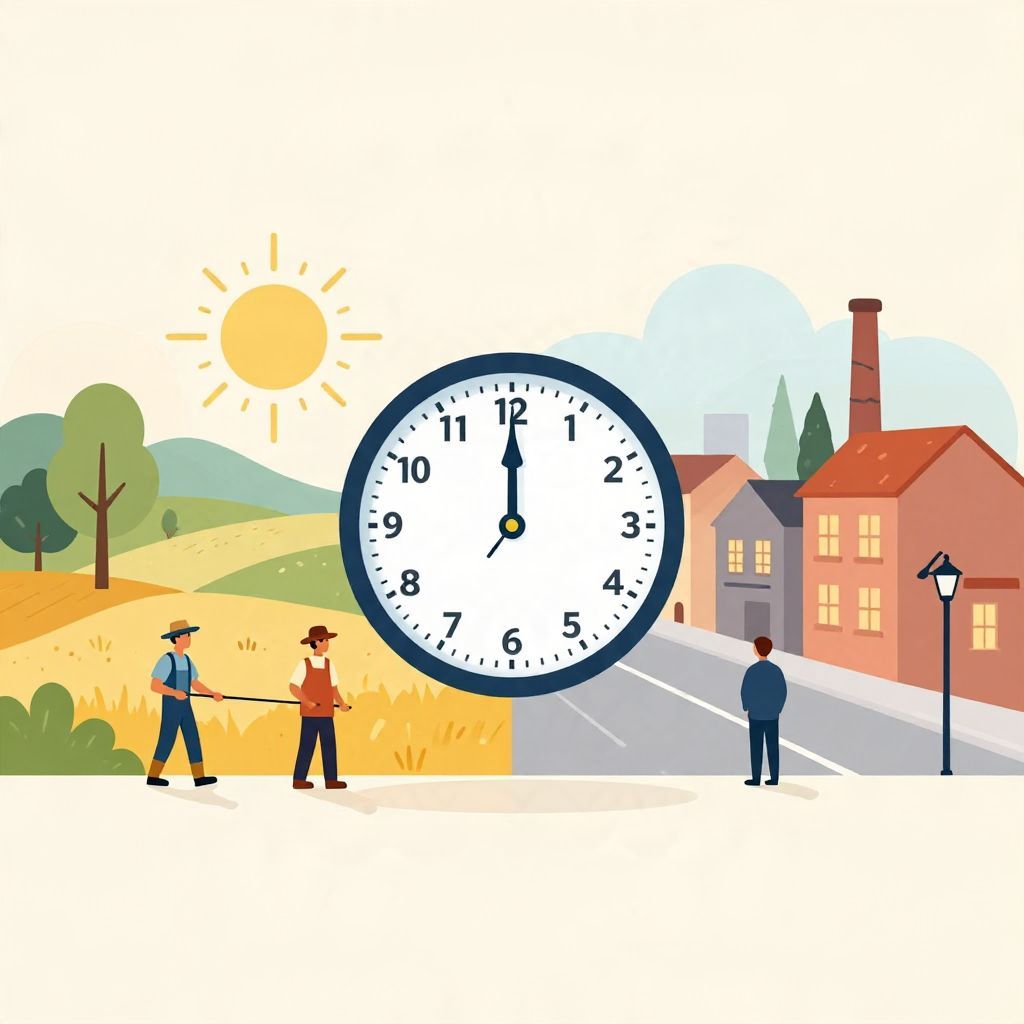
Why do we have daylight saving time? The short historical answer is that governments adopted it to shift an hour of human activity toward the evening, when more daylight could be used and less artificial lighting was needed. The idea was tied to energy savings, wartime efficiency, and later to traffic, commerce, and leisure.
Its history is less about one inventor “creating” it and more about a series of practical experiments, especially in the early 20th century, when industrial societies began to manage time more aggressively.
Why do we have daylight saving time?
We have daylight saving time because modern states and businesses wanted to make better use of daylight by moving clocks forward in spring and back in autumn. The original arguments emphasized saving fuel and electricity, especially during wartime, but the practice also reflected changing work patterns, urban life, and the desire to extend evening daylight for activity.
How the idea developed
Daylight saving time did not begin as a single global policy. It emerged from a mix of scientific proposals, local experiments, and wartime legislation. The basic logic was simple: if people wake and work earlier by the clock, they can use more daylight in the evening and less in the morning, when many are asleep or indoors.
Early proposals before national adoption
Ideas for adjusting clocks to daylight appeared in the 19th century. One of the best-known advocates was the New Zealand entomologist George Hudson, who proposed shifting time in the 1890s so he would have more evening daylight for collecting insects. In Britain, the builder William Willett also promoted the idea in the early 1900s, arguing that people were wasting morning light by sleeping through it.
These proposals mattered historically because they show that daylight saving time was not invented for a single emergency. It grew out of broader concerns about industrial schedules, urban routines, and the perception that standardized clock time could be adjusted to suit modern life.
World War I and the first large-scale adoption
The first major national adoptions came during World War I. Germany and Austria-Hungary introduced daylight saving time in 1916, and other countries soon followed, including Britain and the United States. The war created pressure to conserve coal and other resources, and governments were eager to squeeze more utility from daylight.
This wartime context is crucial. Daylight saving time was not initially sold as a lifestyle convenience. It was framed as a patriotic measure that could help reduce fuel consumption and support the war economy. Once adopted, however, it proved politically durable in some places because people also liked the extra evening light.
What problem was daylight saving time supposed to solve?
Historically, daylight saving time was meant to reduce the need for artificial lighting and to align waking hours more closely with daylight. In practice, the benefits have varied by era and region. Early 20th-century societies depended more heavily on coal and gas lighting, so the energy-saving argument carried real weight. Later, the rationale shifted toward convenience, recreation, and traffic safety.
Energy conservation was the original argument
Before widespread electric lighting and air conditioning, shifting an hour of activity could make a noticeable difference in lighting use. During wartime, when fuel supplies were strained, that mattered even more. Governments hoped that if people used daylight in the evening, they would burn less fuel after dark.
Over time, the energy argument became more complicated. As electricity use changed and households relied on different technologies, the savings became less obvious and sometimes inconsistent. Even so, the original conservation logic remains central to understanding why daylight saving time was introduced in the first place.
Social and economic reasons also mattered
Daylight saving time was not only about energy. It also served commercial and social goals. More daylight after work encouraged shopping, sports, travel, and outdoor leisure. Businesses in retail and recreation often favored it because people were more likely to be active outside in the evening.
Farmers, however, were often less enthusiastic. Agricultural work is governed by the sun, not the clock, and shifting official time could create friction with transport schedules, markets, and labor routines. Popular belief sometimes says daylight saving time was created for farmers, but historically that is misleading. Many farmers opposed it or found it inconvenient.
A brief timeline of daylight saving time
The history of daylight saving time is best understood as a sequence of wartime adoption, peacetime debate, repeal in some countries, and later standardization in others.
- 1890s: Early proposals appear, including George Hudson’s idea in New Zealand.
- Early 1900s: William Willett campaigns for clock changes in Britain.
- 1916: Germany and Austria-Hungary adopt daylight saving time during World War I.
- 1916–1918: Britain, the United States, and other countries follow.
- Interwar period: Some countries keep it, others abandon it, and local practices vary widely.
- World War II: Many governments reintroduce or extend it for wartime efficiency.
- Postwar era: Daylight saving time becomes a recurring seasonal policy in many countries, though not all.
Why did it spread beyond wartime?
Once introduced, daylight saving time survived in many places because it became associated with modern scheduling. Cities, railways, television, retail, and later air travel all benefited from predictable time rules. Even when the original fuel-saving rationale weakened, governments often kept the practice because changing it again seemed disruptive.
The role of standard time
Daylight saving time made sense only after standard time had become normal. In the 19th century, many places kept local solar time, which varied from town to town. Railroads and telegraphs pushed societies toward standardized time zones. Once time itself became a coordinated public system, governments could also manipulate it seasonally.
In that sense, daylight saving time is a product of the same historical forces that created modern timekeeping: industrialization, national administration, mass transportation, and the need for synchronized schedules.
Public resistance and periodic reform
Despite its long history, daylight saving time has always been controversial. Critics argue that it disrupts sleep, complicates scheduling, and offers limited benefits. Supporters reply that it better matches daylight to active hours and can improve evening life. These debates have led some countries to abandon the practice, while others have kept it or altered the dates of change.
The fact that the policy persists in some places and not others shows that daylight saving time is not a natural law but a historical compromise. Governments have repeatedly adjusted it in response to war, economics, public opinion, and changing patterns of daily life.
Did daylight saving time actually save energy?
Historically, the answer has depended on the period and the type of energy used. In the early 20th century, when lighting was a major household expense, the savings could be meaningful. In later decades, the picture became mixed. Less lighting use in the evening could be offset by more heating or cooling, especially in regions with extreme temperatures.
That uncertainty helps explain why the policy has remained debated. Daylight saving time was introduced for a clear historical reason—conserving resources during wartime and industrial modernity—but its long-term effects have been harder to pin down and have varied by place.
Why do some countries use it and others do not?
Daylight saving time is shaped by geography, climate, politics, and culture. Countries closer to the equator often see less seasonal variation in daylight, so the benefit is smaller. In some regions, the disruption outweighs the gains. In others, especially where summer evenings are valued for commerce and recreation, the practice remains popular.
National history also matters. Some governments adopted daylight saving time during wartime and then retained it; others rejected it as unnecessary or inconvenient. The result is a patchwork of time rules that reflects different historical experiences rather than a single global standard.
The historical meaning of daylight saving time
Daylight saving time is a reminder that even something as ordinary as the clock is a historical invention shaped by power, technology, and social habits. It was created to solve practical problems in industrial and wartime societies, then preserved because it suited some modern routines better than others.
So, why do we have daylight saving time? Because governments once believed, with good reason in their own context, that changing the clock could save fuel, support wartime needs, and make better use of daylight. The practice has outlived its original setting, but its origins remain rooted in the history of industrialization and modern state planning. For more on how societies organize time and daily life, see related history articles on the history of standard time and life on the home front during World War I.