
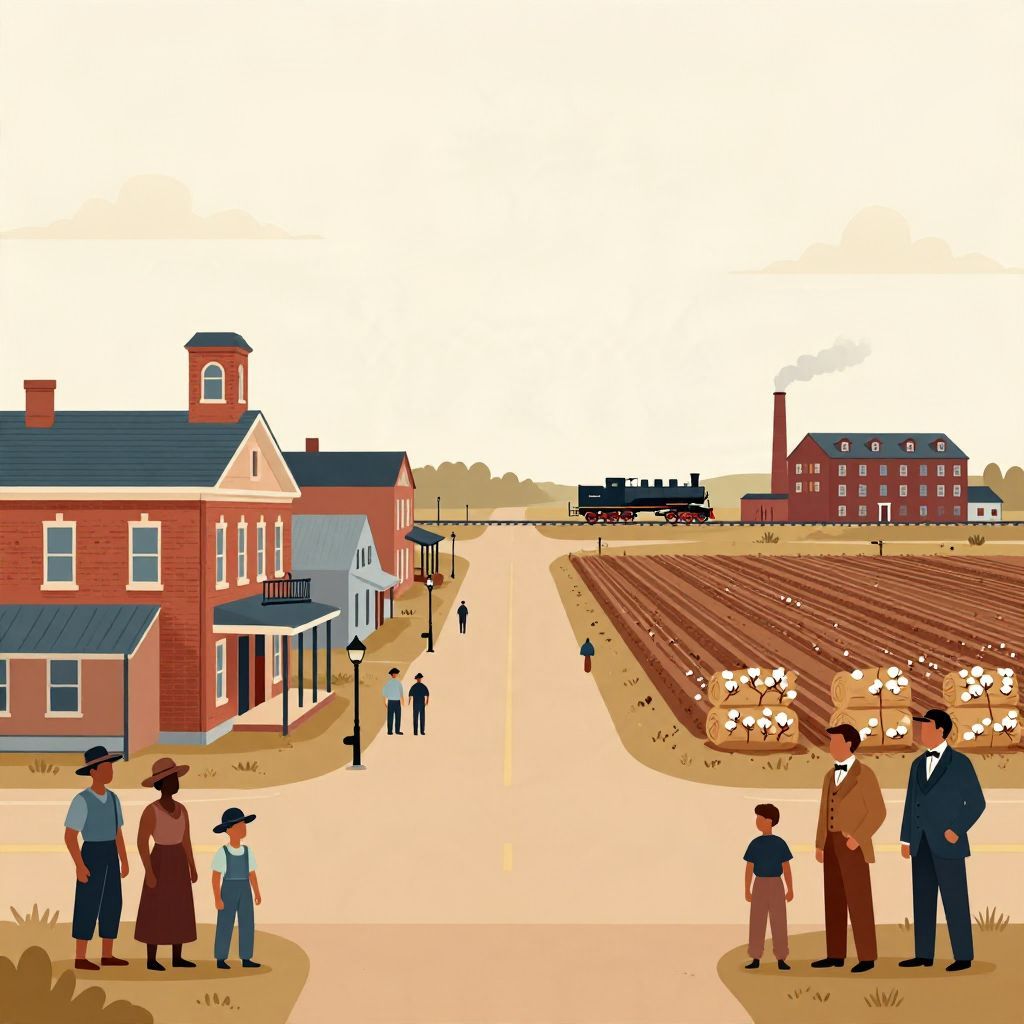
What was the New South? In U.S. history, the term refers to the post–Civil War South that emerged after Reconstruction, especially from the 1870s through the early 20th century. It described a region trying to modernize its economy, attract industry, and move beyond the slave-based plantation system that had collapsed in 1865.
Yet the “New South” was never simply new. It combined genuine economic change with the persistence of white supremacy, rural poverty, and political disfranchisement. Understanding it means looking at both the promises of industrial growth and the harsh realities that shaped Southern life after the Civil War.
What Was the New South?
The New South was a postwar vision and reality in which Southern leaders promoted industrialization, railroads, urban growth, and a more diversified economy after the Confederacy’s defeat. In practice, it was also a region where racial segregation, tenant farming, and political exclusion remained deeply entrenched, limiting how far “new” the South actually became.
Where Did the Idea of the New South Come From?
The phrase gained prominence in the late 19th century, especially through journalists, editors, and politicians who wanted to redefine the South after slavery and the Civil War. One of the best-known advocates was Henry W. Grady, editor of the Atlanta Constitution, who argued in the 1880s that the region should embrace business, manufacturing, and reconciliation with the North.
Grady and others used the term to signal a break from the “Old South” of plantation agriculture, secession, and slave labor. Their message was partly economic and partly political: they hoped to attract Northern capital, restore Southern influence within the nation, and present the region as modern and forward-looking.
The Old South versus the New South
- Old South: a slaveholding, plantation-centered society before the Civil War.
- New South: a postwar South emphasizing railroads, mills, mines, and manufacturing.
- Continuity: both eras were shaped by racial hierarchy and elite control, even though labor systems changed.
Why Did Southerners Call for a New South?
The Civil War left the South devastated. Cities, rail lines, farms, and infrastructure had been damaged, while emancipation destroyed the labor system that had supported the plantation economy. Many white Southerners also feared political and social change during Reconstruction, when formerly enslaved people claimed rights and Black political participation expanded.
Economic recovery required rebuilding transportation, attracting investment, and finding new sources of labor and capital. At the same time, many white leaders wanted to regain control of Southern politics after Reconstruction ended. The New South idea offered a way to pursue both goals while presenting the region as stable and business-friendly.
Major forces behind the New South
- Destruction from war: the Confederacy’s defeat left the region impoverished and infrastructure-poor.
- End of slavery: plantation labor had to be replaced by new labor arrangements.
- National industrial growth: the late 19th century was an era of rapid U.S. industrialization.
- Political retreat from Reconstruction: white Southern Democrats sought to restore local control.
How Did the New South Change the Economy?
The most visible change was industrial expansion. Southern boosters promoted textile mills, tobacco processing, iron and steel production, coal mining, lumbering, and railroad construction. Cities such as Atlanta, Birmingham, Charlotte, and Richmond became symbols of this transformation. Railroads linked Southern raw materials to national markets, while new mills and factories created urban wage labor.
This growth was real, but uneven. The South remained poorer than much of the North, and many industries depended on low wages, weak labor protections, and state support. Industrialization did not erase the region’s agricultural dependence; instead, it often coexisted with it. Cotton still dominated much of the economy, tying the South to global commodity markets and leaving farmers vulnerable to price swings.
Industries associated with the New South
- Textiles: especially in the Carolinas and Georgia.
- Iron and steel: notably around Birmingham, Alabama.
- Tobacco processing: especially in Virginia and North Carolina.
- Railroads and shipping: which connected Southern goods to national and international markets.
- Lumber and mining: important in several parts of the region.
Did the New South Improve Life for Most Southerners?
For many white business leaders, the New South meant growth and modernization. For many ordinary Southerners, however, daily life remained harsh. Sharecropping and tenant farming trapped large numbers of Black and white farmers in cycles of debt. Land ownership remained concentrated, and agricultural labor was often insecure and poorly paid.
After Reconstruction, Southern state governments and white Democratic elites also built a system of segregation and disenfranchisement. Through poll taxes, literacy tests, grandfather clauses, intimidation, and violence, Black voters were systematically excluded from politics. The New South, in this sense, was not a democratic rebirth but a reordering of power that preserved white supremacy under new economic conditions.
Social realities of the New South
- Sharecropping: farmers rented land and paid with a share of the crop, often falling into debt.
- Tenant farming: renters paid cash or crop shares, usually with little security.
- Segregation: racial separation became codified in law and custom.
- Disfranchisement: Black political rights were sharply reduced after Reconstruction.
Who Promoted the New South?
Business leaders, editors, railroad developers, and some politicians promoted the New South as a path to prosperity. Henry W. Grady became its most famous public voice, but he was not alone. Civic boosters in growing cities argued that the South could compete economically with the North if it embraced industry, education, and investment.
At the same time, not everyone agreed on what modernization should mean. Some white Southerners clung to agrarian ideals and local autonomy, while others feared that industrial growth would weaken traditional social hierarchies. Black Southerners, meanwhile, had their own visions of progress, often centered on education, land ownership, voting rights, and economic independence. Their aspirations were frequently blocked by discriminatory laws and violence.
How Did Race Shape the New South?
Race was central to the New South. Although the phrase suggested renewal, the region’s modernization was built within a racial order that denied equality to African Americans. White leaders often promoted industrial development while defending segregation and limiting Black citizenship. Economic change did not produce racial justice; in many ways, it reinforced existing inequalities in new forms.
Black communities responded with institution-building, mutual aid, churches, schools, newspapers, and political organizing. Educators and leaders such as Booker T. Washington advocated practical education and economic advancement, though his approach was debated by other Black intellectuals and activists. The larger struggle over rights, labor, and citizenship defined the era far more than booster slogans did.
Important racial dynamics
- Segregation laws: increasingly formalized in the late 19th century.
- Violence and intimidation: used to suppress Black political participation.
- Black institution-building: churches, schools, and civic groups provided support and leadership.
- Competing visions of advancement: economic self-help, political rights, and education all mattered.
Was the New South a Success?
The answer depends on the standard used. If the goal was to diversify the Southern economy, attract investment, and expand rail and industrial development, then the New South achieved some success. Southern cities grew, factories multiplied, and the region became more closely tied to the national industrial economy.
If the measure is broad social transformation, however, the New South fell far short. Poverty remained widespread, labor exploitation continued, and racial inequality hardened into Jim Crow segregation. The region modernized economically without becoming more just. That contradiction is one of the defining features of Southern history after the Civil War.
What Is the Historical Significance of the New South?
The New South matters because it helps explain how the postwar South changed without fully breaking from its past. It shows how economic modernization can coexist with social repression. It also reveals how memory and language were used to shape public understanding: “new” suggested progress, but the lived reality for many people was continuity in inequality.
Historians often treat the New South as both a real economic transformation and a political ideology. It was real because industry, cities, and transportation did expand. It was ideological because boosters used the term to market the region, reassure investors, and argue that the South had moved beyond the Civil War. In practice, however, the region’s power structure remained deeply conservative on race and labor.
Key Facts About the New South
- Time period: mainly from the 1870s through the early 20th century.
- Main slogan: modernization after the Civil War.
- Leading advocate: Henry W. Grady is the best-known promoter.
- Economic changes: railroads, textiles, mining, steel, and urban growth.
- Social reality: sharecropping, segregation, and Black disfranchisement persisted.
- Historical meaning: a mix of genuine economic change and continued racial hierarchy.
Conclusion
The New South was the post–Civil War South’s attempt to redefine itself through industry, commerce, and modernization. It marked an important shift away from the slave plantation economy, but it did not create equality or broad prosperity. Instead, it blended economic change with the persistence of white supremacy, making it one of the most complex eras in Southern history. For related Southern history context, see what the Stono Rebellion was and whether Confederate money is worth anything.