
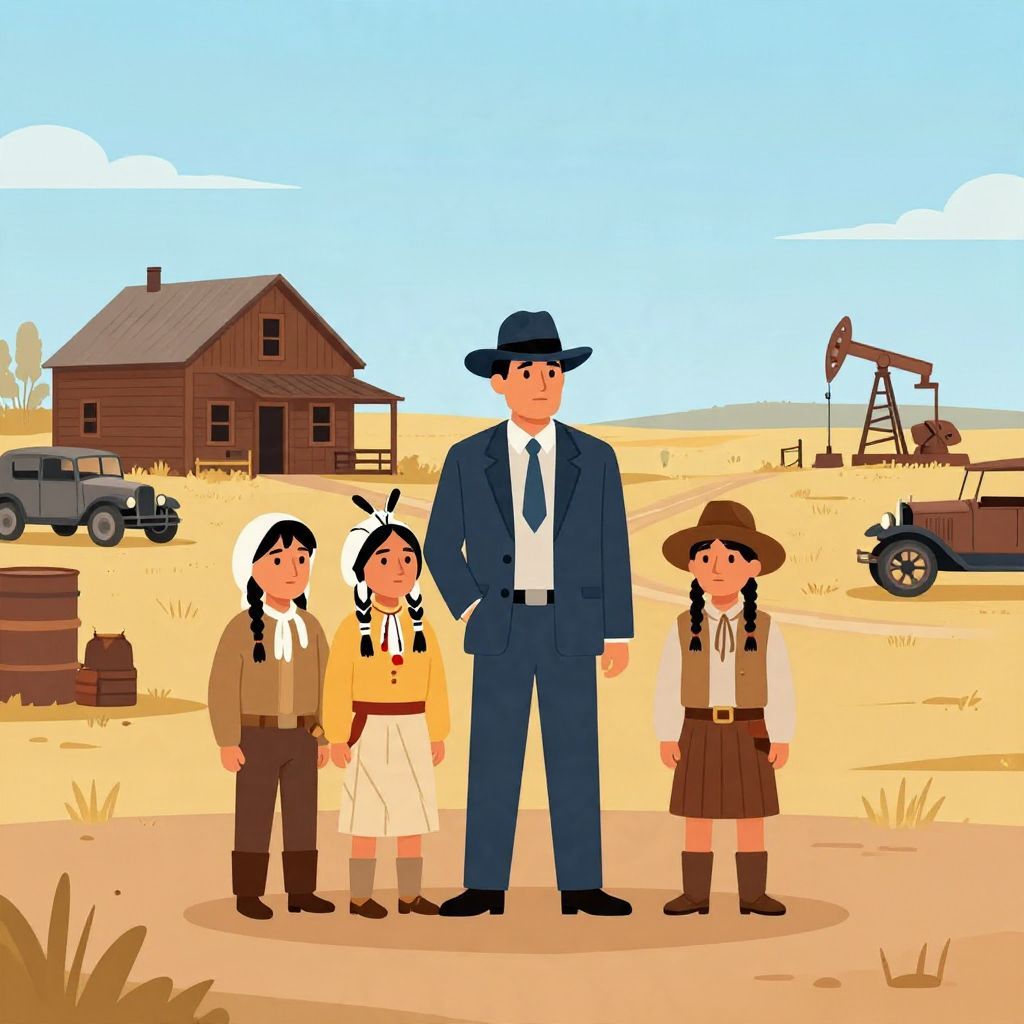
Is Killers of the Flower Moon a true story? Yes—Killers of the Flower Moon is based on real events in 1920s Oklahoma, centered on the Osage Nation murders and the early years of the FBI. But the film and the book are dramatic retellings, so some scenes, characters, and dialogue are compressed or adapted for storytelling.
The historical core is real: members of the Osage Nation were targeted in a deadly conspiracy after oil wealth made the tribe one of the richest communities in the United States. The case became one of the most notorious murder investigations in American history and exposed corruption, racism, and failures of law enforcement.
Is Killers of the Flower Moon a true story?
Yes. The story is based on documented events in Osage County, Oklahoma, during the 1920s, when several Osage people were murdered in what became known as the Reign of Terror. The film adapts David Grann’s nonfiction book, which draws on court records, government investigations, and historical reporting.
What happened to the Osage Nation in the 1920s?
The Osage had been forced onto land in what became Oklahoma, but that land later proved to contain valuable oil. After the tribe secured mineral rights, oil royalties made many Osage citizens extraordinarily wealthy. That wealth also made them targets for exploitation, fraud, guardianship schemes, and murder.
Why oil mattered so much
In the early 20th century, oil was transforming the American economy. The Osage mineral estate meant that tribal members received income from leases and royalties. In an era of racist assumptions that Native people could not manage wealth, outsiders often tried to control Osage finances through legal manipulation and violence.
The “headright” system
One important historical detail is the headright system, under which each enrolled Osage member had a share in the mineral estate. Those shares could be inherited, which created a powerful motive for people who wanted to marry into Osage families, gain control of inheritances, or remove heirs from the line of succession.
The murders and the “Reign of Terror”
Between roughly 1921 and 1926, multiple Osage people were killed under suspicious circumstances in Osage County. Some deaths were initially treated as accidents or illnesses, which delayed accountability. Over time, investigators uncovered a broader pattern of conspiracy involving poisoning, shootings, and cover-ups.
Key names in the historical case
- Mollie Burkhart, an Osage woman whose family was deeply affected by the murders
- Ernest Burkhart, her husband, whose role was later tied to the conspiracy
- William Hale, a powerful local figure accused of orchestrating parts of the plot
- Tom White, the federal investigator associated with the case
The film focuses on the murders of members of Mollie Burkhart’s family, but the historical terror was broader than one household. Scholars and Osage historians have emphasized that the violence was part of a larger pattern of predation against Native wealth and Native life.
How accurate is the film?
Killers of the Flower Moon is historically grounded, but it is still a film, not a documentary. Its broad outline is true, yet it simplifies some parts of the investigation and centers certain characters more heavily than the historical record alone might suggest. That is normal for a feature adaptation.
What the film gets right
- The setting in 1920s Oklahoma and the importance of Osage oil wealth
- The pattern of murders and intimidation
- The racism and indifference that shaped the initial response
- The role of federal investigation in exposing the conspiracy
What is dramatized or condensed
Films often combine events, compress timelines, and streamline supporting figures. Some conversations are imagined, and some relationships are presented in a more direct way than a historian would phrase them. That does not make the story false; it means the film is a dramatic interpretation of real history.
Where the history comes from
The main modern source for the story is David Grann’s 2017 nonfiction book, which brought renewed public attention to the case. Grann’s work drew on archival research, court records, and historical testimony. The book is not the only source, but it helped shape how many viewers now understand the case.
Why historians treat it as real history
The murders were investigated by federal authorities, prosecuted in court, and documented in public records. That makes this one of the best-attested true-crime stories in U.S. history. The uncertainty lies not in whether the crimes happened, but in how every individual motive, conversation, or private arrangement unfolded behind the scenes.
Why this story matters historically
The Osage murders were not only a criminal case; they were also a window into broader American history. They reveal how Native communities could be vulnerable even when they possessed legal rights and economic power. They also show how local corruption and racial prejudice could block justice until federal intervention became unavoidable.
Connection to the FBI
The investigation is often linked to the early reputation of the Bureau of Investigation, the agency that later became the FBI. The case helped demonstrate the need for stronger federal law enforcement, though it also reflected the limits and biases of the era. The story is therefore important both in Native American history and in the history of American policing.
What the film leaves out or simplifies
No single movie can capture the full scale of the Osage experience. The film focuses on one family and one conspiracy, but the historical context includes land policy, forced removal, guardianship abuse, and a wider atmosphere of exploitation. Those longer forces mattered as much as the individual crimes.
Common misunderstandings
- It was not just a mystery. It was a targeted campaign tied to money and power.
- It was not isolated. The killings fit a wider pattern of abuse against Native people.
- It was not fully solved by one hero. Multiple investigators, witnesses, and legal actions were involved.
Historical significance and legacy
The Osage murders remain important because they force a confrontation with uncomfortable truths about U.S. history: Native dispossession did not end with treaties, and legal recognition did not guarantee safety. The case also remains part of ongoing conversations about historical memory, reparative justice, and how Native stories are told in popular culture.
In that sense, Killers of the Flower Moon is both a true story and a reminder that truth in history often includes complexity, uncertainty, and the limits of dramatic retelling. If you want more films and historical adaptations examined, you may also like whether Sarah’s Oil is based on a true story and whether Gangs of New York is a true story.