
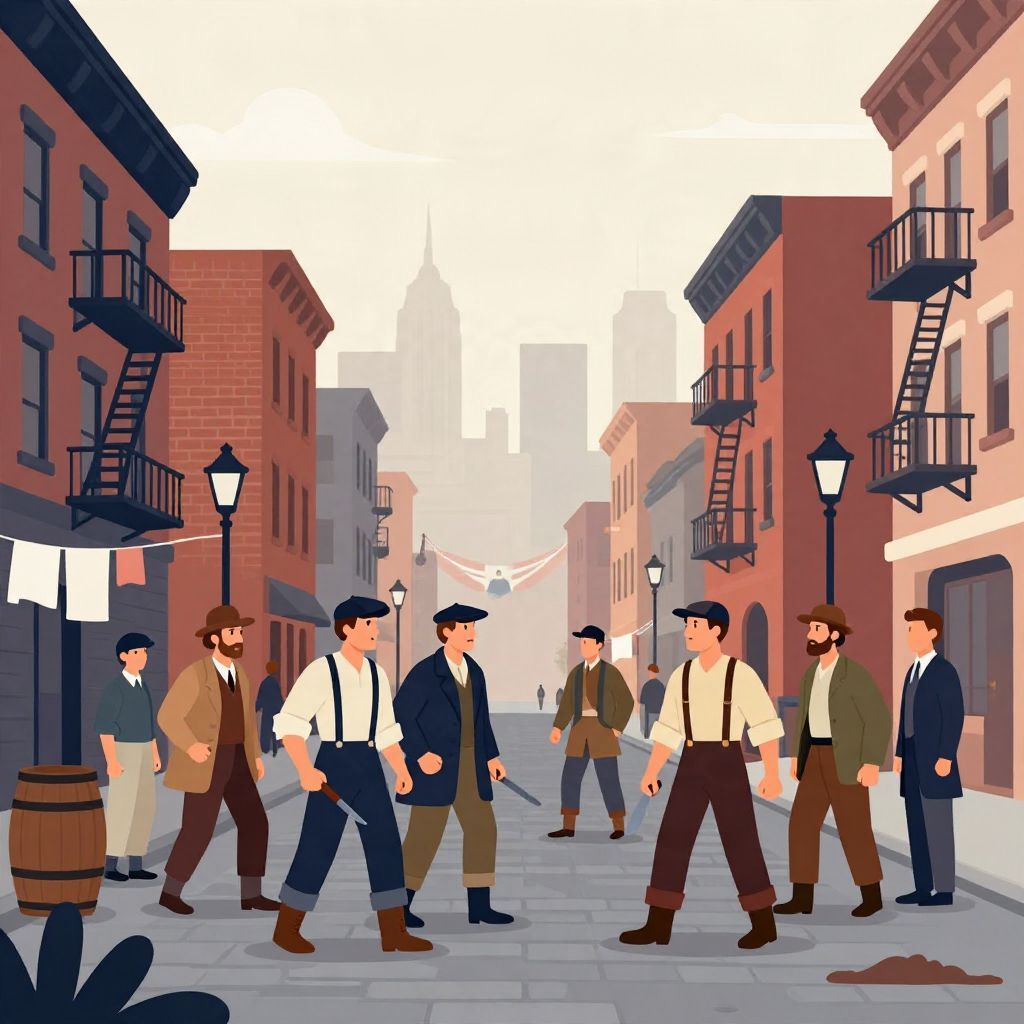
Is Gangs of New York a true story? Yes and no. Martin Scorsese’s film is rooted in real nineteenth-century New York history, especially the violent politics of the Five Points neighborhood and the city’s gang culture. But the central characters, the revenge plot, and many dramatic events are fictionalized or compressed for storytelling.
The movie blends documented history with invention, so the best way to judge it is not as a literal record, but as a historical drama inspired by real people, real tensions, and a real urban world.
Is Gangs of New York a true story?
Gangs of New York is not a true story in the strict sense. It is a fictional narrative set against real events in New York City during the mid-19th century, especially the 1840s and 1850s. The film captures genuine social conflict, but its main characters and central feud are invented or heavily dramatized.
What parts of the film are historically grounded?
The movie draws on real conditions in New York City: rapid immigration, ethnic tension, political corruption, street violence, and the rise of machine politics. The Five Points district in Lower Manhattan really was notorious for overcrowding, poverty, crime, and gang activity. Irish immigrants, in particular, faced hostility and discrimination, which helped fuel conflict in the city.
The Five Points neighborhood
Five Points was a real neighborhood formed by the intersection of several streets in lower Manhattan. By the 1840s, it had become one of the city’s most crowded and infamous districts. It was associated with tenements, saloons, brothels, and street gangs, though popular accounts sometimes exaggerated its lawlessness. The film uses this setting accurately as a symbol of urban unrest and immigrant struggle.
Immigration and nativism
Large-scale Irish immigration after the Great Famine of the 1840s transformed New York. Many newcomers arrived poor and Protestant nativists viewed them with suspicion or hostility. That tension is central to the film’s atmosphere. The movie also reflects the rise of anti-immigrant politics, which was real and influential in the period.
Gang violence and political street power
Street gangs did exist in New York, and many were tied to local politics. Some gangs acted as neighborhood enforcers, ballot box intimidators, or factional muscle. The film’s depiction of gang warfare is stylized, but the connection between violence and politics is historically credible. In the mid-19th century, elections could be rough, partisan, and physically dangerous.
What is fictionalized or invented?
The film’s main story is not based on a single documented event. The personal rivalry between Amsterdam Vallon and Bill “The Butcher” Cutting is fictional. So are most of the specific duels, betrayals, and revenge sequences. The movie creates a dramatic framework that allows real historical forces to be seen through an invented personal conflict.
Amsterdam Vallon and Bill “The Butcher”
Amsterdam Vallon is not a historical figure. Bill “The Butcher” Cutting is loosely inspired by several real gang leaders, especially William Poole, a notorious boxer, gang leader, and anti-immigrant political figure in New York. But the film’s Bill is not a precise portrait of Poole. He is a composite character shaped to embody nativist violence and the rough politics of the era.
The revenge plot
The storyline in which a young man returns to avenge his father’s death is a classic dramatic device, not a documented historical episode. It gives the movie emotional structure, but it should not be mistaken for actual history. The historical value lies more in the setting than in the plot.
Jenny Everdeane and other characters
Several major characters, including Jenny Everdeane and many of the gang members, are fictional or composite creations. They help the film represent different social types—pickpockets, political operatives, immigrants, and street toughs—but they are not drawn from a single archival record.
Which real historical figures appear in the film?
The film includes some real people, though often in compressed or altered form. Their presence helps anchor the story in actual New York politics, but the movie still takes liberties with chronology and relationships.
William “Boss” Tweed
William M. Tweed, the famous Tammany Hall political boss, appears as a young man in the film. Tweed was a real figure who later became one of the most powerful and corrupt politicians in New York City. However, the movie places him in a simplified timeline and uses him mainly to represent the rise of machine politics.
Fernando Wood and Tammany Hall
The film gestures toward the influence of political machines such as Tammany Hall, which did indeed shape urban politics in the 19th century. Tammany was not merely a criminal enterprise; it was also a political organization that built loyalty among immigrant voters by offering jobs, aid, and representation. Its history is more complicated than the film’s gang-versus-gang model suggests.
William Poole and the Bowery Boys
William Poole, sometimes called “Bill the Butcher,” was a real nativist leader associated with the Bowery Boys. He was known for his violence and anti-Irish stance and was killed in 1855. The film borrows his notoriety, but it turns him into a larger-than-life villain.
How accurate is the film’s historical atmosphere?
For atmosphere, the film is often strong. It conveys the rough texture of mid-19th-century urban life: muddy streets, crowded tenements, public violence, and political spectacle. The production design, costumes, and sense of social tension are widely praised because they evoke the period’s instability, even when the story itself is fictional.
What the film gets right
- The importance of immigration in reshaping New York City
- The existence of violent street gangs and political enforcers
- The influence of nativist prejudice against Irish Catholics
- The rough-and-tumble nature of urban politics before modern policing and election reform
- The symbolic importance of Five Points as a center of poverty and conflict
What the film simplifies
- It turns complex political movements into a personal feud
- It exaggerates the neat division between “native” and “immigrant” factions
- It compresses events from different years into one dramatic narrative
- It presents gang warfare as more organized and theatrical than it often was
- It gives the impression that one duel or one gang battle could decide the city’s future
Why did the real New York of this era produce gangs and political violence?
The city was growing faster than its institutions could manage. Between immigration, industrialization, and uneven housing, many neighborhoods became overcrowded and economically unstable. In that environment, gangs offered protection, identity, and local power. Political parties also used street fighters to influence elections and intimidate opponents.
Urban growth and poverty
New York in the mid-1800s was expanding rapidly. New arrivals often settled in packed districts where wages were low and public services were limited. Poverty did not automatically create gangs, but it made neighborhood loyalty, survival networks, and informal power structures much more important.
Politics on the street
Before modern election administration, voting could be chaotic. Political clubs and gangs sometimes blurred together. Men who could mobilize crowds, break up rival meetings, or control a block had real leverage. The film captures that atmosphere well, even if it turns it into a more cinematic contest than the historical record usually shows.
Did the film follow the book?
The movie is loosely based on Herbert Asbury’s 1928 book The Gangs of New York. That book was highly influential, but historians have long noted that Asbury wrote in a vivid, sensational style and did not always separate lore from documentation as carefully as modern scholarship would require. Scorsese’s film borrows the book’s energy and imagery, but it is not a direct adaptation of a single verified history.
History versus legend
Because the book itself blends fact, anecdote, and colorful storytelling, the film inherits some of that ambiguity. This is one reason viewers sometimes assume the movie is more historically precise than it really is. In reality, it is best understood as a historical interpretation shaped by both research and legend.
So how should viewers interpret Gangs of New York?
Viewers should treat the film as a dramatized portrait of a real historical moment, not as a documentary. Its value lies in showing how immigration, violence, neighborhood identity, and machine politics could intersect in one city at one time. Its weakness is that it turns those forces into a highly personalized melodrama.
If you want the short answer: Gangs of New York is inspired by true history, but its main story is fictional. The setting, some characters, and many social tensions are real; the central plot is not.
That distinction matters because the film is most useful when it sparks interest in the actual history of 19th-century New York—its immigrant neighborhoods, political machines, and street-level conflict. For readers interested in similar historical questions, related topics such as the history of Tammany Hall and the history of Five Points in New York can help place the movie in its wider context.