
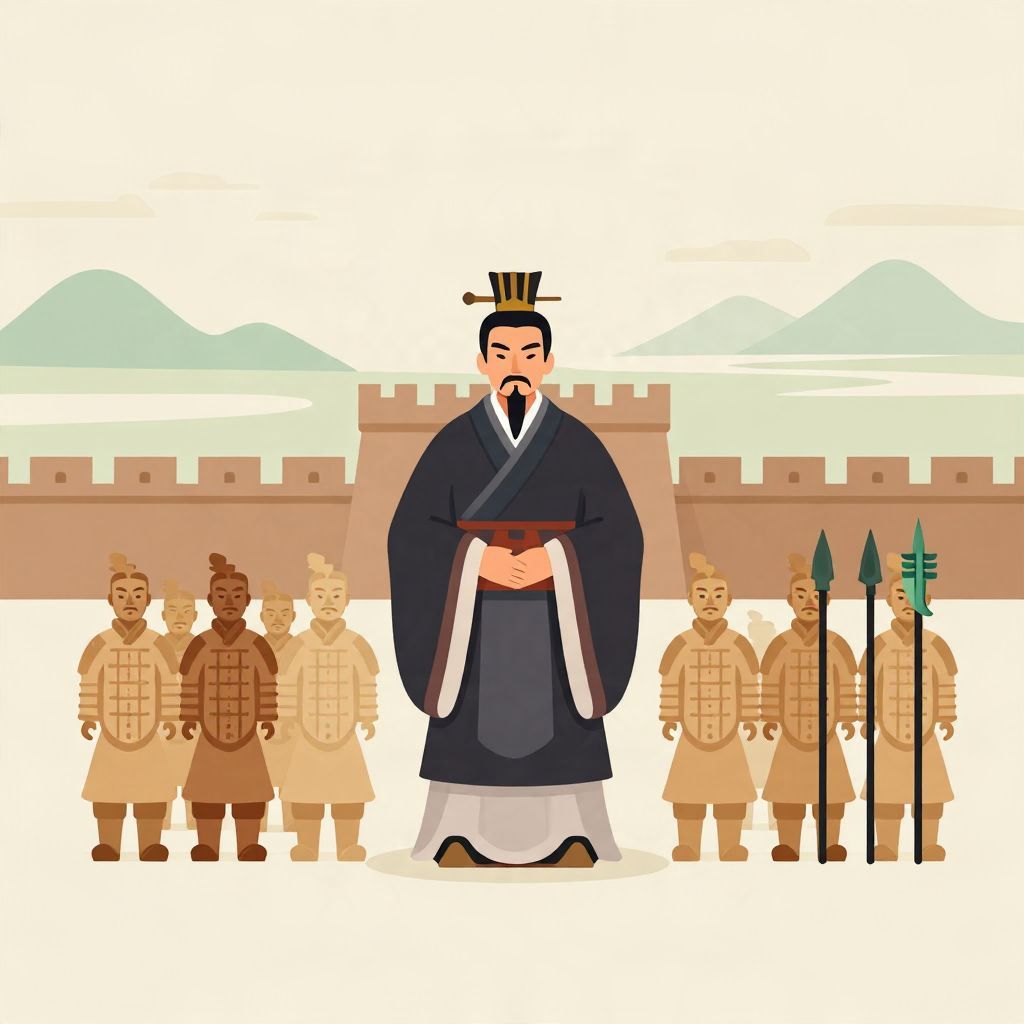
The Qin Dynasty is one of the shortest major dynasties in Chinese history, but its impact was enormous. If you are asking, “How long did the Qin Dynasty last?” the direct answer is that it ruled for about 15 years, from 221 BCE, when Qin Shi Huang unified China, to 206 BCE, when the dynasty collapsed after widespread rebellion.
Despite its brief life, the Qin created the political blueprint for imperial China. It centralized power, standardized writing and measures, and launched major state projects that shaped later dynasties for centuries.
How long did the Qin Dynasty last?
The Qin Dynasty lasted from 221 BCE to 206 BCE, or about 15 years. Some historians count from earlier Qin rule in the state of Qin, but the dynasty as an empire began when Qin Shi Huang unified the warring states in 221 BCE. Its fall came quickly after his death, amid succession troubles and rebellion.
The rise of Qin: from state to empire
Before becoming a dynasty, Qin was one of several powerful states during the Warring States period of ancient China. Over time, Qin gained military strength, administrative discipline, and political momentum. By the late third century BCE, it had defeated rival states one by one and ended centuries of fragmentation.
Why Qin succeeded
Qin’s success was not accidental. Its rulers built a highly organized state with strong laws, efficient taxation, and a merit-based military system that rewarded service and results. These reforms helped Qin mobilize resources more effectively than many of its rivals, who were often divided by local elites and inconsistent rule.
The most famous Qin ruler was Ying Zheng, later known as Qin Shi Huang, meaning “First Emperor of Qin.” In 221 BCE, after conquering the last rival kingdom, he declared a unified empire. This moment is often treated as the beginning of imperial China.
What happened during the Qin Dynasty?
Although the Qin Dynasty was short, it was highly transformative. The government replaced older feudal-style arrangements with a centralized bureaucracy. Officials were appointed by the state rather than inherited through noble rank, and the empire was divided into commanderies and counties for tighter control.
Major reforms under Qin Shi Huang
- Standardized writing so officials across the empire could communicate more easily.
- Unified weights, measures, and even axle widths to improve trade and administration.
- Strengthened roads and transport networks to move troops and supplies.
- Expanded legalist rule, emphasizing strict laws and harsh punishments.
- Connected and reinforced frontier defenses, including earlier walls in the north.
These reforms made the empire more governable, but they also increased pressure on the population. Heavy labor demands, strict laws, and harsh penalties created widespread resentment. What made the state stronger also made it more unpopular.
The Great Wall and other state projects
Qin Shi Huang is often associated with the Great Wall of China. The historical reality is more complex. He did not build the entire wall as it exists today, but his government linked and extended earlier defensive walls in the north. These works were part of a broader strategy to protect the frontier against nomadic threats.
Other large projects included road construction, palace building, and the emperor’s famous mausoleum complex near modern Xi’an, guarded by the Terracotta Army. These projects demonstrated imperial power, but they also required enormous labor and resources.
Why did the Qin Dynasty fall so quickly?
The Qin Dynasty collapsed because its political system was strong in conquest but fragile in succession and public support. When Qin Shi Huang died in 210 BCE, the court struggled over who should succeed him. The empire then faced rebellion, and within a few years the dynasty was gone.
Succession crisis after Qin Shi Huang
Qin Shi Huang died while traveling in 210 BCE. His death exposed deep weaknesses in the regime. Court officials manipulated the succession, and the throne passed to a weaker ruler, often identified as Qin Er Shi. Without the founder’s authority, the government became unstable and increasingly unable to control unrest.
Popular discontent and rebellion
By the end of the dynasty, many people were exhausted by taxation, forced labor, military conscription, and legal punishments. Local uprisings broke out, and rebel leaders gained momentum. The most important of these revolts helped bring down the Qin and opened the way for the Han Dynasty.
The dynasty’s fall was swift: from unification in 221 BCE to collapse in 206 BCE, the Qin had lasted only a short time in imperial form. Yet its institutions survived in modified form under later rulers.
Was the Qin Dynasty really only 15 years long?
Yes, if you mean the imperial Qin Dynasty, it lasted about 15 years. However, the broader history of Qin power stretches back earlier than 221 BCE, when the state of Qin was already rising within the Warring States system. So the answer depends on whether you mean the state of Qin or the dynasty after unification.
Different ways historians count Qin’s duration
- As a dynasty: 221 BCE to 206 BCE, about 15 years.
- As a ruling state: much longer, since Qin had existed as a major power before unification.
- As a historical legacy: its influence continued long after its fall through later imperial institutions.
This distinction matters because the Qin’s importance is not measured only by how long it ruled. In many ways, it mattered because it ruled for so little time yet changed so much so quickly.
What was life like under the Qin?
Life under the Qin was shaped by order, discipline, and state demands. The government sought uniformity across the empire, which may have improved administration and trade, but ordinary people often experienced the dynasty through taxes, military service, and labor obligations.
Law, control, and daily life
The Qin are often described as harsh because their legal system imposed severe punishments for offenses that could be treated more leniently in later periods. The state also monitored communities closely. This did not mean every person lived under constant terror, but it does mean the dynasty’s rule was unusually strict by ancient standards.
At the same time, the Qin’s standardization measures likely made some aspects of daily life easier for merchants, officials, and travelers. Shared measurements and a more uniform script helped the empire function as a single political unit.
The Qin legacy: short-lived but foundational
Although the Qin Dynasty ended quickly, its legacy was lasting. Later Chinese dynasties rejected some of its harshness, but they kept many of its administrative innovations. The idea of a unified Chinese empire under centralized rule became a permanent feature of Chinese political history.
Lasting contributions of the Qin
- Created the first unified Chinese empire.
- Established a centralized bureaucracy.
- Promoted standardization across a vast territory.
- Set a model for later dynasties, especially the Han.
- Helped define the role of the emperor as supreme ruler.
The Qin also became a cautionary example. Later historians often argued that its downfall showed the danger of ruling through force alone. That interpretation became influential in Chinese political thought, especially in contrast to the longer-lived Han Dynasty, which blended central authority with a somewhat more flexible style of governance.
Why the Qin Dynasty still matters today
The Qin Dynasty matters because it marks the transition from divided kingdoms to imperial China. Its reforms helped create the administrative and cultural framework that later dynasties inherited. Even its failures were historically important, because they showed what kind of state could unify China and what kind of rule could not endure.
So, how long did the Qin Dynasty last? Only about 15 years as an empire. But in historical terms, that short span was enough to reshape China’s political future for more than two millennia. If you want to explore the dynasty’s wider context, you may also be interested in how long the Great Wall is and the history behind how many people died building the Great Wall of China.