
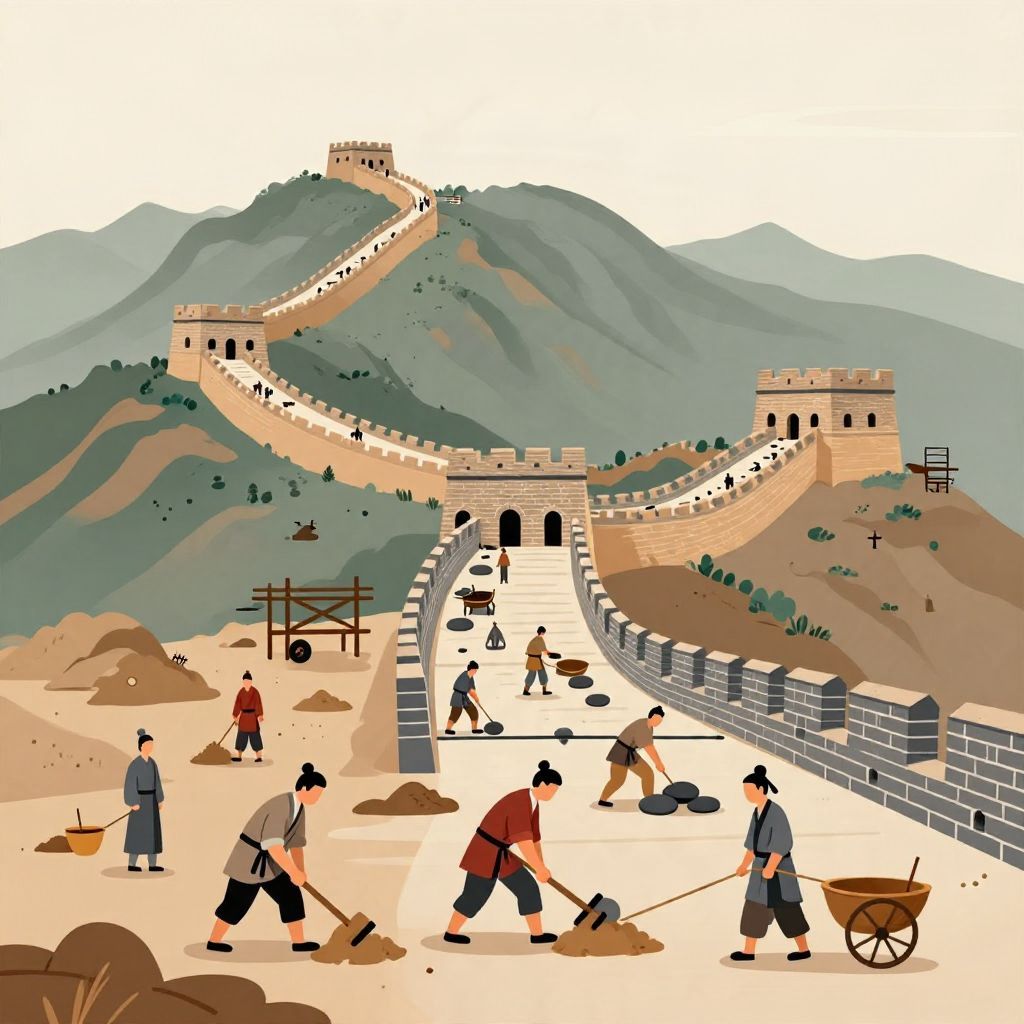
How many people died building the Great Wall of China? The honest answer is that no one knows the exact number. The wall was not one single project but a series of fortifications built, expanded, repaired, and rebuilt over many centuries, especially under the Qin, Han, and Ming dynasties. Historians therefore rely on fragmentary records, estimates, and later tradition rather than a precise death toll.
What is clear is that construction was extremely dangerous and often brutal. Thousands, and very likely many more, laborers died from exhaustion, hunger, disease, exposure, falls, and harsh punishment. The Great Wall became a symbol of imperial power, but also of the human cost of large-scale state building in ancient China.
How many people died building the Great Wall of China?
There is no reliable total death count for the Great Wall because it was built over centuries by different dynasties. For the early Qin wall, ancient sources describe massive forced labor and terrible mortality, but modern historians treat popular claims of “millions” with caution. The safest answer is that many thousands died, and possibly far more across all periods.
Why there is no exact number
The Great Wall was never a single construction campaign with one payroll, one labor force, or one official casualty report. Different walls and stretches were built from the Warring States period through the Ming dynasty, roughly the 7th century BCE to the 17th century CE. Records survive unevenly, and ancient governments did not keep modern-style death statistics.
A wall built in many eras
When people ask about the Great Wall, they often imagine one continuous structure. In reality, there were many walls. Early states built frontier barriers before China was unified. The Qin dynasty connected and extended defenses after 221 BCE. The Han dynasty pushed walls and beacon systems farther west. The best-known surviving stone-and-brick wall was largely rebuilt under the Ming dynasty between the 14th and 17th centuries.
Different labor systems, different risks
Each dynasty used different labor arrangements. Some workers were conscripted peasants serving state labor obligations. Others were soldiers, convicts, or hired laborers. The danger depended on terrain, climate, supply lines, and supervision. Mountain work, desert outposts, and winter construction all increased the odds of death even before disease and malnutrition are counted.
What the historical records actually say
Ancient Chinese sources do not give a trustworthy total for deaths on the Great Wall. They do, however, describe severe suffering during the Qin period, when the state mobilized huge numbers of workers for wall building, roads, and other projects. Later texts and popular stories turned that suffering into a moral warning about tyranny, but they do not provide a precise figure.
The Qin dynasty and forced labor
Under Qin Shi Huang, the first emperor of a unified China, labor was heavily centralized. The state moved large numbers of men to frontier projects, including wall construction. Ancient writers such as Sima Qian later portrayed Qin labor policy as harsh and politically destructive. That does not mean every detail is literal, but it does confirm that the work was coercive and dangerous.
Later dynasties also imposed heavy burdens
The Han and Ming dynasties inherited the frontier logic of the wall: defend against raids, control movement, and signal imperial power. Ming records are better preserved than earlier ones, and they show enormous expenditures of labor and materials. Even when workers were not literally dying by the thousands on a single site, the system still extracted a heavy toll through overwork, accidents, and starvation in remote garrisons.
Why popular estimates are so high
Modern popular culture often repeats claims that “millions” died building the Great Wall. This figure is difficult to verify and is usually treated by historians as an exaggeration or a symbolic estimate rather than a documented total. The number became famous because it captures the scale of suffering, not because it comes from a complete census of deaths.
The legend of Meng Jiangnü
One reason the wall is associated with mass death is the famous legend of Meng Jiangnü, whose husband supposedly died while working on the wall and whose tears caused part of it to collapse. This story is culturally important, but it is folklore, not historical evidence. It reflects how later generations remembered the wall: as a place where families were broken and laborers vanished far from home.
Why “millions” is hard to prove
To support a claim of millions of deaths, historians would need dependable records of workforce size, duration, mortality rates, and regional losses across multiple dynasties. Those records do not exist in full. Some labor forces were enormous, but the total number of deaths is unknowable. A very large number is plausible; an exact million-count is not.
What made the work so deadly?
The Great Wall was deadly not because of battle alone, but because of the conditions under which it was built. Workers faced long marches, poor food, extreme weather, and dangerous terrain. In many places, the wall ran through mountains, deserts, and remote passes where supply was difficult and rescue almost impossible.
Common causes of death
- Exhaustion from heavy manual labor and long workdays
- Hunger and dehydration in poorly supplied frontier zones
- Disease spreading in crowded camps
- Exposure to cold, heat, wind, and sandstorms
- Accidents from falls, collapsing earth, and stone work
- Punishment under harsh military and legal systems
Frontier geography mattered
Much of the wall crossed difficult land. In northern China, workers had to build in arid, windy regions where water and timber were scarce. In mountainous areas, they had to cut foundations into rock and haul materials uphill. The wall was an engineering achievement, but it was also a logistical struggle that consumed human lives as well as stone and earth.
How historians estimate the human cost
Because exact death records are missing, historians use indirect evidence. They examine administrative texts, memorials, later histories, archaeological remains, and the political context of each dynasty. This method can show that mortality was severe, but it cannot produce a single definitive number for all periods combined.
Evidence from labor systems
Chinese states often relied on corvée labor, a system in which peasants owed unpaid service to the government. This made it possible to mobilize huge workforces quickly. It also meant that laborers were often poorly protected and could be sent far from home. High turnover, desertion, illness, and death were all likely in such a system, even when records do not record each case individually.
Archaeology and material evidence
Archaeology confirms the scale of construction and the difficulty of the work. Excavations and surveys show that many sections were built with compacted earth, stone, brick, and timber under harsh frontier conditions. Human remains are not always directly linked to wall sites, but the physical evidence supports the written picture of dangerous, labor-intensive construction.
So what is the best answer?
If you want a concise historical answer, it is this: no one knows the exact number of people who died building the Great Wall of China. The death toll was certainly very high over the centuries, probably numbering in the thousands and perhaps far beyond that, but the famous “millions” figure is not securely documented.
A careful historical summary
The Great Wall should be understood as a long series of frontier projects, not one event. Its builders included soldiers, peasants, convicts, and conscripted laborers. Some died in construction accidents, many from the hardships of frontier life, and others from the coercive labor systems that sustained imperial defense. The wall’s human cost is real, even if the exact total is lost to history.
Why the question still matters
The Great Wall is often celebrated as a symbol of Chinese civilization, state power, and architectural endurance. But it also reveals how premodern states could mobilize labor on a vast scale with little regard for individual welfare. Asking how many people died building it forces us to look beyond the monument itself and consider the people whose labor made it possible.
In the end, the Great Wall stands not only as a military structure but as a memorial to centuries of human effort and suffering. The exact death toll cannot be known, but the historical record makes one point unmistakable: building the wall cost many lives, and its fame should never obscure that fact.