
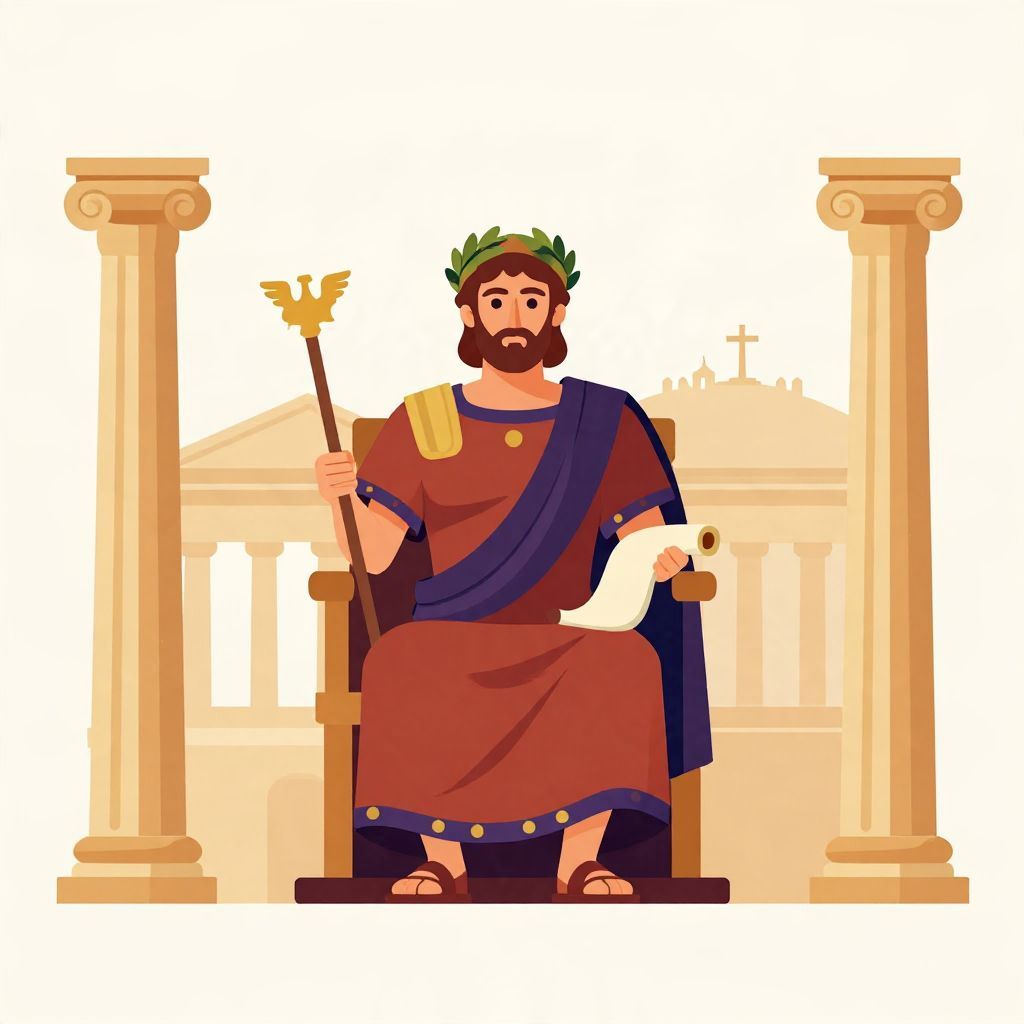
The emperor when Jesus died was most likely Tiberius, the second Roman emperor, who ruled from AD 14 to AD 37. Jesus’ crucifixion is usually dated to the early 30s AD, most often around AD 30 or AD 33, during the governorship of Pontius Pilate in Roman Judaea.
That answer is straightforward, but the historical setting is more complex. The death of Jesus took place in a Roman province shaped by imperial power, local politics, and religious tensions, so understanding the emperor helps explain the world in which the event occurred.
Who was emperor when Jesus died?
Tiberius was emperor of Rome when Jesus died. Most historians place the crucifixion during Tiberius’ reign, under the authority of Pontius Pilate, the Roman prefect of Judaea. The exact year is debated, but the most commonly suggested dates are AD 30 or AD 33, both within Tiberius’ rule.
The Roman ruler in Jesus’ lifetime
Tiberius and the Roman Empire
Tiberius succeeded Augustus and ruled a vast empire stretching around the Mediterranean. By the time of Jesus’ death, Rome had already become the dominant power in the eastern Mediterranean, including Judaea. The emperor did not personally oversee local trials in Jerusalem, but his authority shaped the entire political system.
In practice, Roman rule in Judaea was exercised through governors and client rulers. That means the emperor’s role was indirect, yet decisive. Any execution by crucifixion was a Roman punishment, and the governor’s approval would have been necessary.
Why Tiberius matters historically
Tiberius was not known as a charismatic public figure in the way Augustus had been, but he was a capable administrator and military leader. His reign was marked by political caution and a strong emphasis on imperial stability. For historians, his reign provides the chronological frame for the final years of Jesus’ life and the early beginnings of Christianity.
How historians date Jesus’ death
The date of Jesus’ death is not recorded in a single universally accepted ancient source. Instead, historians combine the New Testament accounts, Roman administrative history, and astronomical calculations. This is why the year is usually given as around AD 30 or AD 33, rather than as an exact certainty.
Why the date is debated
The Gospels place Jesus’ death during the governorship of Pontius Pilate, who ruled Judaea from about AD 26 to AD 36. The challenge is matching the Gospel chronology with the Jewish calendar and the timing of Passover. Different scholarly reconstructions produce different plausible years.
- AD 30 is often favored by scholars who reconstruct a shorter ministry for Jesus.
- AD 33 is also widely argued, especially when astronomical and calendrical calculations are brought into the discussion.
- Both dates fall securely within the reign of Tiberius.
What is certain and what is not
It is historically well supported that Jesus was executed under Roman authority during Tiberius’ reign. What remains uncertain is the exact calendar date. Responsible history distinguishes between the broad certainty of the emperor’s identity and the narrower uncertainty of the precise year.
Rome, Judaea, and the political background
Judaea was not an independent kingdom at the time of Jesus’ death. It was under Roman control, and its rulers had to balance Roman expectations with local religious and social pressures. This setting helps explain why a preacher from Galilee could become entangled in imperial justice.
Pontius Pilate’s role
Pontius Pilate was the Roman prefect of Judaea. He represented imperial authority in the province and had the power to order executions. The Gospel narratives present him as the official who authorized Jesus’ crucifixion, even if local leaders played a role in bringing the case forward. That arrangement fits the broader structure of Roman provincial rule.
Local tensions in Judaea
Judaea in the early first century was politically sensitive. Religious festivals drew large crowds to Jerusalem, and Roman officials were alert to any sign of unrest. A public execution by crucifixion was not only punishment but also a warning. It signaled that Rome controlled order and could suppress perceived threats.
What was the Roman Empire like under Tiberius?
Under Tiberius, the Roman Empire was mature, organized, and deeply hierarchical. Augustus had transformed the old Roman Republic into an imperial system, and Tiberius inherited that structure. The empire was not yet the sprawling, later empire of popular imagination, but it already dominated a huge region of the ancient world.
Key features of the period
- Centralized authority in Rome, with the emperor as the top political figure.
- Provincial administration through governors, prefects, and client rulers.
- Military control used to maintain peace and collect taxes.
- Cultural diversity across the empire, including Greek-speaking eastern provinces like Judaea.
Jesus lived and died within this imperial world. His ministry took place in a region where Roman roads, taxation, law, and military power all shaped daily life. The emperor himself may have been far away, but imperial authority was present in the background of every major political decision.
The significance of Tiberius in Christian history
Tiberius is important in Christian history not because he appears as a central character in the Gospels, but because his reign anchors the chronology of Jesus’ life. For Christians, the crucifixion is the defining event that leads to the resurrection narrative and the spread of the early church. For historians, Tiberius provides the Roman framework in which those events occurred.
From execution to movement
Jesus’ death did not end the story. Within a few decades, his followers were preaching in Jerusalem, Syria, Asia Minor, and beyond. The early Christian movement emerged inside the Roman world, and its growth was shaped by the empire’s roads, cities, and communication networks. Ironically, the same imperial system that executed Jesus also helped spread the religion associated with him.
Common misunderstandings about the emperor and Jesus’ death
Because the question is often asked in a simple way, it is easy to confuse the emperor with the local ruler or to assume that the emperor personally ordered the crucifixion. Historical evidence does not support that idea.
What people often get wrong
- It was not Augustus; Augustus died before Jesus’ public ministry is usually placed.
- It was not a direct imperial trial in Rome; the execution happened in Judaea under a provincial governor.
- The exact year is uncertain; historians usually give an approximate date rather than a single guaranteed one.
These distinctions matter because they keep the answer historically accurate. The emperor was Tiberius, but the immediate political actor was Pontius Pilate, operating within the Roman provincial system.
Why this question still matters
Asking who was emperor when Jesus died is more than a trivia question. It places one of the most influential events in world religious history inside a specific political and historical setting. That setting was the Roman Empire under Tiberius, with Judaea governed by Roman officials and local tensions running high.
The best historical answer is therefore clear: Tiberius was emperor when Jesus died, most likely around AD 30 or AD 33. If you want more background on the world of Roman power, see what the Roman Forum was and when Jesus’ birthday was traditionally placed.