
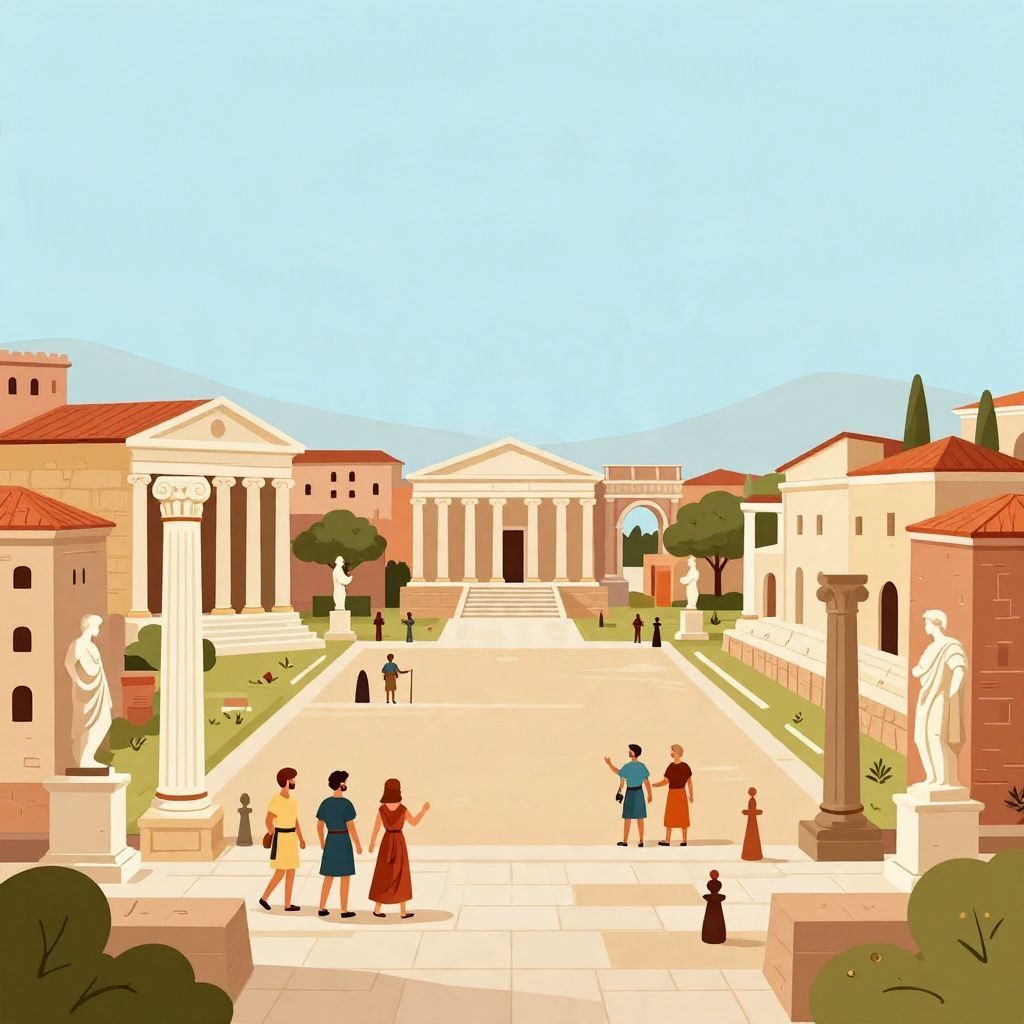
What is the Roman Forum? It was the central public space of ancient Rome, a place where politics, religion, law, commerce, and ceremony overlapped. For centuries, it served as the city’s civic heart, where Romans gathered to debate, worship, trade, celebrate victories, and witness public life unfold.
Today, the Forum is one of the most famous archaeological sites in the world. Its ruins preserve the layered history of Rome itself: from early settlement and republican government to imperial expansion, Christian transformation, and eventual abandonment.
What Is The Roman Forum?
The Roman Forum was the main public square of ancient Rome, located in the valley between the Palatine, Capitoline, and other hills. It functioned as a political, religious, legal, and commercial center from the early Republic through the Imperial period, making it the symbolic and practical heart of Roman public life.
Where Was the Roman Forum Located?
The Forum sat in a low-lying basin in the center of Rome, in what is now modern Italy. In antiquity, this area was originally marshy and prone to flooding. Over time, Roman engineering transformed it into a dry, paved civic space connected to major roads, temples, basilicas, and government buildings.
A strategic urban location
Its position mattered. The Forum lay at a crossroads between the city’s hills and near the route of the Tiber River, making it a natural meeting point for residents, visitors, officials, and merchants. Because it was so accessible, it became the obvious place for public gatherings and state business.
How Did the Roman Forum Begin?
The earliest history of the Forum is partly archaeological and partly reconstructed from later Roman tradition. Before it became a formal civic center, the area was used for burials, drainage, and informal gathering. By the late 7th or early 6th century BCE, after major drainage works such as the Cloaca Maxima, the space was being developed for public use.
From marsh to civic center
Roman tradition linked the Forum’s development to the early kings of Rome, especially the Tarquins, but historians treat these stories cautiously because they were written down much later. What is clear is that the area gradually shifted from a practical lowland into the city’s main public square as Rome grew in political complexity.
What Was the Roman Forum Used For?
The Roman Forum was used for many purposes at once. It was where elections were held, laws were discussed, court cases were heard, religious rites were performed, markets operated, and military triumphs were celebrated. In other words, it was not just a square but the stage on which Roman civic identity was performed.
Politics and government
During the Roman Republic, citizens gathered in and around the Forum for assemblies and public debate. Important political institutions met nearby, including the Senate in the Curia. Speakers addressed crowds from the Rostra, the famous platform for public oratory. Elections, announcements, and political contests all depended on this central space.
Law and justice
The Forum was also a legal center. Courts and magistrates operated there, and public legal proceedings were part of everyday Roman life. Because Roman politics and law were closely connected, the same space that hosted debate and voting also hosted judgments, contracts, and official pronouncements.
Religion and ritual
Religion was woven into the Forum’s daily use. Temples dedicated to deities such as Saturn, Vesta, Castor and Pollux, and Concord stood there or nearby. Priests, magistrates, and citizens took part in rituals that helped legitimize the state and mark important civic moments. Roman public life was inseparable from religious observance.
Trade and daily life
Although the Forum is often remembered for politics, it also had an economic role. Shops, stalls, and market activity existed in and around the area, especially in earlier periods. As Rome expanded, some commercial functions shifted elsewhere, but the Forum remained a place where money, patronage, and social exchange intersected.
Why Was the Roman Forum So Important?
The Roman Forum mattered because it concentrated the power and identity of Rome in one place. It brought together institutions that, in many other societies, might have been physically separate. By placing religion, law, politics, and public memory side by side, the Forum helped define what it meant to be Roman.
A symbol of the Republic
In the Republican era, the Forum represented the ideal of civic participation, even though Roman society was deeply unequal. Elite competition, popular politics, and public ceremony all took place there. The space made Roman government visible, dramatic, and communal, even when real power remained concentrated among the wealthy and powerful.
A symbol of imperial power
Under the emperors, the Forum remained important but changed in meaning. Emperors used it to display authority, sponsor building projects, and connect themselves to Rome’s past. Monuments, arches, and restored temples turned the area into a landscape of memory and political messaging, not just a working civic square.
What Buildings and Monuments Were in the Roman Forum?
The Forum contained many structures built across centuries. Some were temples, some were civic buildings, and others were commemorative monuments. Because the area was repeatedly rebuilt, altered, and reused, the Forum became a layered historical site rather than a single planned complex.
Key structures associated with the Forum
- Curia – the Senate house, where senators met.
- Rostra – the speaker’s platform used for public addresses.
- Temple of Saturn – one of the Forum’s oldest and most recognizable temples.
- Temple of Vesta – linked to the sacred fire maintained by the Vestal Virgins.
- Basilica Julia – a large public building used for legal and business activity.
- Basilica Aemilia – another major civic and commercial structure.
- Arch of Septimius Severus – a triumphal arch celebrating imperial victory.
Temples and civic architecture
Many Forum buildings were rebuilt after fires, political changes, or changing tastes. This means the ruins visible today belong to different periods, from the Republic to late antiquity. The result is a site that reveals how Roman public architecture evolved over time rather than a frozen snapshot of one era.
How Did the Roman Forum Change Over Time?
The Forum changed dramatically as Rome changed. In the early Republic, it was the center of a growing city-state. In the late Republic, it became a crowded arena of political competition and public spectacle. Under the Empire, it was monumentalized, while some practical functions shifted to other areas of the city.
The Republican Forum
During the Republic, the Forum was the main venue for civic participation. Citizens, magistrates, senators, and advocates used it for political and legal life. It was noisy, crowded, and highly active, reflecting a city whose public culture depended on face-to-face interaction.
The Imperial Forum
As emperors consolidated power, they built new forums and monumental complexes elsewhere in Rome, including the Imperial Fora. These additions did not replace the old Forum entirely, but they reduced its exclusive centrality. The original Forum remained important as a historic and ceremonial center, even as Rome’s administrative landscape expanded.
Late antiquity and decline
By the later Roman Empire, the Forum’s role diminished. Political institutions changed, public life shifted, and some buildings fell into disrepair. In the medieval period, the area was partly abandoned, quarried for stone, and overgrown. The once-busy center of Rome became a field of ruins known in later centuries as the Campo Vaccino, or “cow field.”
What Can Archaeology Tell Us About the Roman Forum?
Archaeology has revealed that the Forum was not built all at once. Excavations show repeated layers of construction, destruction, rebuilding, and reuse. This helps historians understand not only the physical site but also the changing priorities of Roman society over many centuries.
Evidence and interpretation
Some aspects of the Forum are well documented through surviving remains, inscriptions, and ancient literary references. Other details, especially from Rome’s earliest centuries, rely on later Roman writers and archaeological inference. Historians therefore distinguish between what can be directly evidenced and what is reconstructed from tradition.
Why the ruins matter
The ruins are valuable because they show how public space functioned in a major ancient civilization. They also reveal the practical realities of Roman urban life: drainage, paving, rebuilding after fire, and the reuse of older monuments. The Forum is not just a symbol of Rome; it is a record of Rome’s long historical development.
What Is the Roman Forum’s Historical Legacy?
The Roman Forum remains one of the most powerful symbols of classical antiquity. It shaped later ideas about government, public space, architecture, and civic identity. Even in ruin, it continues to influence how people imagine ancient Rome: not as a distant abstraction, but as a living city of debate, ritual, and power.
Influence on later cultures
Renaissance and modern observers studied the Forum as a model of ancient grandeur. Artists, architects, and historians were drawn to its ruins because they represented the rise and fall of a great civilization. In this way, the Forum became not only a Roman site but also a European cultural reference point.
Key Facts About the Roman Forum
- Location: Central Rome, in the valley between major city hills.
- Origins: Developed gradually from the early centuries of Rome, likely by the late 7th or early 6th century BCE.
- Main role: Civic, religious, legal, and commercial center.
- Peak importance: Especially significant during the Roman Republic and early Empire.
- Later fate: Declined in late antiquity and became ruins in the medieval period.
Why the Roman Forum Still Matters Today
The Roman Forum matters because it shows how a civilization organized power in public view. It was the place where Rome’s institutions met its rituals, and where ordinary urban life intersected with state authority. Understanding the Forum helps explain how Rome governed itself, represented itself, and remembered itself.
In the end, the Roman Forum was more than a square: it was the living center of ancient Rome’s public world. If you want to explore more about how societies organize power and identity, you may also find what a feudal system was and what cultural divergence means useful next reads.