
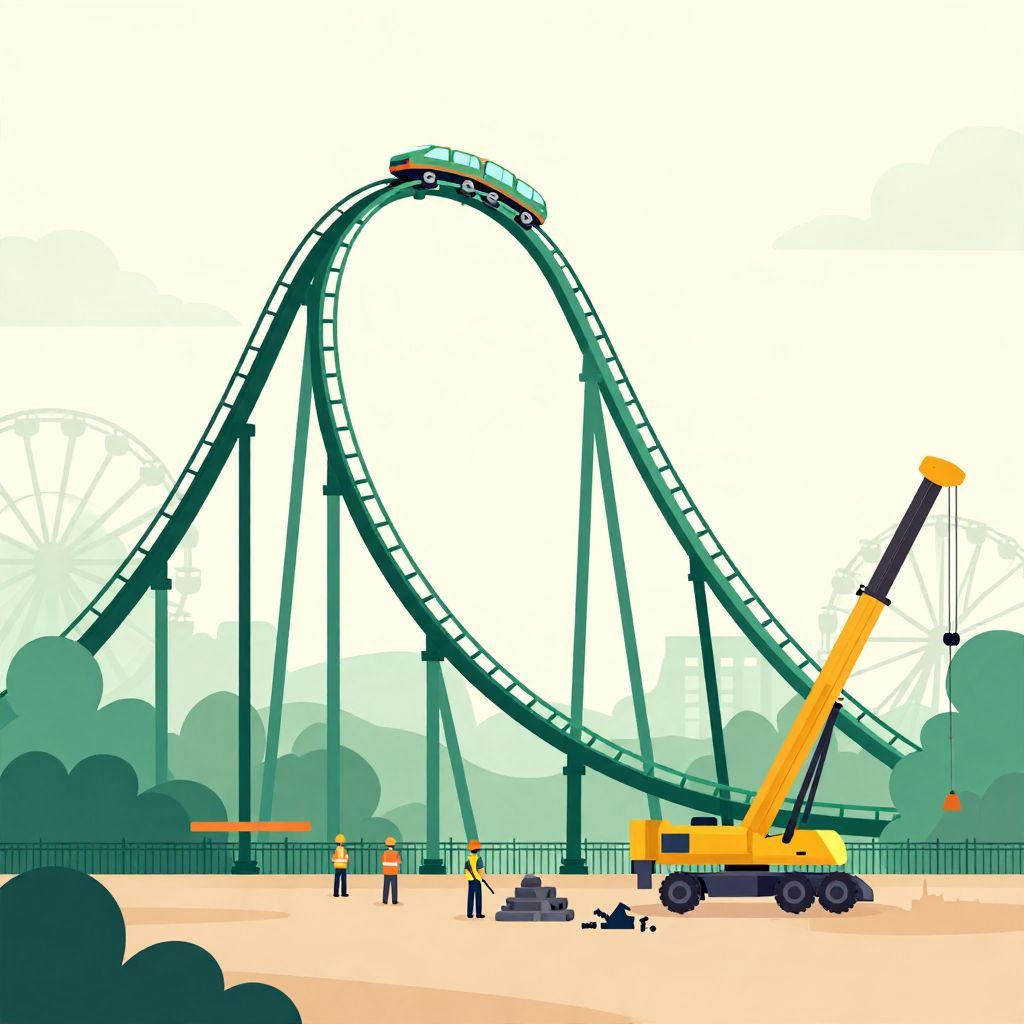
Why was Kingda Ka demolished? The short answer is that the roller coaster became too costly and difficult to keep operating in the long term, especially after years of heavy use, maintenance demands, and changing business priorities at Six Flags Great Adventure in New Jersey.
Its demolition also reflects a broader history of amusement parks: even record-breaking rides can be removed when repairs, reliability, and future redevelopment plans outweigh the value of keeping them. Kingda Ka was not torn down because it was historically unimportant, but because it had reached the end of its practical life.
Why was Kingda Ka demolished?
Kingda Ka was demolished because it was expensive to maintain, increasingly difficult to keep reliable, and no longer fit the park’s long-term operational plans. Built as a headline-grabbing attraction, it became one of the most famous launch coasters in the world, but extreme rides often age quickly. Once upkeep, downtime, and replacement costs rise, parks sometimes decide that removal is the most practical option.
What Kingda Ka was and why it mattered
Kingda Ka opened in 2005 at Six Flags Great Adventure in Jackson Township, New Jersey. For years, it held the title of the world’s tallest roller coaster and was also known for its dramatic hydraulic launch. It became a symbol of the early-2000s amusement-park race for size, speed, and spectacle.
The coaster’s fame mattered because it was not just another ride. It was a marketing landmark, designed to draw attention from far beyond New Jersey. Like many record-setting attractions, it helped define an era when parks competed to build the tallest, fastest, or most extreme ride possible.
The coaster boom of the early 2000s
Kingda Ka belonged to a period when major theme parks used giant coasters to create headlines. These rides were expensive to build and expensive to maintain, but they could instantly become a park’s signature attraction. In that sense, Kingda Ka was both a thrill ride and a business strategy.
That strategy worked for a time. The coaster’s record-setting status gave the park publicity, but records are temporary. As newer rides appeared elsewhere, the value of keeping an aging giant coaster depended less on novelty and more on whether it still made financial and operational sense.
The practical reasons behind the demolition
There was no single dramatic cause. Instead, Kingda Ka’s demolition was the result of several pressures building over time. The most important were maintenance costs, reliability concerns, and the challenge of keeping an aging, highly specialized ride safe and profitable.
1. High maintenance demands
Extreme coasters need constant inspection and repair. Kingda Ka’s launch system, tall structure, and complex mechanical components required specialized upkeep. As rides age, parts wear out, systems become harder to service, and maintenance costs rise. For a park, that can turn a famous attraction into a financial burden.
2. Operational reliability
Large, complex rides are often vulnerable to downtime. If a coaster is frequently closed for repairs or weather-related issues, it may not deliver enough value to justify the expense of keeping it. Even a legendary ride can become less useful if it cannot operate consistently throughout the season.
3. Changing business priorities
Amusement parks are always balancing nostalgia against redevelopment. A ride that once anchored a section of the park may eventually occupy valuable land that could be used for something newer, more reliable, or more profitable. In that sense, demolition is often part of a broader business decision rather than a judgment on the ride’s cultural importance.
4. The lifecycle of record-breaking rides
Many record-holding attractions are built with a limited lifespan in mind. They are designed to make an immediate impact, not necessarily to last for decades without major reinvestment. Once the record is gone and the ride ages, parks must decide whether to pour money into it or replace it with a new attraction.
Historical context: why giant coasters often disappear
Kingda Ka’s removal fits a long pattern in amusement-park history. From wooden coasters to steel launch rides, attractions are often demolished when they become too expensive to repair or when parks want to refresh their image. The history of thrill rides is full of spectacular openings followed by quiet retirements.
This is especially true for rides that push engineering limits. The more extreme the design, the more specialized the maintenance. That can make them iconic but also fragile in business terms. A coaster may be famous worldwide and still be vulnerable to the same economic pressures that affect far less famous rides.
Why parks replace icons
Parks remove major rides for several common reasons:
- to reduce maintenance and repair costs
- to improve reliability and guest capacity
- to make room for new attractions
- to refresh the park’s brand and marketing appeal
- to respond to changing safety, insurance, or operational needs
Kingda Ka’s demolition should be understood through this lens. It was not unusual in amusement-park history; what made it notable was the ride’s fame and scale. Its destruction drew attention because it had once represented the peak of coaster ambition.
What happened before the demolition
Before demolition, Kingda Ka had already lived through years of intense use and periodic downtime. Like many major rides, it remained a subject of public fascination long after its record-setting debut. The coaster’s status changed over time from cutting-edge engineering marvel to aging infrastructure.
By the time demolition became the chosen path, the park had likely concluded that the site could be used more effectively in another way. That is a familiar story in theme-park history: the old attraction makes way for the next generation, even when the old one still has a devoted following.
Why the decision can seem sudden
To visitors, a demolition may appear abrupt. In reality, these decisions are usually the result of years of planning, cost analysis, and internal discussion. Parks rarely remove a major ride without considering replacement options, redevelopment schedules, and the long-term value of the land.
That means the public often sees only the final act—the wrecking equipment, the dismantled track, the empty skyline—but not the slow accumulation of practical reasons that made demolition likely.
Why Kingda Ka’s removal attracted so much attention
Kingda Ka mattered because it was more than a ride: it was a landmark. For coaster enthusiasts, it represented a peak in the history of amusement-park competition. For casual visitors, it was a visible symbol of the park itself. When a structure like that is removed, it feels like the end of an era.
Its demolition also highlights how quickly technological marvels can become historical artifacts. What was once the newest and most daring attraction can, within a few decades, become a candidate for removal if the economics no longer work.
The difference between fame and permanence
History is full of famous structures that did not last forever. That is especially true in entertainment industries, where novelty is part of the product. A ride can be beloved, record-breaking, and culturally memorable without being permanent. Kingda Ka’s story shows how fame does not guarantee survival.
What Kingda Ka’s demolition means for amusement-park history
Kingda Ka’s demolition is a reminder that amusement parks are living, changing spaces. They preserve memories, but they also evolve. In that sense, the removal of a famous coaster is not only an ending; it is also a sign of how parks adapt to new economics, new engineering standards, and new audience expectations.
For historians of leisure and popular culture, the coaster’s removal is significant because it captures a broader pattern: the rise and fall of spectacular consumer attractions. These structures are built to impress, but they are also subject to the same forces that shape all commercial history—cost, demand, and reinvestment.
Conclusion
Kingda Ka was demolished because it had become too costly and difficult to keep operating as an aging, highly specialized attraction. Its removal reflects the usual life cycle of major amusement rides: a dramatic debut, years of fame, then a practical decision to clear the way for something new. If you’re interested in how attractions and public spaces change over time, you may also enjoy reading about the history of amusement parks and the history of roller coasters.