
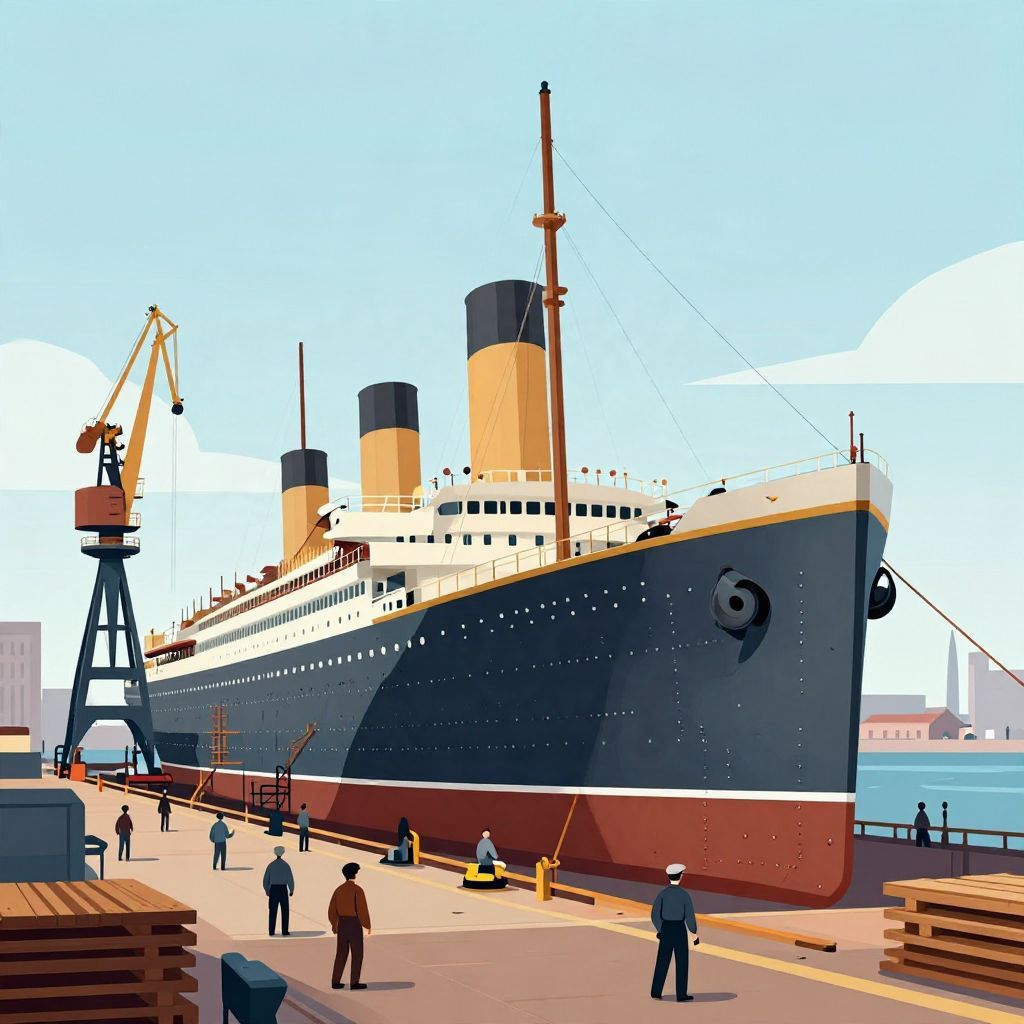
Where was Titanic built? The famous ocean liner was built in Belfast, Ireland, at the Harland and Wolff shipyard on Queen’s Island in Belfast Lough. Construction began in 1909, and the ship was launched in 1911 before being fitted out for sea trials and service.
Titanic’s birthplace mattered because it reflected the industrial power of early 20th-century shipbuilding. The ship was one of three Olympic-class liners ordered by the White Star Line, and Belfast’s massive shipyard was chosen because it had the size, labor force, and engineering capacity to build such an enormous vessel.
Where Was Titanic Built?
Titanic was built in Belfast, in what is now Northern Ireland, at the Harland and Wolff shipyard. More specifically, the ship was constructed on Queen’s Island in Belfast Lough, where the yard had the cranes, slipways, and workshops needed for a vessel of Titanic’s unprecedented scale. Her hull was laid down in 1909, launched in 1911, and completed in 1912.
The Belfast Shipyard That Built Titanic
Harland and Wolff was one of the most important shipbuilding firms in the world at the time. By the early 1900s, it had developed a reputation for building large, fast, and luxurious liners for the White Star Line. Titanic was built alongside her sister ship, RMS Olympic, as part of a major expansion in transatlantic passenger travel.
Why Belfast?
Belfast was a practical choice, not a symbolic one. The city had a long shipbuilding tradition, access to skilled workers, and a deep-water industrial setting suited to heavy construction. Harland and Wolff also had a close business relationship with White Star Line, making Belfast the natural place for the project.
The yard itself was enormous. It included metalworking shops, drawing offices, fitting-out quays, and giant gantry cranes that could handle the ship’s huge components. Building Titanic required thousands of workers and a carefully coordinated industrial process.
How Titanic Was Built in Belfast
Titanic was not assembled in one sudden effort. She was built in stages, using the methods of early 20th-century ship construction. The steel hull was put together on the slipway, then launched into the water before the interior was completed at the fitting-out berth.
Key stages of construction
- Design and planning at Harland and Wolff’s offices in Belfast.
- Keel laying in 1909, marking the start of physical construction.
- Hull assembly on the slipway, using steel plates and rivets.
- Launch on 31 May 1911, when Titanic entered Belfast Lough.
- Fitting out through 1911 and early 1912, including engines, interiors, and safety equipment.
- Sea trials in April 1912 before departure for Southampton.
The launch was a major event in Belfast. It was not the end of construction, but it was the moment the giant hull first met the water. After that, the ship remained in the harbor area while workers installed machinery, decorated the public rooms, and completed the technical systems needed for service.
What Kind of Place Was Queen’s Island?
Queen’s Island was part of Belfast’s busy industrial waterfront. It was not a glamorous setting, but it was one of the most advanced shipbuilding centers in the British Isles. The area was dominated by docks, workshops, cranes, and rail connections that made large-scale construction possible.
This industrial landscape helps explain why Titanic could be built there. The ship was a product of modern engineering, mass labor, and imperial-era trade networks. Belfast’s shipyard was not just a workplace; it was part of the economic engine that supported ocean travel between Europe and North America.
Who Built Titanic?
Titanic was built by the workforce of Harland and Wolff under the direction of experienced shipbuilders and engineers. The project involved designers, riveters, boilermakers, carpenters, electricians, and many other trades. No single person “built” Titanic alone; it was the result of coordinated industrial labor.
Important names connected with the build
- Harland and Wolff — the shipbuilding firm responsible for construction.
- White Star Line — the company that ordered the ship.
- Thomas Andrews — the shipyard’s managing director and head of the design team for the Olympic-class liners.
- Lord Pirrie — a leading figure at Harland and Wolff and a key force behind the project.
Thomas Andrews is especially associated with Titanic’s design and construction because he oversaw many of the practical details and later sailed on the ship’s maiden voyage. Still, Titanic was a collective achievement of a large industrial organization rather than the work of one visionary alone.
Was Titanic Built in Ireland or Northern Ireland?
This question depends on historical context. In 1912, when Titanic was completed, Belfast was part of the United Kingdom of Great Britain and Ireland. The modern political division of Ireland came later, after the partition of Ireland in the early 20th century. Today, Belfast is in Northern Ireland, but historically the ship was built in Ireland as it existed at the time.
That distinction matters for accuracy. Saying Titanic was built in Belfast, Ireland, is historically correct for the period of construction. Saying it was built in Belfast, Northern Ireland, is also geographically true today, but it uses a later political label.
Why the Location Matters in Titanic’s Story
Titanic’s construction site is important because it connects the ship to the industrial world that created it. The liner was a masterpiece of modern engineering, but it was also shaped by the limitations and assumptions of its time. Belfast’s shipyard could build a ship of extraordinary size, yet even that advanced environment could not eliminate all risk.
The ship’s construction also reflects the confidence of the Edwardian age. Titanic was designed to symbolize comfort, speed, and prestige on the North Atlantic route. Built in Belfast, she represented both the ambitions of transatlantic travel and the power of British shipbuilding at its height.
What Happened After Titanic Was Built?
Once completed, Titanic left Belfast for sea trials in April 1912 and then sailed to Southampton to begin her maiden voyage. Her tragic sinking later that month made her construction site part of a much larger historical memory. Belfast became permanently linked with the ship, not only as the place where she was built but also as the place where her story began.
Today, Titanic’s Belfast origins are remembered through museums, heritage sites, and public history projects. The shipyard area has been transformed, but its role in world maritime history remains central to understanding the vessel.
Historical Takeaway
Titanic was built at Harland and Wolff in Belfast, on Queen’s Island in Belfast Lough, during the years 1909 to 1912. The ship’s construction reflects the industrial strength of Belfast, the ambitions of the White Star Line, and the technological confidence of the early 20th century. For readers interested in Titanic’s later fate, see also how the Titanic broke in half and how long it took the Titanic to sink.