
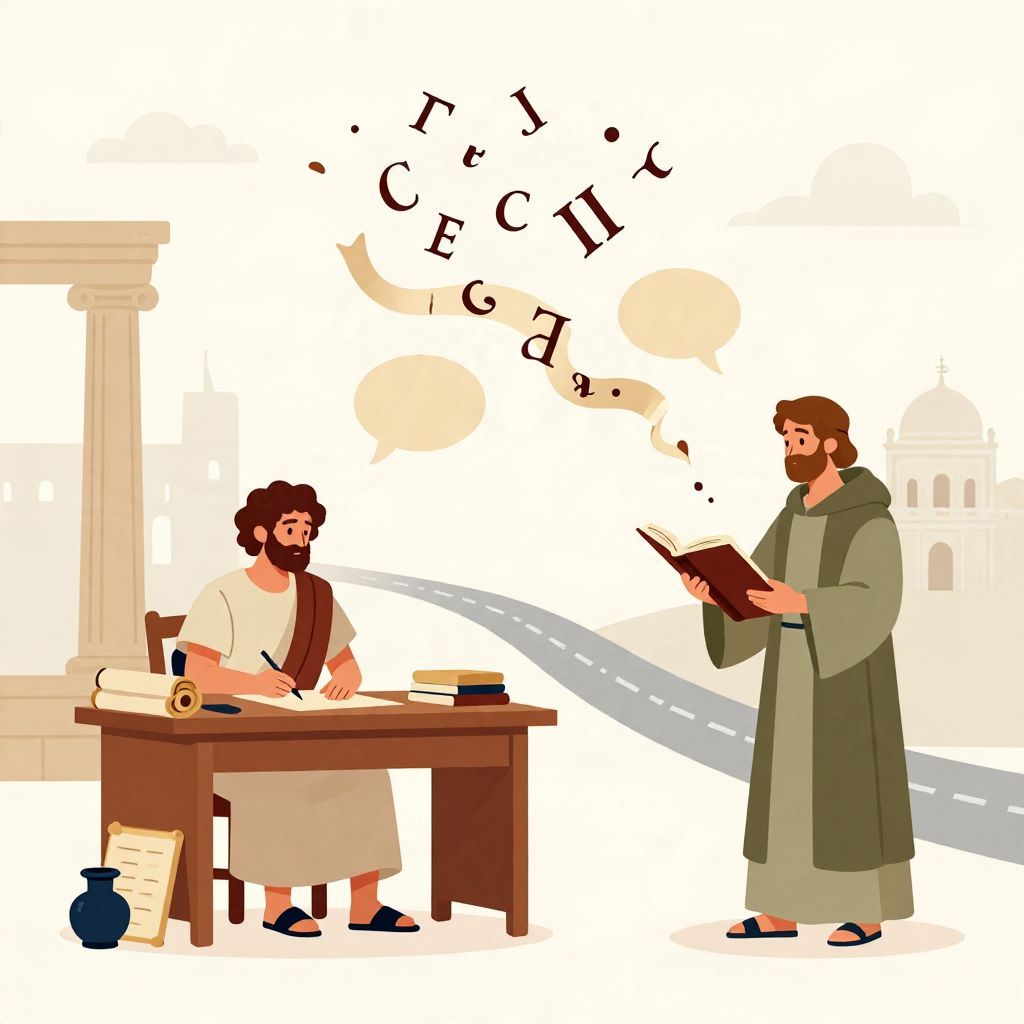
Why did Latin die? The short answer is that Latin did not suddenly vanish. It slowly changed, split into regional forms, and stopped being the everyday spoken language of most people in western Europe after the fall of the Roman Empire.
What survived was not “dead” Latin itself, but a written, educated form used by the Church, scholars, and administrators for centuries. The spoken language evolved into the Romance languages, including Italian, French, Spanish, Portuguese, and Romanian.
Why Did Latin Die?
Latin “died” as a common spoken language because the Roman Empire broke apart, long-distance political unity weakened, and everyday speech changed from place to place. Over time, local varieties of Latin drifted far enough apart that they became separate languages. Latin remained important in writing, religion, and learning, but it ceased to be the normal mother tongue of most people.
Latin Did Not Die Overnight
It is more accurate to say that Latin transformed than that it died. In ancient Rome, people already spoke different kinds of Latin depending on class, region, and situation. Educated writers used Classical Latin, while ordinary people spoke a more flexible everyday form often called Vulgar Latin. The spoken language kept changing for centuries.
By late antiquity, roughly from the 3rd to 6th centuries CE, the Latin spoken in Gaul, Iberia, Italy, North Africa, and the Balkans was no longer identical. After the western Roman Empire weakened in the 5th century, there was less political and cultural pressure to keep speech uniform. That regional divergence is the real story behind Latin’s “death.”
The Main Reasons Latin Stopped Being a Living Everyday Language
1. The Roman Empire was no longer unified
For several centuries, Roman roads, trade, law, the army, and administration helped spread Latin across a huge territory. Even so, local speech kept changing. Once imperial power in the West collapsed in the 5th century, the shared institutions that encouraged a common language also weakened. People still needed to communicate, but they did so more locally.
2. Most people learned Latin by speaking it, not by studying it
Latin did not spread everywhere through formal school instruction. In many provinces, it was acquired as a practical language of soldiers, merchants, officials, and urban life. That meant it was always vulnerable to change. Without a central authority enforcing one standard spoken form, pronunciation, vocabulary, and grammar slowly shifted in different regions.
3. Local languages and accents influenced it
In conquered regions, Latin mixed with older languages and regional speech habits. In Gaul, Celtic influences mattered; in Iberia, pre-Roman languages and later contact with Germanic and Arabic speakers shaped local speech; in the Balkans, Latin interacted with Greek and other languages. These influences did not “kill” Latin by themselves, but they helped produce distinct regional forms.
4. Literacy was limited
Most people in the Roman world were not highly literate. That mattered because written Latin could preserve a standard form, but everyday speech could change freely. After the empire’s decline, fewer people had access to education in classical writing. The gap between formal Latin and spoken Latin widened, making the written language increasingly separate from ordinary life.
5. The Church preserved Latin as a learned language
One reason Latin seems to have “survived” is that the medieval Church used it for liturgy, administration, theology, and scholarship. But this was not the same as being a living native language. Clergy learned Latin through study, not from parents at home. In effect, Latin became a second language of learning rather than the first language of daily conversation.
How Latin Became the Romance Languages
As spoken Latin changed region by region, it gradually became the Romance languages. This process was slow and uneven, with no single date when Latin ended and French or Spanish began. People in late antiquity and the early Middle Ages would not have said, “We no longer speak Latin.” They would have experienced local speech as normal, even as it drifted away from classical norms.
Examples of change over time
- Latin caballus contributed to words for “horse” in several Romance languages.
- Latin case endings simplified, making word order and prepositions more important.
- Some sounds shifted differently in different regions, creating distinct pronunciation patterns.
- Vocabulary changed as local needs, rulers, and cultures changed.
By around the 8th to 10th centuries, many regional forms were clearly separate from written Latin and from one another. By then, a speaker from one region might struggle to understand another region’s everyday speech, even if both still recognized Latin as the prestigious language of books and church.
Why Written Latin Survived So Long
Latin remained alive in a different sense because institutions kept using it. Medieval universities, monasteries, legal documents, diplomatic correspondence, and the Catholic Church all relied on Latin. It had enormous prestige because it linked medieval Europe to Roman authority, Christian tradition, and learned culture. A language can stop being native speech while continuing to matter deeply in writing.
The difference between spoken and written Latin
This distinction is crucial. Spoken Latin evolved naturally in homes, markets, and streets. Written Latin was often taught, corrected, and standardized. The result was a split between the language people spoke and the language educated elites wrote. That split helped preserve Latin, but it also ensured that the written form became increasingly detached from daily life.
Did Latin Die Because of Barbarian Invasions?
Not exactly. Older accounts sometimes blamed “barbarian invasions” for destroying Latin, but that explanation is too simple. Germanic kingdoms did emerge in former Roman territories, and they changed political life. Yet most conquerors adopted Latin for administration and law because it was already the language of local populations and records. Latin did not disappear because invaders banned it; it changed because society changed.
That said, political fragmentation after the 5th century did matter. The western empire no longer had a single state structure to support one spoken standard across vast distances. Over generations, that fragmentation encouraged local speech communities to develop separately.
When Did Latin Stop Being Spoken?
There is no single answer, because the process varied by region. In some places, Latin-like speech evolved into Romance languages earlier; in others, it remained closer to Latin for longer. Roughly speaking, by the early Middle Ages, Latin was no longer the everyday mother tongue of most people in western Europe. But as a learned language, it remained in use for more than a thousand years after that.
Romania offers a special case, since Latin survived there in a different historical setting and later developed into Romanian. Outside the Romance-speaking world, Latin eventually became a language of scholarship rather than daily communication.
The Legacy of Latin After Its “Death”
Latin’s decline as a spoken language did not mean cultural disappearance. In fact, its legacy is enormous. It shaped law, religion, science, medicine, education, and literature across Europe and beyond. Many modern English words come from Latin directly or through French and other Romance languages. Even today, Latin terms remain common in biology, law, and academic writing.
Latin also survived as a symbol of authority and continuity. For centuries, to know Latin was to have access to power, learning, and international communication. That prestige explains why it lasted so long after it had ceased to be anyone’s first language.
So, Why Did Latin Die?
Latin died as a living everyday language because the Roman world that sustained it fragmented, local speech changed over time, and no central authority kept one spoken standard alive. It did not disappear in a dramatic collapse. It gradually evolved into new languages while remaining a powerful written and scholarly language for centuries.
If you want to explore the topic further, it helps to ask whether Latin is a language in the modern sense and whether it is still spoken today; both questions connect directly to its long afterlife. See also is Latin a language? and is Latin still spoken?