
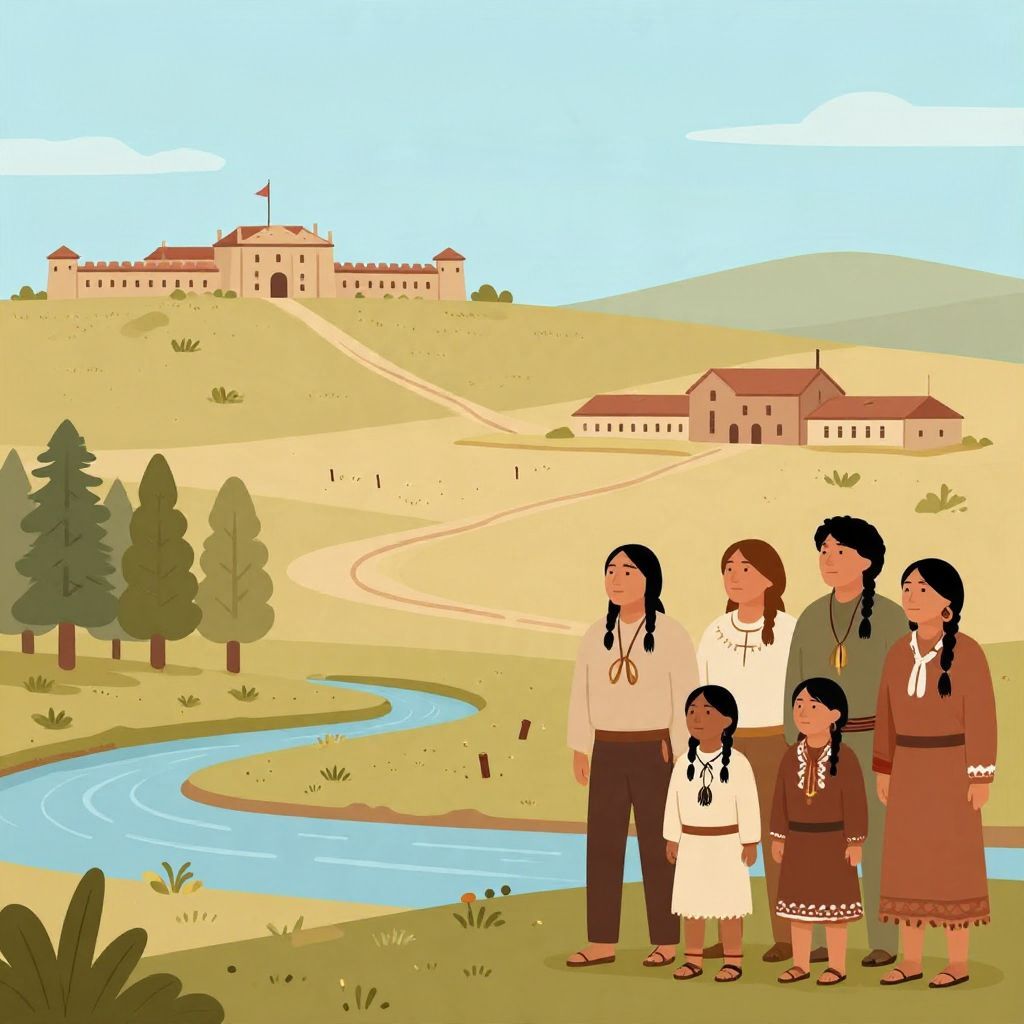
The phrase “No one is illegal on stolen land” is a political and moral statement, not a legal doctrine. It reflects the history of colonization in the Americas, where European empires and later settler states took Indigenous lands through war, disease, coercive treaties, forced removal, and legal systems that denied Indigenous sovereignty.
To understand the phrase, you have to understand both the history of land seizure and the modern laws that regulate migration. The slogan challenges the idea that some people are “illegal” while living on territory acquired through conquest and dispossession.
What does “No One Is Illegal on Stolen Land” mean?
The phrase argues that modern states built on colonized territory should be cautious about labeling migrants as “illegal,” because the land itself was often taken from Indigenous peoples without free consent. It is a critique of settler colonial history, immigration enforcement, and the political power of borders.
Why is the land called “stolen”?
In the Americas, much of the land now governed by the United States, Canada, and many Latin American states was acquired through European colonization beginning in the late 15th century. “Stolen” refers to the large-scale seizure of Indigenous territory through violence, unequal treaties, forced displacement, and the destruction of Indigenous political control.
Colonization and conquest
After 1492, Spanish, Portuguese, French, British, and later U.S. expansion transformed the hemisphere. Colonizers claimed land through royal charters, military conquest, missionary settlement, and legal doctrines that treated Indigenous peoples as subjects to be managed rather than sovereign nations with equal rights.
Disease, war, and displacement
European diseases devastated Indigenous populations long before many inland regions were directly occupied. That demographic collapse made conquest easier, but it did not make it peaceful or consensual. In many places, Indigenous communities resisted for centuries through diplomacy, warfare, migration, and legal action.
Treaties and broken promises
Treaties were often presented as agreements between nations, but they were frequently negotiated under pressure, misunderstood, or later violated. In the United States, for example, federal and state governments repeatedly ignored treaty obligations when land became valuable for settlement, mining, railroads, or agriculture.
How did settler states become “legal” on Indigenous land?
Settler states did not become legitimate simply because they existed long enough. They built legal systems that recognized their own sovereignty while limiting Indigenous authority. Over time, courts, legislatures, and military force turned conquest into law, even when the original taking of land was unjust by modern ethical standards.
Doctrine and law
European empires developed doctrines such as discovery, conquest, and terra nullius in different forms. These ideas claimed that land could be occupied or claimed if it was not used in a European legal sense, even when Indigenous societies had long-standing systems of land stewardship, governance, and territory.
Removal and reservation systems
In the 19th century, many governments shifted from direct conquest to forced removal and confinement. Indigenous peoples were pushed onto reservations, reserves, or missions, often on land less suitable for farming or survival. This allowed settlers to occupy the most productive territory while claiming the state had “resolved” Indigenous claims.
Assimilation policies
States also tried to erase Indigenous identity through boarding schools, language bans, religious conversion, and the suppression of ceremonies. These policies were not just cultural; they were political tools designed to weaken Indigenous claims to land and sovereignty.
Is the slogan historically accurate?
As a broad historical claim, yes: many modern states in the Americas were built on land taken from Indigenous peoples. But the slogan is also a simplification. “Stolen land” does not mean every inch of territory was seized in the same way, at the same time, or by the same actors. History is uneven, and Indigenous peoples were never passive victims.
Indigenous sovereignty still exists
One important historical fact is that Indigenous nations did not disappear. Many continue to assert sovereignty, govern communities, defend treaty rights, and revive languages and traditions. The phrase “stolen land” points not only to past dispossession but also to the ongoing reality that Indigenous political rights were never fully surrendered.
Not all borders arose from the same process
Some boundaries were set by war, some by treaty, some by purchase, and some by colonial administration. Even where a state’s borders are now internationally recognized, that does not erase the original history of conquest or the claims of Indigenous peoples within those borders.
What does this have to do with immigration?
The slogan connects Indigenous dispossession to modern immigration debates. It asks whether states that were formed through colonization have the moral authority to treat newcomers as criminals while ignoring the earlier violence that created the state’s territory in the first place.
Legal status and moral argument are not the same
Historically, “illegal” refers to violating a law, not to a person’s inherent worth. Immigration law is created by states, and those laws can be harsh, selective, and politically driven. The slogan does not erase legal categories; it questions whether those categories are morally adequate on land taken from others.
Why activists use it
Activists use the phrase to link anti-immigrant policies with colonial history. They argue that border enforcement often divides communities, criminalizes movement, and benefits states that were themselves founded through unauthorized settlement from an Indigenous perspective.
How historians interpret the phrase
Historians generally agree that settler colonialism involved land theft, coercion, and the restructuring of Indigenous life. They also note that the phrase is activist language, not a neutral description. Its strength lies in moral clarity; its weakness is that it compresses a long, complex history into a single sentence.
Settler colonialism as a structure
Many scholars describe settler colonialism as a system that seeks not only to exploit land but to replace Indigenous societies with a new permanent population. That framework helps explain why land seizure, border-making, and immigration control can be historically connected.
Different national histories, shared patterns
The United States is the most common reference point for the slogan, but similar patterns appear in Canada, Australia, New Zealand, and parts of Latin America. The details differ, yet the common thread is the transformation of Indigenous territory into state territory through colonial power.
Important historical context in the United States
In the United States, the history behind the slogan includes the Indian Removal era, westward expansion, the reservation system, and repeated treaty violations. The federal government often treated Native nations as obstacles to national growth rather than as sovereign political communities.
Key developments
- 1492 onward: European colonization begins in the Americas.
- 18th and 19th centuries: British, Spanish, French, and later U.S. expansion intensifies Indigenous land loss.
- 1830: The Indian Removal Act accelerates forced displacement in the southeastern United States.
- Late 19th century: Reservation confinement, allotment, and assimilation policies expand.
- 20th century to present: Indigenous activism, treaty-rights litigation, and land-back movements challenge colonial assumptions.
The legacy today
Modern debates over pipelines, water rights, mining, sacred sites, and land restitution show that the past is not over. The phrase “No one is illegal on stolen land” survives because the underlying issues of sovereignty, displacement, and state power remain unresolved.
What is the strongest historical takeaway?
The strongest historical takeaway is that modern borders and immigration laws sit on top of much older histories of conquest. The slogan is not a legal argument that cancels all law, but a reminder that legality and justice are not always the same thing. It asks readers to see migration, sovereignty, and land ownership in a longer historical frame.
For readers interested in the wider context, related history articles on American imperialism and nationalism in history can help explain how states claim territory, define belonging, and turn power into law.